
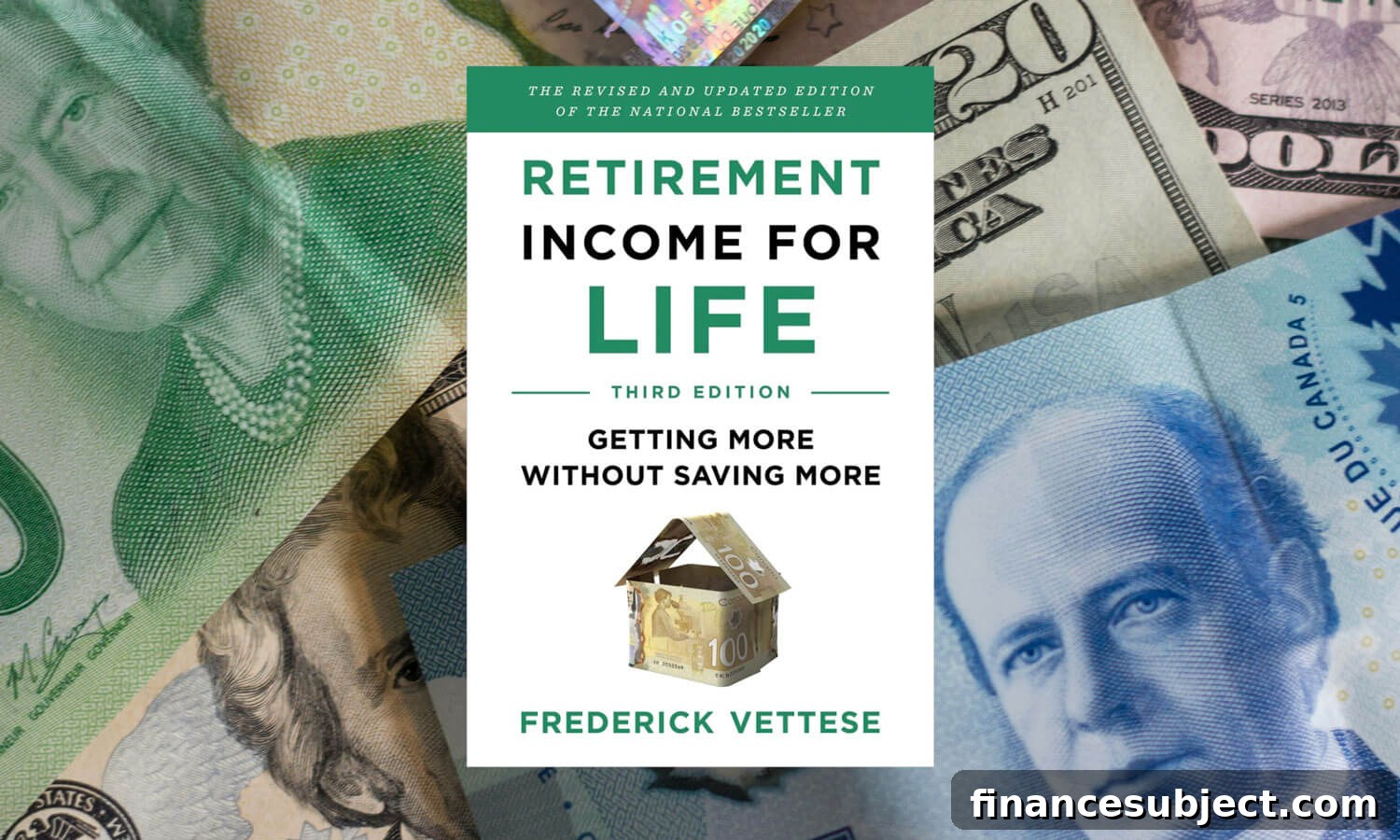
As I approach my 71st birthday, I’m naturally focused on the practical question of what to do when my registered retirement savings plan (RRSP) must be wound up. Do I convert it to a registered retirement income fund (RRIF)? Buy an annuity? Or split the assets between both options? I plan to explain RRIF mechanics in an upcoming Retired Money column, since a RRIF will likely become the destination for most of my retirement savings — and probably for my spouse’s savings a year later. Meanwhile, I’ve been reading the third edition of actuary Frederick Vettese’s book, Retirement Income for Life: Getting More Without Saving More, and testing his PERC (personal enhanced retirement calculator) using our family’s numbers.
The many editions of Retirement Income for Life
I reviewed the second edition of this book for Retired Money in October 2020, and MoneySense covered the first edition two years earlier. Vettese — who I’ve learned is nearly the same age as I am — updates the material in each new edition to reflect shifting risks and financial realities. The central update in the third edition (ECW Press, January 2024) is clear: after decades of low inflation, the risk of rising inflation must be taken seriously again. That shift forces retirees to manage not only longevity and investment risk, but inflation risk as well.
Vettese has reassessed the five core “enhancements” he recommended in earlier editions. They are:
- Lowering investment management fees
- Transferring investment risk to the government
- Transferring more risk to insurance companies through annuities
- Using his PERC retirement calculator
- Maintaining a backstop, such as tapping home equity through options like a reverse mortgage
He notes that some of these enhancements are now more important than before, while others have declined in priority. In particular, annuities are under renewed scrutiny because most traditional annuities offer very limited inflation protection.
What is PERC? And how to use this calculator for retirement planning
PERC — the Personal Enhanced Retirement Calculator — is the fourth enhancement in Vettese’s framework and receives a full chapter in the new edition. He developed the tool while writing the first edition in 2018. A basic, no-cost version is available to try online at perc-pro.ca, and buyers of the print book can request a free ebook version from the publisher with proof of purchase.
Vettese emphasizes two features that set PERC apart. First, the calculator models the realistic behavior that retirees’ spending tends not to perfectly match inflation in advanced years — PERC assumes spending may lag inflation later in life. Second, the tool is independent: it’s not sponsored by a bank or investment firm, and it explicitly shows how outcomes change if you buy an annuity or defer CPP (Canada Pension Plan) benefits.
Deferring CPP: Sometimes people shouldn’t wait until age 70
On deferring CPP, my own decision is already made — I started CPP at 66 when my wife retired, while she waited until 68. We had considered waiting until 70, but inflation shocks and temporary policy adjustments to CPP and Old Age Security (OAS) in recent years created circumstances where earlier collection made sense for some retirees. Still, deferring CPP remains a valuable tool for many and is one of the trade-offs PERC helps quantify.
Partial annuitization also remains on the table. My wife’s locked-in retirement account (LIRA) will likely convert to a life income fund (LIF) soon. We both have relatively modest employer pension benefits — what I jokingly call my “mini” and “micro” pensions — so weighing annuities, RRIFs and other income sources is important to build a dependable retirement income plan.
How to use annuities in retirement
Vettese has long recommended partial annuitization as a way to reduce longevity risk. Earlier guidance suggested annuitizing about 30% of RRSP assets at liquidation; the latest edition lowers that recommendation to roughly 20% for many retirees. Annuities provide guaranteed lifetime income, but most traditional annuities offer limited protection against inflation and typically include survivor benefits only at extra cost.
The book also highlights newer annuity-like products that weren’t available in earlier editions. Investment firms now offer longevity solutions such as pooled-income or tontine-like products — for example, a longevity pension fund and modern tontine structures. These solutions generally invest in stocks and bonds rather than relying on insurance company guarantees. They tend to offer higher potential income but without the guaranteed payments or survivor benefits of traditional annuities; Vettese describes them as “a less nerdy version of annuities” for retirees willing to accept some investment risk.
But back to PERC
The free PERC demo gives a stripped-down view you can try with no obligation. For privacy reasons, the full report output must be printed rather than stored with identifying details. For more detailed planning, a one-year Canadian customized PERC subscription costs $135 plus tax. The full version lets you enter both partners’ financial details (which Vettese recommends), incorporates pre-tax pension amounts, and handles tax calculations automatically to produce a clear summary of likely retirement income under different scenarios.
Newsletter
Get free MoneySense financial tips, news & advice in your inbox.
Retirement income includes work income for me
I won’t disclose personal financial details here, but PERC reinforced what I already suspected: I continue to work by choice, on a self-employed basis, partly because I enjoy it and partly because it helps my retirement income mix. Even if you like working, circumstances can change. Clients may drop away or health or market conditions might force an earlier transition to full retirement. That’s why understanding where your income will come from — guaranteed sources, market-dependent withdrawals, annuities, CPP and possible home-equity options — matters. PERC’s strength is helping you see those sources and trade-offs clearly so you can plan with confidence.
Read more Retired Money columns:
- Are GICs worth it for retirees?
- Tontines in Canada: Moving from theory to practice as a solution to our retirement crisis
- How much money do you need to retire in Canada? Is it really $1.7 million?
- Inflation a scourge for retirees? Ottawa’s silver lining(s)