What caught my eye this week.
This week the investing world is focused on ChatGPT — a major advance in artificial intelligence and natural language processing that’s already prompting fresh debate about its impact on business, media and markets.
ChatGPT, short for “Chat Generative Pretrained Transformer,” is a large language model developed by OpenAI. It can produce coherent, human-like text from simple prompts, and that capability opens a wide range of practical uses — from customer support to content generation, marketing copy and automated summarization.
For companies and investors, the arrival of robust language models raises two linked questions: how will AI change the economics of the firms we hold, and how should investment strategies adapt? The answers are mixed. On one hand, automation driven by advanced AI could trim costs and lift productivity for businesses that adopt it effectively. On the other, automation can erode demand for routine human labour, creating transition risks for firms and workers.
There’s also a content-quality concern. As models produce large volumes of automated text, the risk of misleading, low-quality or fraudulent information increases if automated output isn’t carefully supervised. That has implications for reputations, regulatory risk and investor confidence — and it may change how retail investors access and trust financial advice online.
Yet AI can be a growth engine. Companies that integrate natural language processing and machine learning into their products and operations may gain efficiency, unlock new services and expand margins. For long-term investors, that means some firms could benefit disproportionately as these technologies become mainstream.
One practical way for investors to participate in this structural shift is through diversified approaches, such as index funds. Broad funds give exposure to a wide set of companies that are developing and deploying new technologies, reducing single-stock risk while capturing the sector’s overall growth potential.
Staying informed matters. Track developments in AI, identify firms with credible strategies for deployment, and be mindful of the evolving regulatory and ethical landscape around automated content and decision-making.
In short, ChatGPT is an important milestone. It’s not just a neat demo — it signals a rapid acceleration of capabilities that investors and companies need to reckon with.
‘More human than human’ is our motto
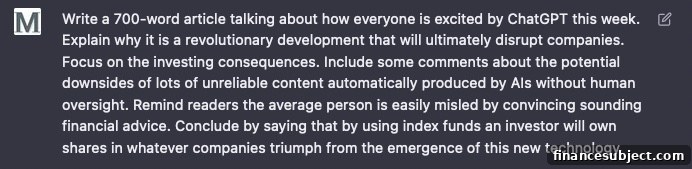
You may have noticed a change of tone in this issue. The paragraph above was produced by ChatGPT itself. I asked the model for a concise overview of the technology and its investment implications; the result was coherent but shorter than requested.
That highlights the current reality: these models can produce useful copy that reads well, but they do not always meet specific editorial expectations without careful prompting and review. They are powerful tools for augmenting human work, not yet seamless replacements for editorial judgement and original analysis.
Still, their speed and scale make them attractive to some operators. Expect to see experiments, content farms and SEO-focused deployments that try to monetize automated output. That may squeeze traffic and advertising revenue for publishers and require publishers to focus on quality, trust and distinctiveness.
At the same time, creative and technical professions face potential disruption. Early adopters will use AI to automate repetitive tasks, but the longer-term question is whether these systems will encroach on higher-value creative and coding work as models improve.
I’m afraid. I’m afraid, Dave
There are valid reasons to be both excited and cautious. Many commentators compare the current moment to early stages of the internet: the initial implementations fall short of the long-term promise, yet the pace of change can be surprisingly fast.
“The promise of what this technology will offer in the future in equal part excites and terrifies me. Much like the early internet, the future potential far exceeds current realities.”
As AI becomes more capable, questions about job displacement, misinformation and platform incentives will grow louder. Communities that value high-quality, reliable content — from programming forums to specialist journalism — may need new moderation and verification systems to preserve trust.
Users, platforms and regulators will all play a role in shaping the next phase. That makes it an important theme for investors to watch: technology, policy and human behaviour will together determine winners and losers.
What do you think — is a hungry AI coming for your job, or is it an opportunity to work alongside smarter tools? Share your views in the comments.
Oh, and come on England!