
This past year has been brutal for investors. It’s the worst year on record for our Slow & Steady passive portfolio, even after a small rebound from last quarter.
In 2022 the portfolio fell about 13%. Our previous worst drawdown was only around 3% in 2018. Since the portfolio began in 2011 we’ve seen just three down years and six years of double-digit gains — a reminder that long stretches of strong returns can be followed by painful setbacks.
That reality raises a practical question: are we mentally prepared to cope with a prolonged period of negative returns?
Mental as anything
During the good years many of us grew used to quick checks of our accounts for a morale boost. When the numbers trend upwards, it feels reassuring: “You’re doing brilliantly — keep it up.” When returns fall, those same screens can feel like a verdict: “You’re going nowhere.”
We all know the sensible mantras — “investing is a long-term game,” “buy low, sell high,” and “be greedy when others are fearful.” History shows that keeping a cool head during market turmoil is one of the toughest but most important skills for investors. The question is whether we can actually follow that advice when market headlines and portfolio values are stacked against us.
Down but not out
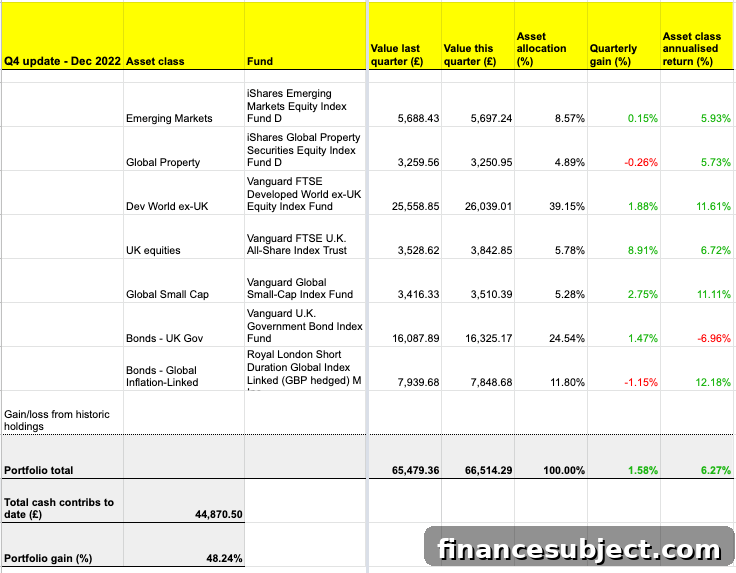
While we wait for better markets, here are the latest numbers from the Slow & Steady portfolio:
The Slow & Steady portfolio is Monevator’s model passive investing portfolio. It launched in early 2011 with £3,000 and adds £1,200 each quarter into a diversified set of index funds tilted towards equities. The portfolio aims to demonstrate long-term passive investing and the effects of asset allocation and rebalancing.
The worst performer in 2022 was UK government bonds. Our gilt fund fell roughly 38% in real terms after inflation, surpassing historic nominal lows seen in past century events. That volatility highlights the difficult choices investors face with bonds right now.
If inflation stays high and bond yields keep rising, bonds could suffer further. Past episodes show extreme losses can be followed by strong recoveries — for example, a dramatic rebound after the gilt sell-off in the early 1920s. Exiting bonds after a bad year risks missing eventual rallies.
Bonds can be confusing and frightening for many investors, but like equities they can recover over time. While it’s reasonable to consider reducing bond exposure if you’re concerned, extreme all-or-nothing decisions — such as swearing off bonds permanently — can cost you diversification benefits and potential rebounds.
The long view
After a year like 2022, it helps to broaden the time horizon. Over multiple periods the portfolio has produced the following nominal annualised returns:
- 1.6% over 3 years
- 3.3% over 5 years
- 6.3% over 12 years
That equates to roughly 3.3% annualised in real terms. Historically a 60/40 portfolio might average around 4% annualised real returns, so while the recent stretch is below average, the longer-term result remains respectable. One year ago the 12-year number looked much stronger at about 9.8% — another reminder how quickly performance can shift.
Building back better?
The property fund in the portfolio took a particularly heavy hit, with around a 25% real-terms loss for the year. Rising interest rates squeezed property valuations and real estate investment trusts (REITs) across the globe.
At the same time, the fund provider rebranded the global property tracker and shifted its index to an ESG-focused version. The fund’s name changed from iShares Global Property Securities Equity Index Fund to iShares Environment & Low Carbon Tilt Real Estate Index Fund, and the underlying index moved to a “Green Low Carbon” target index.
In practice, the change appears modest. Initial analysis suggested only a small number of the roughly 340 investable companies would be excluded and the top holdings and sector weights were broadly reshuffled rather than transformed. The green index slightly underperformed the standard index over the five-year annualised period when comparing available figures.
I respect investors who want their capital to reflect their values, but I’m cautious about the ESG label. The potential for greenwashing is high, and verifying ethical claims across global real estate can be difficult. Also, choosing ESG funds shouldn’t be a substitute for individual lifestyle choices that reduce environmental impact.
For now, as a passive investor, I plan to keep the property holding to preserve the portfolio’s illustrative purpose. However, it would be sensible to consider creating a separate ESG version of the portfolio to show how value-driven investing compares with conventional passive strategies.
What say thee?
I’d like readers’ views. Should passive fund managers switch index trackers to green indices? Should I replace this fund with one focused purely on commercial property as an asset class? Would you be interested in an ESG passive portfolio so we can compare the outcomes of different approaches?
Please share your thoughts in the comments below.
Annual rebalancing time
It’s time for the portfolio’s annual maintenance. We previously agreed to shift 2% per year from conventional gilts into index-linked bonds until each reaches a 50/50 split within the bond allocation. That means the Vanguard UK Government Bond index fund target falls to 27% and the Royal London Short Duration Global Index-Linked fund target rises to 13%.
The portfolio’s overall equities-to-bonds split remains at 60/40. As part of annual rebalancing we sell portions of the best-performing assets and buy the underperforming ones — after 2022 that translates into trimming some equity exposure and adding to bonds. While counterintuitive, higher bond yields make gilts relatively more attractive in the long run.
Inflation adjustments
To preserve purchasing power, we increase our regular contributions each year by inflation. Using the RPI measure, which rose sharply this year, we will contribute £1,200 per quarter in 2023 — up from £1,055 in 2022 and £750 when the portfolio began in 2011.
New transactions
The quarterly £1,200 contribution is allocated across seven funds according to our target weights. The trades for this cycle were:
UK equity
Vanguard FTSE UK All-Share Index Trust – OCF 0.06%
Rebalancing sale: £457.14 (Sell 1.951 units @ £234.35)
Target allocation: 5%
Developed world ex-UK equities
Vanguard FTSE Developed World ex-UK Equity Index Fund – OCF 0.14%
Rebalancing sale: £984.72 (Sell 1.958 units @ £502.91)
Target allocation: 37%
Global small cap equities
Vanguard Global Small-Cap Index Fund – OCF 0.29%
Rebalancing sale: £124.68 (Sell 0.334 units @ £372.79)
Target allocation: 5%
Emerging market equities
iShares Emerging Markets Equity Index Fund D – OCF 0.2%
Rebalancing sale: £280.10 (Sell 156.435 units @ £1.79)
Target allocation: 8%
Global property
iShares Environment & Low Carbon Tilt Real Estate Index Fund – OCF 0.17%
New purchase: £134.76 (Buy 60.596 units @ £2.22)
Target allocation: 5%
UK gilts
Vanguard UK Government Bond Index – OCF 0.12%
New purchase: £1,957.69 (Buy 14.781 units @ £132.45)
Target allocation: 27%
Global inflation-linked bonds
Royal London Short Duration Global Index-Linked Fund – OCF 0.27%
New purchase: £954.18 (Buy 921.911 units @ £1.04)
Dividends reinvested: £203.38 (Buy another 196.502 units)
Target allocation: 13%
New contribution: £1,200
Trading cost: £0
Average portfolio OCF: 0.16%
If you prefer a simpler approach, consider a diversified all-in-one fund such as the Vanguard LifeStrategy range or another multi-asset fund that matches your risk tolerance.
Interested in tracking your own investments? A portfolio tracking spreadsheet can help you measure performance and rebalance effectively.
Take it steady,
The Accumulator
- -27% in nominal terms with CPI inflation at 10.7%.[↩]
- See the JST Macrohistory database, which documents UK gilt returns since 1871.[↩]
- Òscar Jordà, Katharina Knoll, Dmitry Kuvshinov, Moritz Schularick, and Alan M. Taylor. 2019. “The Rate of Return on Everything, 1870–2015.” Quarterly Journal of Economics, 134(3), 1225-1298.[↩]
- The riskier, longer maturities do anyway. Short-term bonds more closely resemble cash.[↩]