

Kyle Prevost, creator of 4 Steps to a Worry-Free Retirement, Canada’s DIY retirement planning course, provides context on financial headlines for Canadian investors. Stephanie Griffiths was an award-winning investor for nearly 20 years before returning to journalism and now serves as a consulting editor and journalist for MoneySense.
Bank earnings strong despite higher loan-loss provisions
This week, Canada’s major banks reported quarterly results for the three months ending January 31, 2024. All six—Canada’s Big Five plus National Bank—reported meaningful increases in provisions for credit losses (PCLs). PCLs are each bank’s estimate of loans that might default; increasing provisions reduce reported earnings and reflect heightened stress for some borrowers as inflation and higher interest rates squeeze household finances.
Canadian bank earnings highlights
Performance for the quarter ended January 31, 2024, at a glance:
- Bank of Montreal (BMO): Adjusted earnings per share $2.56 (analysts had estimated about $3.02). Revenue: $7.67 billion (below estimates near $8.36 billion).
- Bank of Nova Scotia (Scotiabank): Adjusted EPS $1.69 (vs. $1.61 estimate). Revenue: $8.43 billion (vs. $8.25 billion estimate).
- Royal Bank of Canada (RBC): Adjusted EPS $2.85 (vs. $2.79 estimate). Revenue: $13.49 billion (roughly in line with estimates).
- TD Bank Group: Adjusted EPS $2.00 (vs. $1.93 estimate). Revenue: $13.77 billion (ahead of expectations).
- Canadian Imperial Bank of Commerce (CIBC): EPS $1.81 (vs. $1.66 estimate). Revenue: $6.22 billion (above estimates).
- National Bank of Canada: Adjusted EPS $2.59 (vs. $2.36 estimate). Revenue: $2.82 billion (above estimates).
BMO noted that customers who renewed mortgages in 2023 saw average payment increases of roughly 21–22% for both fixed and variable five-year mortgages. Among the banks, BMO was the only one to miss analyst expectations materially, largely due to weaker capital markets revenue and larger loan-loss provisions; its stock fell more than 3% on that news. BMO’s CEO expressed confidence that results will improve as economic growth strengthens and rates ease later in the year.
CIBC and National Bank posted results about 9–10% above consensus, while RBC and Scotiabank beat estimates by more modest amounts. These banks were able to offset increased loan-loss provisions through strength in other business lines.
Across the border, Berkshire Hathaway reported a 21% rise in operating earnings for its underlying businesses in 2023. Warren Buffett’s annual shareholder letter highlighted Berkshire’s financial strength and its historic ability to capitalize on periods of market panic—remarks some interpreted as a cautious signal about market risk.
Is the stock market in a bubble?
The term “bubble” has become a frequent headline since the 2008 crash. A market bubble typically describes an asset price run-up that detaches from underlying fundamentals—where speculative demand, hype and fear of missing out drive prices to unsustainable levels before a sharp collapse.
“A market bubble occurs when prices rapidly rise to unprecedented levels and then collapse. Bubbles expand as frenzied buyers push prices higher and higher, fuelled by hype and fear of missing out. Bubbles eventually burst when sentiment shifts, sellers vastly outnumber buyers and prices implode.”
— MoneySense glossary definition of market bubbles
To judge whether the U.S. stock market is in a bubble, the key question is how much of the market’s value is supported by fundamentals—primarily corporate earnings—versus how much is driven by speculative enthusiasm. Recent analysis shows that, for the S&P 500, total market value has largely tracked earnings growth over time, which suggests fundamentals, not pure speculation, are driving much of the rise.
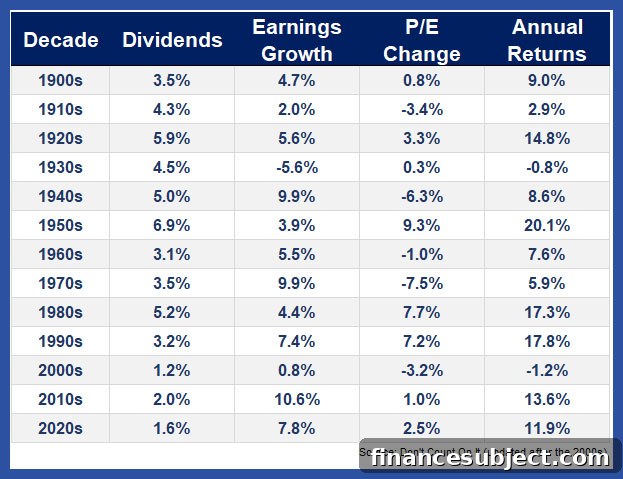
Three important takeaways from recent research:
- Price-to-earnings (P/E) multiples have expanded somewhat over the last two decades, but not to extreme levels that would suggest a broad, economy-wide bubble.
- Earnings growth has been a dominant driver of higher valuations—companies have generally become more profitable, supporting higher market caps.
- Global companies have steadily improved efficiency and margins, which supports long-term shareholder returns.
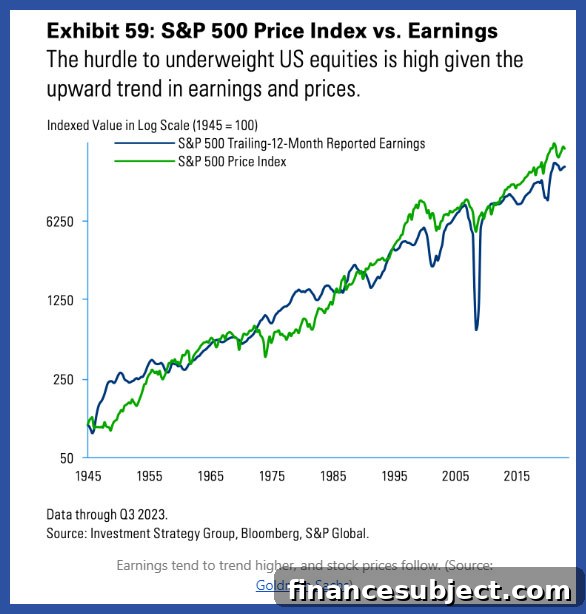
In short, while equity markets can and do experience corrections and bear markets, current evidence suggests the recent gains are largely backed by improving corporate profits rather than pure speculation. That reduces—but does not eliminate—the likelihood of a catastrophic, economy-wide bubble bursting.
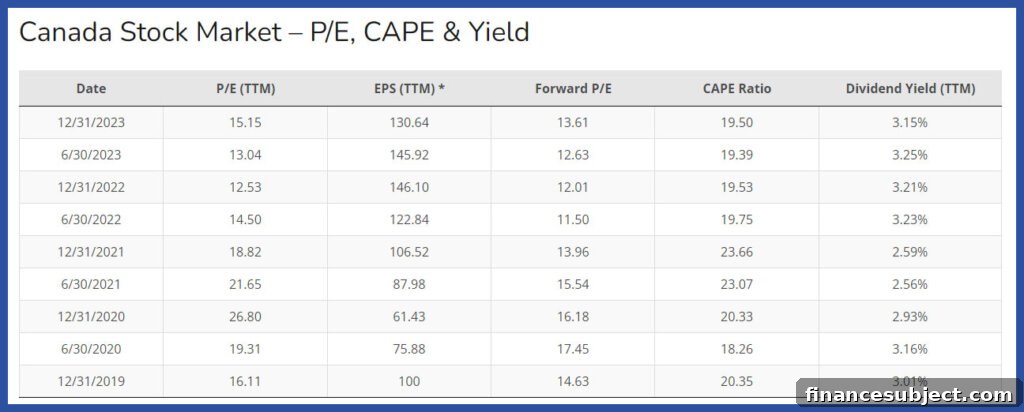
Note: The CAPE ratio (Cyclically Adjusted Price-to-Earnings) smooths earnings using ten years of inflation-adjusted profit data to provide a longer-term valuation perspective.
Putting Nvidia’s big day into context
Nvidia’s meteoric rise is one of the most striking market stories in recent years, and it helps explain why U.S. markets have outperformed many other regions. Several large U.S. tech names—including the so-called “Magnificent Seven”—have driven a substantial share of market gains.
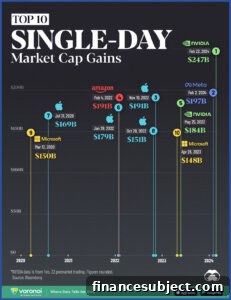
Recent single-day market-cap gains are concentrated among U.S. technology leaders over the last few years. For perspective, Nvidia’s one-day gain of roughly US$247 billion is comparable to the combined market value of two of Canada’s largest banks—an extraordinary single-day increase in value. Similarly, Meta’s sizable one-day gains earlier this year added nearly US$200 billion in market value.
It may be tempting to dismiss these moves as bubble behavior, but the strong earnings growth and real business improvements at several of these companies temper that view. Unlike the dot-com era, today’s winners tend to be profitable businesses with clear cash flows and dominant market positions.
That said, Nvidia’s current valuation already embeds very high expectations. After its recent surge the stock trades at a price-to-earnings multiple far above many large peers. For Nvidia to justify continued rapid price appreciation, demand for its chips must remain extraordinary, and it must fend off competitors such as AMD and Intel. Investors should be aware that a lot is expected of these firms going forward.
RRSPs are not a scam
With the RRSP contribution deadline now past, there’s renewed debate over whether Registered Retirement Savings Plans (RRSPs) are worth using. Some critics label RRSPs a “scam” because contributions eventually get taxed when withdrawn in retirement. That description misunderstands how RRSPs work.
An RRSP is an investment account with tax-deferred status—not an asset class. It is a registered vehicle that shelters investments from tax until withdrawal. The primary benefit is timing: contributions are deductible when you are likely earning more, and withdrawals are taxed when you are typically in a lower income bracket in retirement. That tax deferral can deliver a meaningful lifetime benefit, especially when refunds are reinvested in low-cost investments to compound over decades.
Whether a TFSA or an RRSP is the better choice depends on your income now versus anticipated income in retirement. If you earn a high income today—say over roughly $100,000 per year—an RRSP is often beneficial because you get more immediate tax relief at a higher marginal rate. If you earn less—perhaps under $40,000—a TFSA can be advantageous since the up-front tax deduction for RRSP contributions is smaller at lower tax rates. For many middle-income earners, the difference is less stark and either account can work well when paired with low-fee investments.
Beware of sales pitches that frame RRSPs as inherently bad. Often, that messaging comes from sellers of higher-fee insurance or mutual fund products. The real issue is the quality and cost of the investments inside the account. Low-fee index funds, ETFs or well-chosen dividend stocks held in an RRSP or TFSA are likely to produce far better outcomes than high-fee actively managed products promoted by commission-driven sellers.
If you receive a tax refund after contributing to an RRSP, consider investing that refund rather than spending it. Over time, disciplined investing and compounding are the difference-makers.
If you’re unsure which account to prioritize, a simple starting rule: if you’re in a higher tax bracket now, favor RRSP contributions; if you’re in a low tax bracket, a TFSA may be the better vehicle. And if you’re uncertain, pick one and stick with a low-cost, diversified investment plan rather than chasing headlines.
Why trust us
MoneySense is an award-winning personal finance publication serving Canadians since 1999. Our editorial team of trained journalists works closely with independent finance experts to evaluate products and explain complex issues. We review offerings across banks, credit unions and card issuers to help readers make informed choices.
Read more about investing
- How might inflation impact your retirement plans?
- What is a cashable GIC?
- Will GIC rates keep going up in 2024?