
Building your own portfolio is a common milestone for DIY investors. Instead of buying a single, all-in-one allocation product, many choose to assemble a mix of low-cost, broadly diversified equity and bond index ETFs and size them to match their risk tolerance and time horizon. At the start, the allocation looks neat and intentional.
Markets, however, are constantly moving. Some asset classes outperform while others lag. Stocks can sprint ahead during bull markets, while bonds often act as ballast during downturns. Over time those differing returns compound at different rates, and the portfolio’s asset mix drifts away from the original targets.
An intended 80% equity portfolio can quietly become 85% or 90% equities after a strong rally. A bad year for stocks can push you further into fixed income than you planned. Those shifts change the portfolio’s risk profile and can make the allocation inconsistent with your plan. At that point, the natural question is: should you rebalance?
You might look to large ETF providers for guidance, but their rules vary. Some funds, like the Vanguard Growth ETF Portfolio (VGRO), describe an 80/20 stock-bond split that may be rebalanced at the sub-advisor’s discretion. Others are stricter: the Hamilton Enhanced Mixed Asset ETF (MIX) runs a leveraged mix of equities, Treasuries and gold and automatically rebalances when weights drift by 2%, which implies frequent turnover. But most individual investors don’t manage institutional mandates or leverage targets. For many DIY portfolios, a simpler approach is better: rather than reacting to every market move, use a consistent, time-based rebalancing schedule to reduce complexity and decision fatigue.
Why rebalance your portfolio at all?
Rebalancing means selling assets that have grown larger than their target weight and buying assets that have fallen below their target so you restore your intended allocation.
When you combine assets that aren’t perfectly correlated and periodically rebalance them, you can capture a rebalancing premium. The explanation comes down to how returns compound. The arithmetic average of periodic returns treats each period independently, while the geometric return is the actual compounded growth you experience after gains and losses build on each other. Investors live with the geometric return; volatility enlarges the gap between arithmetic and geometric averages.
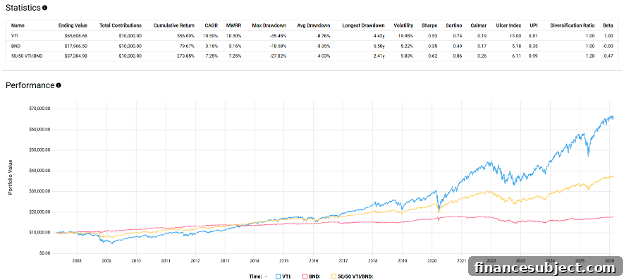
By mixing assets with different correlations and rebalancing them back to target, you can reduce overall volatility. Narrowing that volatility gap improves compounding over time. A simple back test helps illustrate this.
Source: testfolio.io
From April 2007 through February 2026, U.S. stocks returned 10.5% annualized and U.S. bonds returned 3.16% annualized. A straight average of those two numbers is 6.83%. A portfolio that held 50% U.S. stocks and 50% U.S. bonds and rebalanced once per year returned 7.25% annualized over the same period. The 0.42% annual difference reflects the benefit of combining and rebalancing the assets rather than simply averaging their standalone returns.
That efficiency also appears in risk-adjusted terms. The all-stock portfolio had a Sharpe ratio of 0.53 and bonds 0.35, while the 50/50 portfolio rebalanced annually achieved a Sharpe ratio of 0.62. Although the 50/50 raw return was lower than a 100% stock allocation, it delivered more return per unit of risk.
When assets move differently from one another, periodic rebalancing can reduce volatility and enforce disciplined buying low and selling high.
How often should I rebalance?
There are two main approaches: band-based rebalancing and time-based rebalancing. Band-based systems trigger trades when allocations drift by a fixed percentage. That can work for funds, but for DIY investors it often encourages excessive monitoring and second-guessing. The more frequently you check thresholds, the more temptation there is to let short-term views influence what should be a mechanical process.
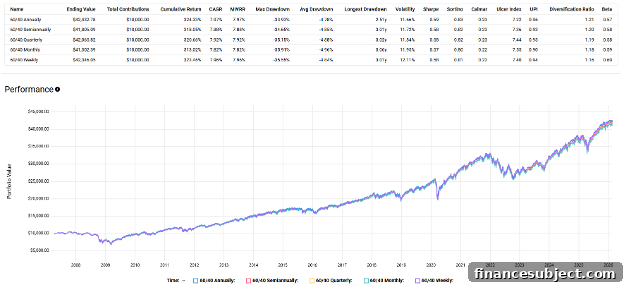
Time-based schedules—rebalancing on a fixed calendar cadence—are easier to follow and less prone to behavioural bias. Still, investors debate how often to act. To test the importance of frequency, a back-test ran five versions of the same portfolio (60% broad U.S. equities, 40% U.S. aggregate bonds) from April 2007 through February 2026. The only difference was rebalancing cadence: annually, semi-annually, quarterly, monthly, or weekly.
Results were surprisingly similar. Annualized returns across all five schedules differed by only a few basis points, and Sharpe ratios clustered tightly between 0.57 and 0.59. In short: rebalancing across asset classes matters, but the exact frequency—within reasonable bounds—matters far less.
Source: testfolio.io
This finding may seem to conflict with the idea that investors should “let winners run” because momentum can be powerful within asset classes. The distinction is important: momentum plays a bigger role inside asset classes (for example, among equities) than it does across asset classes. Equity leadership and trends can persist, but bonds typically follow different drivers—interest rates and credit conditions—and have lower correlation with stocks. Rebalancing between asset classes is therefore more about risk management and preserving your intended structure than fighting momentum.
Practical constraints on frequent rebalancing
Back-tests often ignore taxes and transaction costs. In a non-registered account, selling appreciated positions to rebalance can trigger capital gains and tax liabilities. Broker commissions—or even bid/ask spreads on ETF trades—create implicit costs. Even if commissions are zero, the bid/ask spread exists and increases with turnover. More frequent rebalancing raises those costs and can erode the benefit.
The objective of rebalancing is risk control and allocation discipline, not constant activity. If annual or quarterly adjustments maintain your target risk profile, trading more often usually introduces unnecessary friction without materially improving outcomes. For many investors, weekly or monthly rebalancing offers little added value.
Personally, a quarterly schedule strikes a good balance: it’s simple to remember, easy to automate, and limits turnover. Setting a recurring reminder for the first trading day of January, April, July and October lets you review and rebalance in one short session.
Keep rebalancing and new contributions separate
Another common question: should new contributions be used to top up underweight assets, or should they follow the original allocation while rebalancing happens on schedule? From a behavioural perspective, consistency is better. Directing new money toward whichever asset is underweight can seem logical, but it introduces discretion and invites market timing.
If your plan calls for 80% equities and 20% bonds, directing new contributions to follow that split and handling rebalancing separately keeps the process rules-based. Otherwise, between rebalance dates you may find yourself tempted to “buy the dip” or otherwise drift from the plan.
Do rebalancing promptly and mechanically. Don’t overthink the cadence or try to time markets. Capture the rebalancing premium, adopt a schedule that limits the urge to tinker, and, where applicable, minimize tax drag and transaction costs.
Read more about investing strategies
- Best robo-advisors in Canada for 2026
- Buffer ETFs vs. market-linked GICs: Which is better?
- If not bonds, then what?
- The ultimate couch potato portfolio guide