
The question “How much should I put in my pension?” has a straightforward answer: enough to generate a comfortable, sustainable retirement income that will last your lifetime.
This article shows a simple method to estimate the size of the pension pot you need to deliver that income. Once you reach your target, you can change how you work or stop working altogether and enjoy the retirement you planned for.
Your target pension pot depends on the level of income you want in retirement. You can estimate that income using budgeting and retirement-planning techniques — ultimately you only need a realistic annual income figure to plug into the calculation below.
The ‘How much should I put in my pension?’ calculation
Here’s a clear example to illustrate the method.
Suppose you want £15,000 a year from your private pension investments, on top of whatever State Pension you expect to receive.
The pension pot required would be:
£15,000 ÷ 0.03 = £500,000
Where:
- Required annual income from your pension = £15,000 (excluding the State Pension or any other guaranteed income).
- Sustainable withdrawal rate = 3% (0.03) — the amount you can safely withdraw in the first year of retirement while aiming to keep your income inflation-proof over the long term.
In this example, a £500,000 invested pension should produce about £15,000 a year in inflation-adjusted income if invested sensibly in a diversified portfolio of global stocks and government bonds.
- Replace £15,000 above with the annual income you’ll need from your pension pot.
- Divide that income by 0.03 to estimate how large the pot should be.
- Add the State Pension and other reliable income sources to compute your total retirement income.
If you’re part of a couple, run the calculation for each partner. Don’t forget to allow for taxes using basic tax planning guidance.
Is that all I need to know?
The arithmetic is this simple, but there are important adjustments to consider, including inflation and tax-efficient wrappers such as Stocks and Shares ISAs. Those are straightforward to apply and explained below.
Keeping up with inflation
The example above gives £15,000 of income at today’s prices. If you won’t retire immediately, adjust your target annually for inflation so future purchasing power is preserved.
Update your pension pot target each year using the UK CPIH inflation rate. For example, if inflation is 2.5%:
£500,000 × 1.025 = £512,500
Your updated pot of £512,500, withdrawn at 3%, would produce:
£512,500 × 0.03 = £15,375
That matches a £15,000 income inflated by 2.5%, so annual inflation adjustments keep your income target realistic.
Stocks and Shares ISAs
Many retirees combine pensions with Stocks and Shares ISAs. Use the same approach for ISA savings: divide the income you want from ISAs by 0.03 to find the ISA target pot.
£5,000 ÷ 0.03 = £166,667
Multiplying a £166,667 ISA pot by 3% gives £5,000 a year. This applies to invested Lifetime ISAs and Stocks and Shares ISAs (not cash ISAs).
Pensions usually outperform ISAs for long-term retirement saving because of tax relief and employer contributions, but ISAs can be very useful in retirement for sheltering tax-free lump sums and ongoing income. Reinvesting your 25% pension tax-free lump sum into ISAs (within annual ISA limits) can help create a tax-free income stream.
The 25% tax-free lump sum – The 3% withdrawal rate assumes any 25% tax-free lump sum you take from your pension is reinvested rather than spent. Reinvested lump sums still contribute to your overall retirement income. Apply the 3% sustainable withdrawal rate to all your investments to estimate total annual income.
The sustainable withdrawal rate
The sustainable withdrawal rate (SWR) is the percentage of your pot you can withdraw in the first year of retirement, then increase that income each year with inflation. We use 3% here because leading researchers find it minimizes the risk of running out of money over a 40-year retirement while remaining achievable for most investors.
Some people claim higher rates are possible, but those figures often ignore the reality of unpredictable investment returns and the sequence of returns risk retirees face early in retirement.
The problem with pension pots
Most modern pensions are defined contribution pots made up of investments in equities and bonds. You create income by selling assets and using dividends and interest. The catch is investment returns are volatile and not guaranteed — withdrawing too much too early risks depleting your pot.
A cautious withdrawal rate reduces the chance of running out of money while still allowing a reasonable standard of living. The 3% rate is based on historical worst-case return sequences and assumes a relatively aggressive allocation such as 70% global equities and 30% government bonds.
If you’ve heard of the 4% rule, be aware that 4% can be optimistic and may not protect you in bad market sequences.
Beware simplistic assumptions
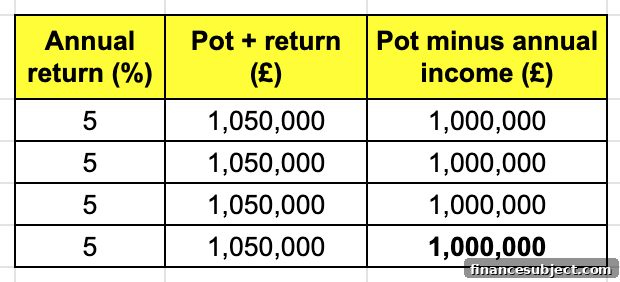
Ignore calculators that assume steady yearly growth like “5% every year.” Those models are risky because they use simple averages and ignore years with losses, which matter a great deal when you are withdrawing money.
Constant growth scenario
Assuming positive returns every year paints an overly rosy picture: two years of +25% return gives a 25% average and grows a £10,000 investment substantially.
Volatile return scenario
Real markets are volatile. A 100% gain followed by a -50% loss gives the same 25% average but leaves you no better off. For retirees, early losses are especially harmful because you may have to withdraw from a depleted pot, missing out on later recoveries. This is known as sequence of returns risk.
An example: start with £1,000,000 and withdraw 5% each year. With steady 5% returns your pot stays stable. But a 50% drop in year one followed by further volatility can shrink the same portfolio dramatically, even if average returns over the period are unchanged.
Recovering from losses
Large losses require disproportionately large gains to recover. A 10% loss needs an 11% gain to break even; a 50% loss needs a 100% gain. Forced selling during market troughs makes recovery even harder, which is why conservative withdrawal rates are recommended.
A 3% SWR keeps withdrawals low enough to give your portfolio the best chance of surviving severe market downturns early in retirement.
Many happy returns
Volatility can also work in your favour: excellent return sequences can grow your pot substantially. Still, retirement success involves both planning and luck. Use prudent assumptions, keep withdrawals sustainable, and plan for inflation and taxes.
If your State Pension or defined benefit pensions start later, you can prudently increase withdrawals early on and reduce them once those guaranteed incomes arrive — but that’s a more advanced strategy worth exploring with a detailed plan.
Take it steady,
The Accumulator
PS – If you’re close to retirement, consider a decumulation strategy that manages volatility and sequencing risk so your investments last as long as you do.