

The unusual market dynamics of the 2022 bear market revealed a significant weakness in the classic 60% equities / 40% bonds portfolio used by many investors. That year was driven by two dominant forces: accelerating inflation across the U.S. and Canada, and rapid interest-rate increases from central banks.
Between January and December 2022, Vanguard’s Balanced ETF Portfolio (VBAL), which targets a 60/40 split, fell 15.04%—almost matching the 16.88% decline of the all-equity Vanguard All-Equity ETF Portfolio (VEQT). The surprise wasn’t equities—stock volatility is expected—but the bond sleeve. Rising rates hit bond prices across the board, and intermediate-duration bonds in particular suffered larger losses than shorter-term holdings, undermining the conventional “ballast” role of fixed income.
| Portfolio Analysis Results (Jan 2022 – Dec 2022) | ||
| Metric | Vanguard All-Equity ETF Portfolio (VEQT) |
Vanguard Balanced ETF Portfolio (VBAL) |
| Start balance | $10,000 | $10,000 |
| End balance | $8,921 | $8,859 |
| Annualized return (CAGR) | -10.79% | -11.41% |
| Standard deviation | 15.96% | 11.96% |
| Maximum drawdown | -16.88% | -15.04% |
| Sharpe ratio | -0.78 | -1.15 |
| Sortino ratio | -1.02 | -1.40 |
When rates climbed to fight inflation, the bond allocation in VBAL—with its relatively long/intermediate duration—lost value quickly. That outcome caught many conservative investors by surprise, especially those who expected bonds to cushion a downturn. As a result, some strategists proposed rethinking the traditional balanced mix.
One increasingly discussed alternative is the 40/30/30 portfolio: 40% equities, 30% bonds, and 30% alternatives. The idea is to keep equity exposure for growth, retain a meaningful bond sleeve for income and stability, and add a substantial alternatives allocation intended to behave differently in stress periods.
What is the 40/30/30 portfolio?
The 40/30/30 framework reallocates part of the traditional bond allocation into an alternatives sleeve—assets that typically have low correlation to stocks and bonds. The goal is to preserve capital when both equities and bonds fall together, as happened in 2022, by introducing strategies or assets that can act independently or countercyclically.
The composition of the 30% allocated to alternatives can vary widely. Institutional implementations often include one or more of the following:
- Hedge fund-like strategies — long-short equity, managed futures, long-volatility, and market-neutral approaches that aim for absolute or low-correlation returns through active or quantitative management.
- Hard assets or digital stores of value — allocations to gold, other commodities, or digital assets such as bitcoin, used as diversifiers and potential inflation hedges.
- Private markets — private equity, private credit, and direct real estate, which offer return potential and diversification at the expense of liquidity and transparent pricing.
Tools
MoneySense’s ETF Screener Tool
Does the 40/30/30 portfolio work?
Evaluating the 40/30/30 approach requires caution. Two common issues complicate the analysis.
First, survivorship bias: it’s easy in hindsight to highlight alternative strategies that performed well, but investors didn’t always have access to those funds or the conviction to hold them when they were new or unproven. Second, performance depends heavily on the chosen time period—strong alternative returns in a few years can skew long-term results.
Nevertheless, there is one transparent, long-running benchmark used to test the concept: the KFA MLM Index. That index follows a systematic trend-following strategy across multiple commodities, currencies, and bond futures, weighting categories by historical volatility. While it doesn’t represent every alternative, it supplies long-term, rule-based data that’s often lacking in this space.
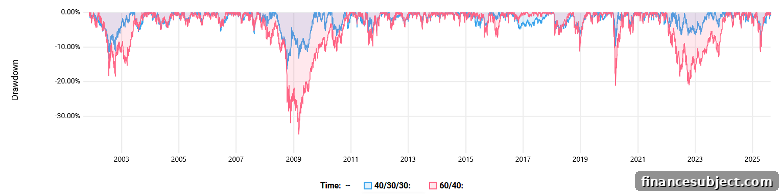
Using data from Nov. 12, 2001, through Aug. 19, 2025, a hypothetical 40/30/30 portfolio composed of the S&P 500, the Bloomberg U.S. Aggregate Bond Index, and the KFA MLM Index (rebalanced quarterly) produced a 6.89% compound annual growth rate (CAGR), compared with 7.46% for a traditional 60/40 mix. Importantly, the 40/30/30 showed better risk-adjusted performance—its Sharpe ratio was 0.71 versus 0.56 for 60/40—and provided stronger downside protection during stress periods.
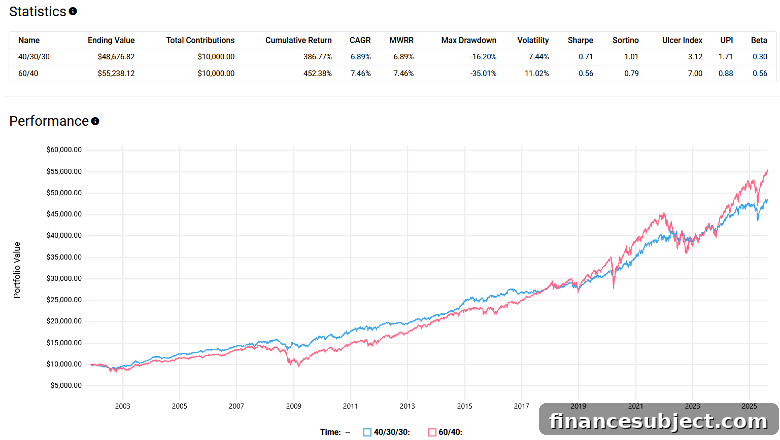
That diversification benefit appeared during major drawdowns—the dot-com crash, the 2008 financial crisis, the 2020 pandemic sell-off, and the 2022 bear market—when the alternatives sleeve often reduced portfolio losses.
Investors can access the KFA MLM Index via the U.S.-listed KraneShares Mount Lucas Managed Futures Index Strategy ETF (KMLM), which follows trend-following futures across commodities, currencies and fixed income. For Canadian investors, KMLM presents practical considerations: currency conversion, a relatively high 0.90% management fee, and a 15% foreign withholding tax on distributions unless the ETF is held in an RRSP.
Can the 40/30/30 portfolio be built with ETFs?
In Canada, alternatives are permitted under National Instrument 81-102, and a growing number of ETFs aim to provide this exposure. A search of Canada-listed “alternative” ETFs reveals roughly twenty products, but they are diverse in strategy, structure and effectiveness.
One accessible option is the NBI Liquid Alternatives ETF (NALT). It uses a quantitative approach to take long and short positions across equity, bond, commodity, and currency futures, aiming for positive returns with low equity correlation. NALT’s management fee is 0.64% and it typically shows a modest bid-ask spread—an indicator of limited liquidity in some alternative ETFs.
NALT returned 8.58% in 2022, when many traditional portfolios were down. Yet it has posted negative results in subsequent years, underlining a key point: many alternatives outperform during stress but can lag during normalized market conditions. Chasing recent winners can therefore be risky.
Another Canadian option is the Picton Mahoney Fortified Market Neutral Alternative Fund (PFMN), which uses a market-neutral strategy to target zero market beta by balancing long and short equity positions. PFMN returned 5.68% in 2022, followed by positive returns in 2023 and 2024, and year-to-date in 2025. Its trade-off is a more complex fee structure: a 0.95% base fee plus a 20% performance fee above a 2% hurdle, with a perpetual high-water mark determining when performance fees apply.
Rankings
Compare the best TFSA rates in Canada
Considerations and caveats
The Canadian alternatives ETF universe is still maturing, and options are limited. That raises manager-specific risks: many strategies rely on a single investment team or a proprietary model, which can introduce style drift or underperformance if the approach changes.
In practice, a 40/30/30 portfolio can improve risk-adjusted returns and protect capital in certain stress scenarios, but it comes with higher fees, implementation complexity, and the possibility of underperforming in bull markets. Building such a portfolio requires careful due diligence, an understanding of fee structures and liquidity, and realistic expectations about how alternatives behave over time.
For many investors, especially those who prioritize simplicity and low cost, sticking with a traditional 60/40 allocation remains a reasonable choice. Others who value added downside protection and are willing to pay for and monitor alternative exposures may find the 40/30/30 approach attractive—but it’s not a guaranteed improvement for every investor.
Read more about investing:
- BMO splits value of asset-allocation ETFs
- ETFs are great for diversification, but check their holdings
- Single-stock ETFs: Approach with caution
- The best online brokers in Canada
- Could bitcoin reach $200,000 by the end of 2025?