
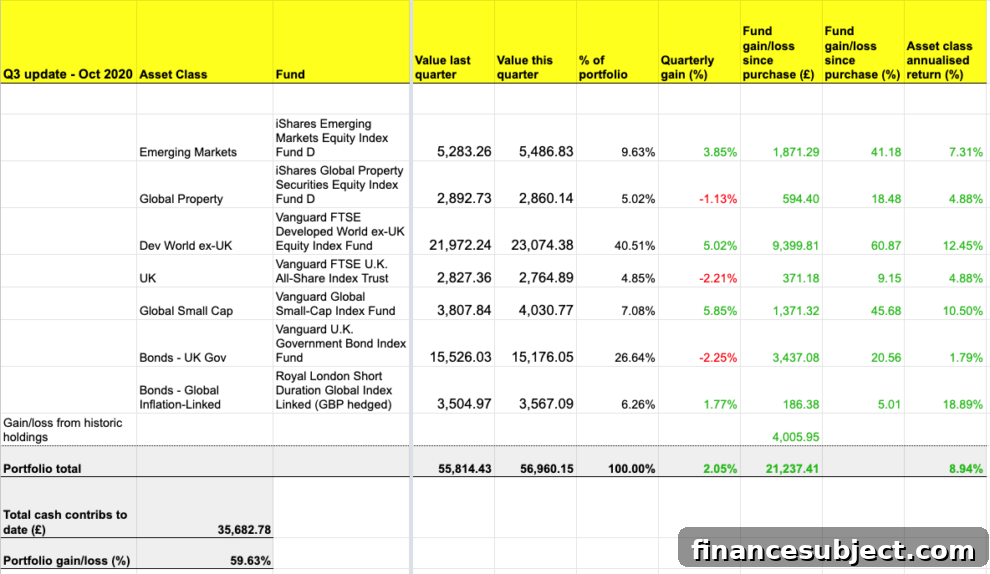
For what looks like a relatively flat quarter, markets have felt distinctly nervy. Our Slow & Steady Passive Portfolio delivered a modest 2% gain over the last three months and sits about 5% higher year-to-date — a performance that owes as much to large-scale fiscal support as it does to market momentum.
Massive fiscal stimulus has clearly propped up risk assets, yet there’s an uneasy, cartoonish quality to the rally: like a runner continuing across thin air after the cliff has ended. It feels comforting in the short term but fragile under scrutiny.
Here are the quarter’s headline numbers, presented for calm reassurance:
The Slow and Steady portfolio is Monevator’s model passive investing portfolio. It was started in early 2011 with £3,000 and receives an additional £976 each quarter into a diversified set of index funds tilted towards equities. You can read the origin story and find previous portfolio posts here.
Age of uncertainty
Living in an age of heightened uncertainty makes every news update feel consequential. A single statistic or a slight shift in sentiment can prompt us to reassess our worldview, our work habits, and our portfolio allocation. That continuous torrent of information flips investor moods between excitement and fatigue, which explains why many of us feel persistently restless.
For long-term, passive investors the appropriate response is usually restraint. The goal is to endure the market’s swings rather than chase them, which is easier said than done when the headlines push our buttons.
Is there anything to do?
Portfolios are, in a way, miniature models of how we perceive the world. They let us pull levers and make decisions that provide a sense of control. When anxiety rises, so does the temptation to tinker.
I spent an afternoon considering how to make the Slow & Steady portfolio more resilient to the recent shifts. There are a handful of sensible options to consider:
- Buy gold — a classic hedge against disorder, though it has already rallied strongly this past year.
- Reduce bonds — tempting when yields are low, but bonds remain an effective volatility buffer.
- Explore alternative investments — these can offer diversification but often come with complexity and higher fees.
- Revisit the Investment Policy Statement — a useful discipline for staying aligned with long-term goals.
- Trim costs — always worth reviewing, although many index funds remain competitively priced.
- Change platform — moving to a lower-fee broker can produce meaningful cost savings without altering your asset mix.
Of those options, switching platforms feels like the most constructive and practical change right now: it reduces costs directly and doesn’t require clairvoyance about markets.
Change management: platform fees
At present the model portfolio is notionally paying 0.25% in platform fees on a portfolio valued around £57,000, which equates to roughly £142 per year. Moving to a flat-fee broker such as Lloyds Share Dealing would reduce that expense. Estimated annual costs there would include:
- £40 platform fee for the stocks and shares ISA
- £42 for the year’s fund purchases (approximately £1.50 per trade across quarterly buys)
- About £12 for occasional rebalancing sales
That totals approximately £94 per year — around 33% less than the current £142. For portfolios materially larger than about £25,000, switching to a flat-fee platform can be particularly beneficial. I’ll check fund availability at Lloyds and aim to move the model portfolio if it makes sense.
New transactions and ongoing allocation
Each quarter we invest £976 across our seven funds according to the portfolio’s target asset allocation. We use Larry Swedroe’s 5/25 threshold rebalancing rule, which did not trigger this quarter.
Trades executed this quarter (funds, ongoing charges and purchases):
UK equity
Vanguard FTSE UK All-Share Index Trust – OCF 0.06%
Fund identifier: GB00B3X7QG63
New purchase: £48.80 — Buy 0.276 units @ £177.38
Target allocation: 5%
Developed world ex-UK equities
Vanguard FTSE Developed World ex-UK Equity Index Fund – OCF 0.14%
Fund identifier: GB00B59G4Q73
New purchase: £361.12 — Buy 0.872 units @ £414.10
Target allocation: 37%
Global small cap equities
Vanguard Global Small-Cap Index Fund – OCF 0.29%
Fund identifier: IE00B3X1NT05
New purchase: £58.56 — Buy 0.194 units @ £301.81
Target allocation: 6%
Emerging market equities
iShares Emerging Markets Equity Index Fund D – OCF 0.18%
Fund identifier: GB00B84DY642
New purchase: £87.84 — Buy 50.922 units @ £1.73
Target allocation: 9%
Global property
iShares Global Property Securities Equity Index Fund D – OCF 0.17%
Fund identifier: GB00B5BFJG71
New purchase: £48.80 — Buy 25.272 units @ £1.93
Target allocation: 5%
UK gilts
Vanguard UK Government Bond Index – OCF 0.12%
Fund identifier: IE00B1S75374
New purchase: £302.56 — Buy 1.594 units @ £189.86
Target allocation: 31%
Global inflation-linked bonds
Royal London Short Duration Global Index-Linked Fund – OCF 0.27%
Fund identifier: GB00BD050F05
New purchase: £68.32 — Buy 62.62 units @ £1.09
Target allocation: 7%
New investment = £976
Trading cost = £0
Platform fee = 0.25% per annum (current)
The model portfolio is notionally held with Cavendish Online, who recently announced they are closed to new business. If you’re comparing platforms, consult the online broker comparison to find a cost-effective option. For many investors, an all-in-one fund such as Vanguard’s LifeStrategy series offers a simple alternative to building a multi-fund portfolio.
Average portfolio OCF = 0.15%
Keep calm, stay diversified, and prioritise low costs where possible — that’s the long-term play for patient investors.
The Accumulator
- We’ve sold seven times in rebalancing moves this past year.[↩]