
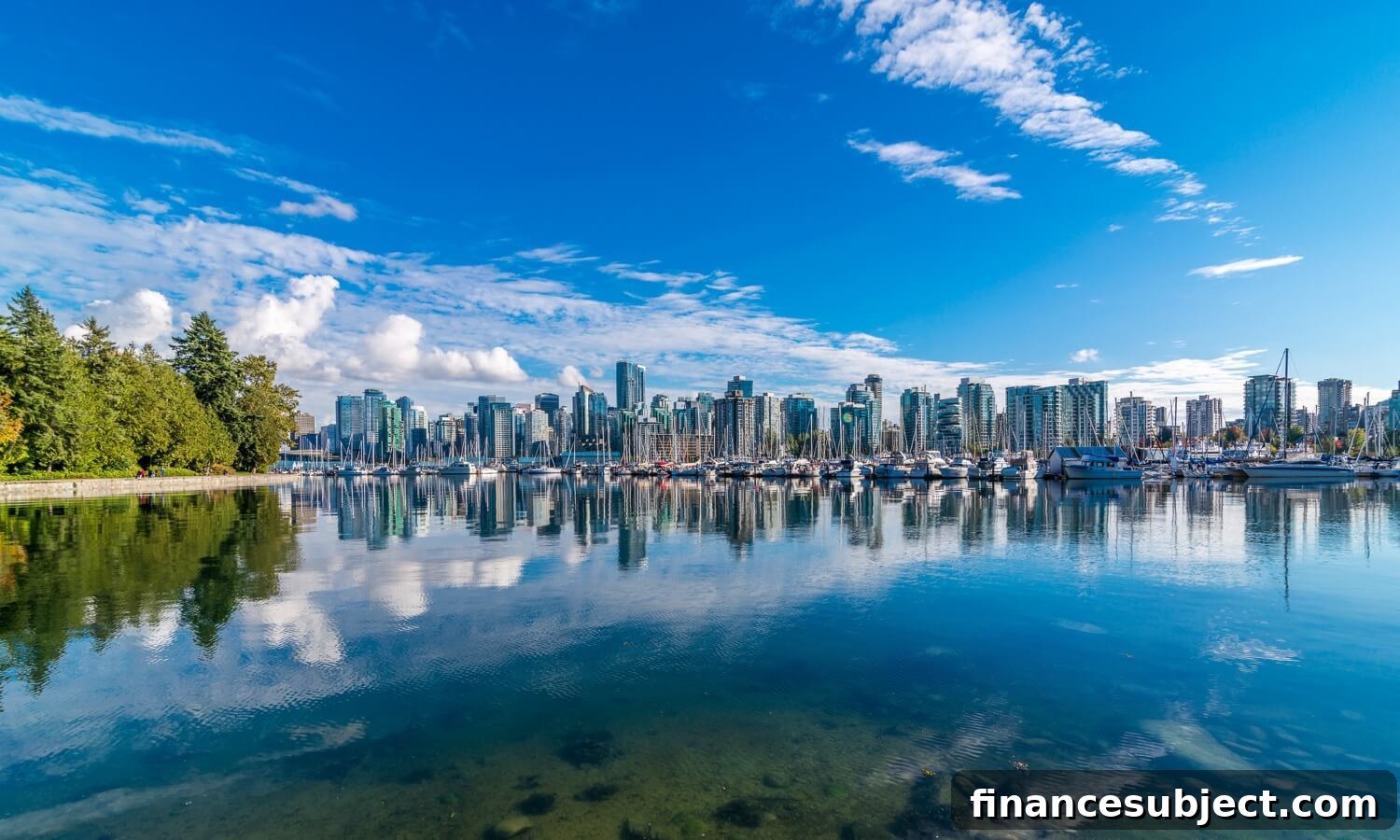
Vancouver is a vibrant, culturally diverse city in British Columbia where tourism, business and the arts meet dramatic mountain and ocean scenery. With some of the mildest weather in Canada, Vancouver remains a highly desirable real estate market, and its home prices rank among the highest in the country.
Table of contents
- Best neighbourhoods in Vancouver
- A closer look at the top three neighbourhoods
- Real estate trends in Vancouver
- Methodology
How to read the results
The table below lists 26 Vancouver neighbourhoods with key real estate metrics. Columns include benchmark price for 2023 (a composite price representing all housing types), price growth over 1, 3 and 5 years, and neighbourhood scores for value, economics and accessibility (each rated 0–5). The final column shows the percentage of households with children. Use the table to compare relative prices, recent momentum and family orientation across areas.
Best places to buy real estate in Vancouver
Below are Vancouver neighbourhoods ranked by our assessment of best places to buy. The table presents benchmark prices and recent growth alongside neighbourhood characteristics to help buyers and investors evaluate opportunities across the city.
| Rank | Neighbourhood | Area | Benchmark price 2023 | 1‑year growth | 3‑year growth | 5‑year growth | Value (0–5) | Economics (0–5) | Accessibility (0–5) | Children (%) |
|---|---|---|---|---|---|---|---|---|---|---|
| 1 | Point Grey | Vancouver West | $2,532,842 | 6% | 24% | 14% | 3.9 | 3.4 | 1.9 | 35% |
| 2 | Dunbar | Vancouver West | $3,044,625 | 0% | 12% | 7% | 1.8 | 5.0 | 2.9 | 51% |
| 3 | Killarney | Vancouver East | $1,677,192 | 1% | 30% | 27% | 4.4 | 2.2 | 0.7 | 47% |
| 4 | Hastings Sunrise | Vancouver East | $1,380,333 | -1% | 29% | 17% | 4.3 | 2.2 | 2.3 | 41% |
| 5 | Collingwood | Vancouver East | $883,342 | 0% | 28% | 15% | 5.0 | 1.4 | 3.2 | 43% |
| 6 | South Cambie | Vancouver West | $1,708,908 | 2% | 13% | -13% | 3.4 | 3.0 | 2.9 | 27% |
| 7 | Fairview | Vancouver West | $892,675 | -1% | 14% | 12% | 4.2 | 2.1 | 4.6 | 16% |
| 8 | Kitsilano | Vancouver West | $1,331,975 | -2% | 15% | 12% | 3.6 | 2.5 | 4.4 | 20% |
| 9 | Downtown | Vancouver West | $721,183 | -1% | 7% | 1% | 4.0 | 2.1 | 5.0 | 12% |
| 10 | University | Vancouver West | $1,279,725 | 2% | 11% | 5% | 4.2 | 1.9 | 1.5 | 39% |
| 11 | Mount Pleasant | Vancouver East | $896,492 | 0% | 14% | 15% | 4.5 | 1.4 | 3.8 | 17% |
| 12 | South Vancouver | Vancouver East | $1,880,783 | 1% | 33% | 30% | 4.3 | 1.4 | 3.9 | 45% |
| 13 | Knight | Vancouver East | $1,449,533 | 2% | 17% | 16% | 4.3 | 1.4 | 4.0 | 34% |
| 14 | False Creek | Vancouver West | $904,967 | -4% | 9% | 6% | 3.4 | 2.1 | 4.6 | 16% |
| 15 | Victoria | Vancouver East | $1,250,733 | -3% | 22% | 23% | 3.9 | 1.4 | 3.1 | 48% |
| 16 | Arbutus | Vancouver West | $3,731,750 | 0% | 16% | 12% | 1.1 | 4.2 | 3.1 | 50% |
| 17 | Mount Pleasant (West) | Vancouver West | $1,090,608 | -2% | 13% | 8% | 3.8 | 1.4 | 3.8 | 17% |
| 18 | Fraserview | Vancouver East | $2,223,583 | 1% | 31% | 26% | 3.7 | 1.4 | 3.1 | 48% |
| 19 | Marpole | Vancouver West | $1,199,700 | -2% | 14% | 1% | 3.5 | 1.5 | 2.1 | 38% |
| 20 | Kerrisdale | Vancouver West | $2,260,533 | 3% | 21% | 8% | 3.4 | 1.5 | 2.1 | 38% |
| 21 | Grandview Woodland | Vancouver East | $1,425,375 | -1% | 21% | 18% | 4.0 | 0.8 | 3.6 | 22% |
| 22 | Renfrew Heights | Vancouver East | $1,547,425 | -5% | 19% | 16% | 3.0 | 1.4 | 3.2 | 43% |
| 23 | Strathcona | Vancouver East | $935,217 | 0% | 13% | 10% | 4.4 | 0.0 | 4.7 | 16% |
| 24 | Coal Harbour | Vancouver West | $1,291,908 | -1% | 4% | -8% | 3.1 | 0.7 | 4.7 | 10% |
| 25 | Oakridge | Vancouver West | $1,473,767 | -6% | -8% | -15% | 1.6 | 1.5 | 2.1 | 38% |
| 26 | Shaughnessy | Vancouver West | $4,109,917 | 0% | 10% | -9% | 0.0 | 2.1 | 4.6 | 16% |
Source: Real Estate Board of Greater Vancouver
Top three neighbourhoods in Vancouver
1. Point Grey
Point Grey’s high prices reflect a concentration of large, high-end homes and well-maintained streets. The 2023 benchmark price was $2,532,842, and the area has posted steady gains in recent years: 6% year‑over‑year, 24% over three years and 14% over five years, giving it a solid value score. The neighbourhood is home to prestigious schools and recreational amenities such as yacht and tennis clubs, and it attracts a diverse mix of residents including professionals, university staff and families. Accessibility is one of Point Grey’s weaker points, with a relatively low score for transit and walkability.
2. Dunbar
Dunbar ranks among Vancouver’s priciest neighbourhoods, located close to the University of British Columbia. Its 2023 benchmark price was $3,044,625. While prices have increased over time, growth has been more modest recently: unchanged year‑over‑year, up 12% over three years and 7% over five years. Dunbar benefits from strong neighbourhood economics, top private and public schools, plentiful parks and a family-friendly environment. Its housing stock is dominated by single-family homes, which affects overall accessibility scores.
3. Killarney
Killarney sits on a south-facing slope in East Vancouver with views toward the Fraser River. Its housing is relatively more affordable compared with central and west-side neighbourhoods, and it has seen notable appreciation: a 2023 benchmark price of $1,677,192 (1% higher than 2022, 30% higher than 2020 and 27% higher than 2018), earning a strong value score. Killarney is quieter and more suburban in feel, with small shopping centres and several public schools, including Killarney Secondary, and a high share of households with children.
What’s happened in the Vancouver real estate market?
Historically, Vancouver experienced a long climb in prices before leveling off in past cycles. In recent years, despite higher borrowing costs, the market recorded growth: the composite benchmark price rose roughly 5% from January to December of the most recent year, with much of that momentum concentrated in the first half of the year when listings were scarce.
Price increases were uneven across market segments. More affordable housing types saw weaker demand at times, while the luxury market held up better and even recorded strong price gains. Local agent Geoff Pershick noted that luxury homes appreciated notably and that capital inflows have supported higher-than-expected sale prices in the high-end segment.
High interest rates discouraged some sellers from listing, reducing available supply, while some buyers delayed purchases. Still, early indicators point to improving conditions as rates stabilize.
“The global wealth shift is bringing a more diverse group of buyers to Vancouver,” said Geoff Pershick. “Last year’s uncertainty slowed some activity, but with interest rates settling, I expect renewed interest from cash buyers.”
Return to menu.
What’s next for real estate in Vancouver?
Recent monthly reports showed rising home sales early in the year, suggesting stronger momentum compared with the previous year. If sales continue to pick up while inventory remains tight, prices could strengthen further.
Pershick expects that as interest rates ease, buyer demand will rise while seller hesitation may persist—an imbalance that typically supports price increases and creates a competitive market for buyers. Supply constraints remain a persistent challenge for Greater Vancouver and are likely to influence market dynamics through the year.
Return to menu.
Get free MoneySense financial tips, news & advice
Subscribe to the MoneySense newsletter for practical guidance on mortgages, buying a home and managing your finances.
Further reading about buying a home
- The best 5‑year fixed mortgage rates in Canada
- Watch: What is mortgage affordability?
- Mortgage payment calculator
- Buying a second home: How it works in Canada
This article was created by Zoocasa.
This unpaid article was written by a content partner based on its expertise and edited by MoneySense.
This article is presented by Ratehub.ca.
This editorial content is presented with financial support from an advertiser; the advertiser did not influence the creation of the content.