
Your 100‑year‑old great‑aunt Maggie has died. The family solicitor summons you, and you expect a modest bungalow, dusty paperwork and a quick probate chat.
Maggie had always struck you as extremely frugal. She wore old clothes, walked to the library, grew vegetables and never owned a car. As a child you assumed she must be poor.
Only she wasn’t.
Maggie’s estate is worth about $1 billion.
How did that happen?
It turns out Maggie’s father was a wealthy American financier. In 1926 he put $53,300 into an investment that, for the sake of the thought experiment, behaved like a zero‑fee, accumulation S&P 500 fund and compounded without taxes or costs for a century.
Then Maggie did the hardest thing of all: nothing.
She didn’t sell. She didn’t switch platforms, or rotate into Japan in 1989, or chase dotcoms in 2000, or panic in 2008. During COVID she didn’t make headlines; she went to get her vaccine and carried on.
She didn’t pay an adviser 1% a year to ask her how she felt about risk.
She simply lived to 100 and let long‑term US equity returns do the rest.
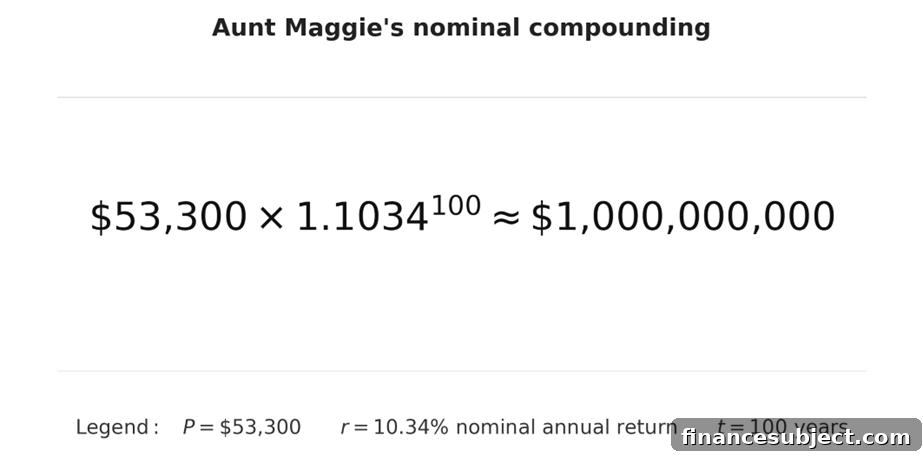
Neat, but purely hypothetical.
Magical thinking
No actual fund in 1926 could have been zero‑fee, accumulation and tax‑free. The S&P 500 in its modern 500‑stock form didn’t exist until 1957. Retail index funds, accumulation share classes and zero‑fee products were decades away, and taxes certainly applied.
Still, the thought experiment illustrates a central truth: compounding can produce astonishing outcomes over long time horizons.
Unfortunately for you, the family heir, reality is less generous.
Heirs and graces
Assume Maggie ended life UK‑domiciled and her estate is subject to UK inheritance tax (IHT). For billionaire‑level math, allowances are negligible, so a 40% IHT rate applies.
After IHT, that $1 billion becomes roughly $600 million — a very good inheritance, but no longer billionaire status. The first major interruption to a century of compounding is almost always tax.
$1 billion to one in the stock market
Here’s the checklist that would be required to turn a modest start into a $1bn fortune through passive equity compounding:
- Start early
- Start with a substantial sum
- Own a top‑performing major market for decades
- Pay minimal or no fees
- Avoid taxes where possible
- Don’t spend any of it
- Don’t sell, gift, switch, rebalance or otherwise crystallise tax events
- And finally: don’t die
Simple in concept, fiendishly hard in practice.
Time
Compound interest is often called the eighth wonder of the world. People know the formula; few truly behave as if they believe it.
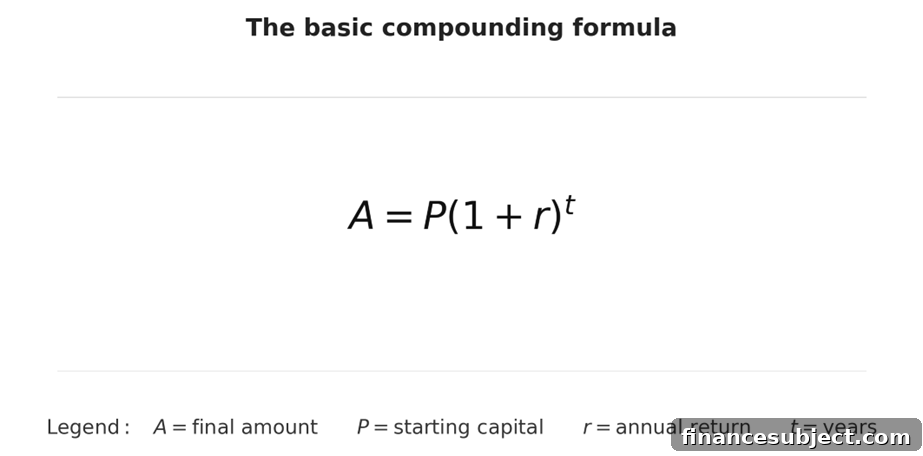
At a nominal 10.34% compound annual growth rate (CAGR) for US equities, $53,300 could hypothetically become $1bn in 100 years. Shorten the horizon and the starting capital must rise: at 50 years you’d need about $7.3m; at 30 years roughly $52m.
Compounding is boring because its power is mostly visible only across decades.
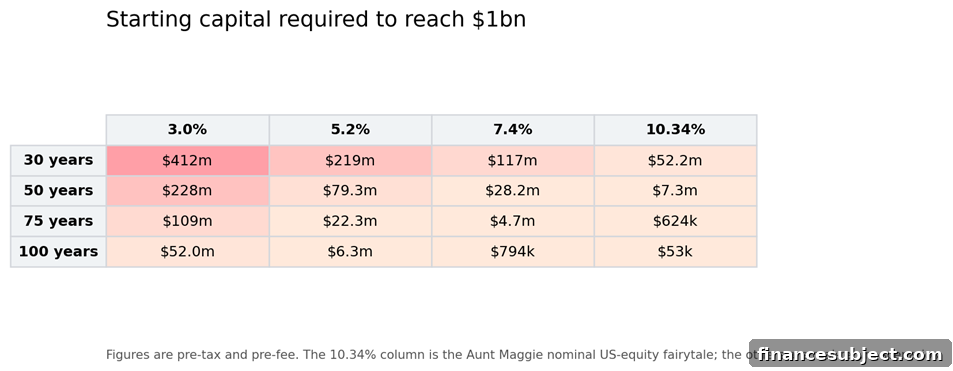
For a realistic long‑run assumption, use a 5.2% real annual return on global equities (a historical long‑run figure sourced from academic return studies). At 5.2% real, the inflation‑adjusted starting sum needed to reach $1bn in today’s money over 100 years is roughly $6.3m.
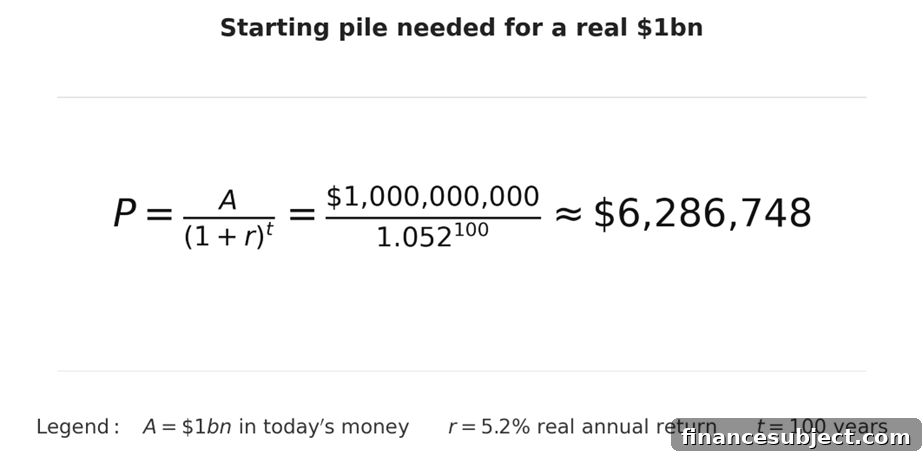
That means your ancestor would already have needed to be fairly wealthy to hit billionaire status via pure passive compounding over a century.
Maggie owned the winner
The S&P 500 is one of the best‑performing national markets of the past century. Had Maggie been born into a different market, results could easily have been much worse. Today many investors favour a diversified global equity allocation rather than trying to pick a single country.
The leaks
Start with the clean $6.3m that would become $1bn at 5.2% real. Then let fees, dividend taxes, foreign‑exchange costs and inheritance taxes do their damage.
A simple conservative model might assume:
- 5.2% real gross equity return
- 0.20% annual implementation cost
- 2.0% dividend yield
- 39.35% higher‑rate dividend tax
- 0.5% FX spread on foreign distributions (equivalent to about a 0.01% annual drag on a 2% yield)
- 40% IHT applied at three generational transfers (years 30, 60 and 90)
- No allowances, reliefs or sophisticated tax planning modelled
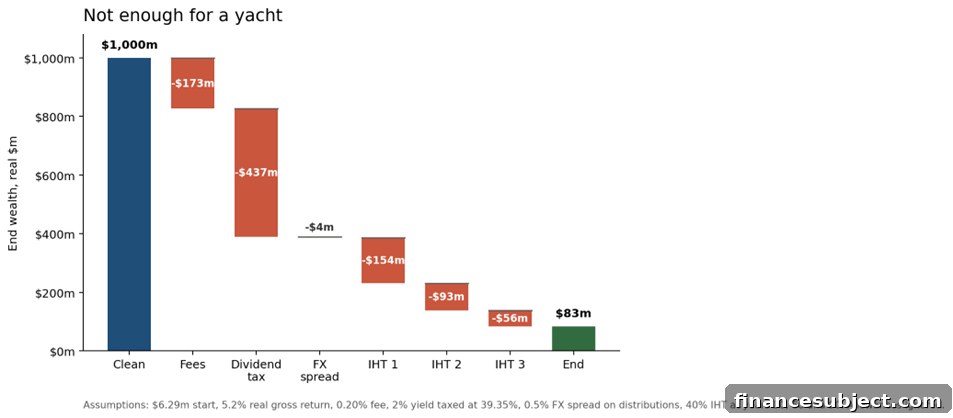
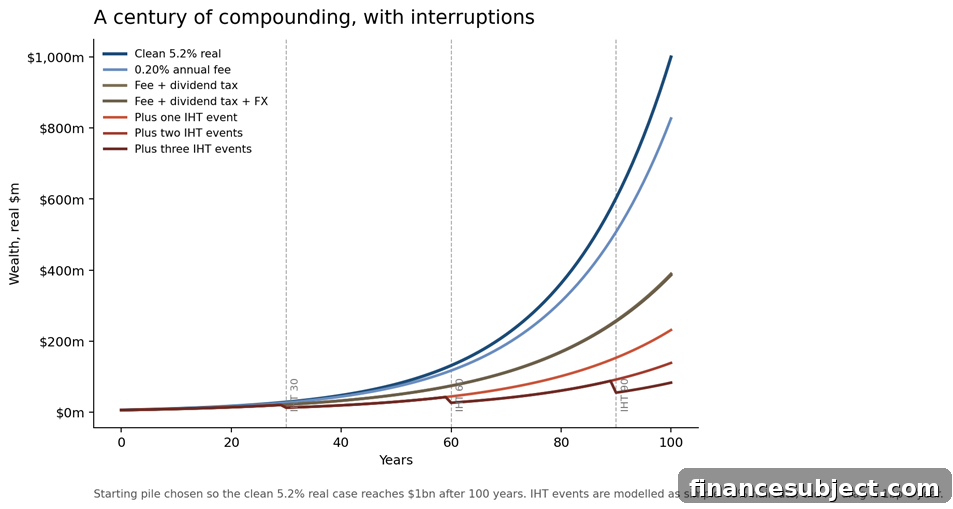
Assuming the pot is never spent, a 0.20% ongoing fee cuts the clean $1bn outcome to about $827m. Taxing a 2% dividend yield at 39.35% introduces roughly a 0.787% annual drag; combining fees and dividend drag reduces the family’s end value to approximately $390m. Adding a small FX cost trims a few more million, leaving about $386m. Then three 40% IHT events over the century reduce that to roughly $83m.
The conceptual line chart shows the contrast: the theoretical uninterrupted compounding versus the post‑fee, post‑tax reality. The idealised curve is the spreadsheet projection; the truncated curve is what remains after costs, taxes and inheritance events.
Yes, Britain has a wealth transfer tax
One rule of compounding is never interrupt it unnecessarily. Dying is a major interruption, especially in jurisdictions with heavy inheritance taxes. In the UK a 40% charge on substantial estates is effectively a wealth tax on transfer.
You can reduce IHT exposure by making gifts more than seven years before death, but that assumes you can reliably predict lifespan and be prepared to pay any associated capital gains tax on gifted assets. Tax rules change, and they often do so to the disadvantage of long‑term wealth holders.
Will your fund make it to 2126?
Buying global equities and waiting sounds simple, but you’re asking a financial product to survive 100 years. It must retain its mandate, stay cheap, avoid forced mergers or regulatory changes and remain available on future platforms. While there are few if any index fund examples with a century of continuous history, some collective investment vehicles and trusts have lasted over 100 years.
| Trust | Launch date | £1,000 after 30 years | CAGR |
| F&C Investment Trust | 19/03/1868 | £14,110 | 9.2% |
| City of London Investment Trust | 01/01/1891 | £10,635 | 8.2% |
| Scottish Mortgage | 17/03/1909 | £27,887 | 11.7% |
| Alliance Trust | 21/04/1888 | £12,268 | 8.7% |
That table shows collective vehicles can last many decades, but the absence of comparable 100‑year total return tables for many products highlights the uncertainty of trusting any single fund for a century.
Are tax wrappers any help?
If you could manage to place roughly $6m (about £4.5m) into a tax‑sheltered ISA, you would eliminate dividend tax and enable costless rebalancing. But ISAs are effectively inheritable only by a spouse; the wrapper itself ends with the surviving spouse unless very specific rules apply.
Pensions once offered a near‑perpetual shelter, but rule changes have reduced their lifetime inheritance advantages. The wider point is that tax shelters can help, but they’re subject to political and regulatory risk.
Practical tax planning principles remain: use your own and your spouse’s tax allowances, make use of children’s allowances where appropriate, and consider making full use of annual allowances — but always seek tailored advice for large sums.
The one weird trick that completely avoids IHT
Don’t die.
Because IHT is triggered by death, the only foolproof way to avoid it entirely is never to transfer your estate through death. That is tongue‑in‑cheek, of course — longevity helps, but it’s not a financial strategy you can reliably engineer.
A healthier lifestyle can increase the odds of a longer life, but health advice is personal and beyond the scope of this article. Reasonable measures that commonly improve longevity include maintaining a healthy weight, regular exercise, vaccination and avoiding unnecessary risks, along with proactive healthcare.
So what would actually help?
Maggie’s example already contains most of the answers:
- Start early
- Start with a meaningful sum
- Hold diversified, long‑term investments rather than concentrating risk
- Minimise fees
- Mitigate taxes where legitimately possible
- Limit consumption from the pot if your goal is long‑term compound growth
- Try to stay healthy
Follow those rules and, in theory, you could see extraordinary wealth accumulation over a century. In practice, taxes, fees, behaviour and mortality make that outcome far less likely.
What is the point?
Is there a point in becoming a billionaire a century from now if you won’t be around to enjoy it? That is a fair and important objection. Personal enjoyment, experiences and spending in life matter — saving every penny for a distant, uncertain future isn’t for everyone.
For some investors, though, the pursuit of compounding and the intellectual satisfaction of managing money are ends in themselves. Others prioritise leaving a legacy. Whatever your motive, Maggie’s story highlights the huge potential of long‑term equity compounding — and the practical barriers that typically prevent it from turning modest sums into fortunes.