
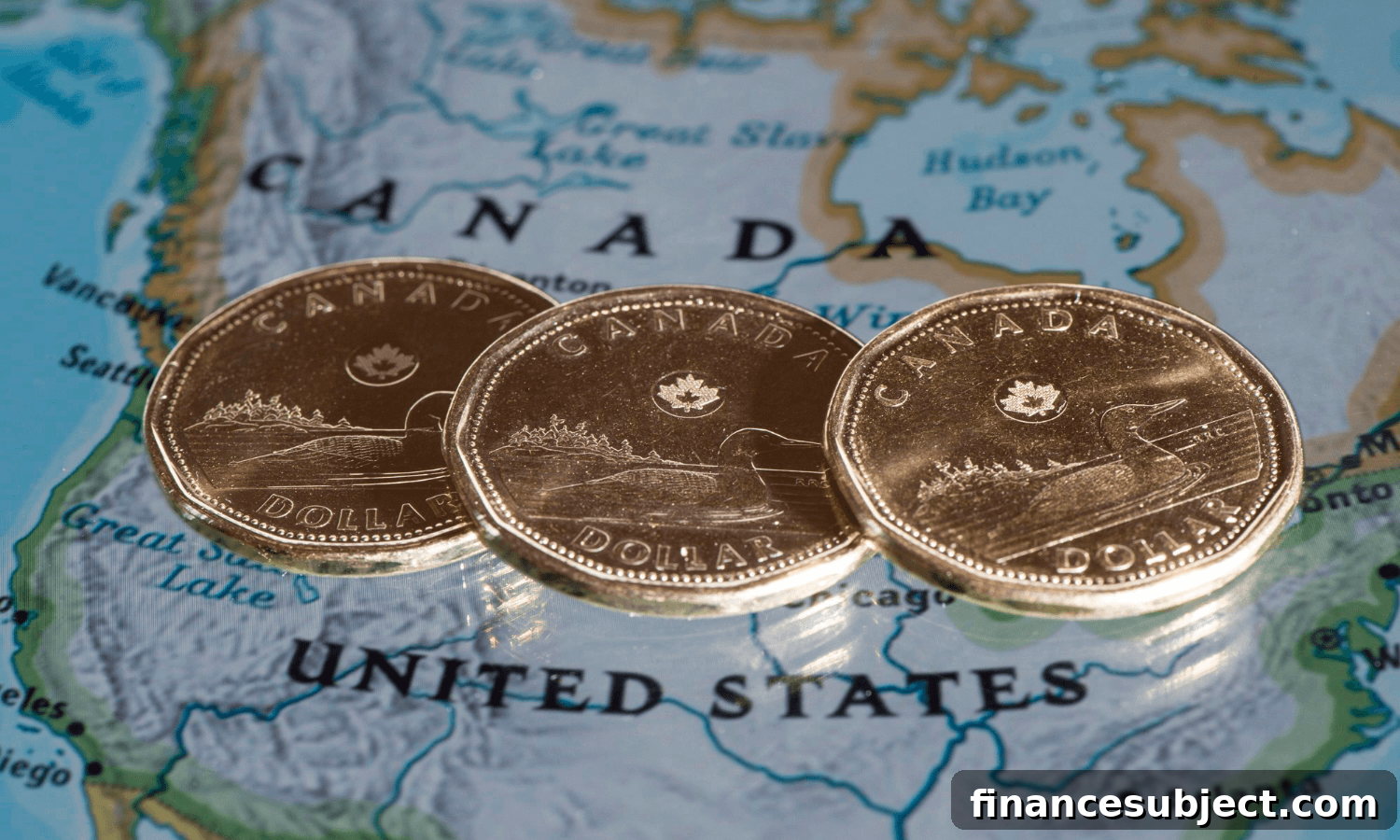
Experts warn that Donald Trump’s election victory could reshape U.S. interest-rate policy because several of his proposed economic measures risk lifting inflation. Any sustained rise in U.S. inflation would likely affect the timing and extent of rate cuts by the U.S. Federal Reserve, and those shifts could spill over to Canada — influencing both Canadian interest rates and the Canadian dollar (the loonie).
Among the policies driving those risks are substantial tariffs on imports, especially from China, combined with tax cuts and lighter regulation intended to spur faster growth. While President Trump has pledged that “inflation will vanish completely,” many economists say his plan could do the opposite: lift prices through higher import costs and stronger domestic demand, complicating central-bank plans to ease policy.
How enacting tariffs could affect inflation in the U.S.
“Tradition tells us that that increase in tariffs will increase inflation in the U.S.,” said Sheila Block, an economist with the Canadian Centre for Policy Alternatives. Tariffs raise the price of imported goods directly, and they can also increase input costs for domestic producers who rely on imported parts and materials. Over time, those higher costs are often passed through to consumers, contributing to headline inflation.
Higher inflation would reduce the Federal Reserve’s room to cut interest rates quickly or deeply. Markets have already begun adjusting expectations about how low and how fast the Fed might lower its policy rate. “If you’re enacting tariffs and pressing hard on the accelerator and creating job shortages and scarcity and wage inflation by running the economy hot, then the Fed won’t necessarily have as much license to cut rates as soon or as deeply as they would otherwise,” said Brian Madden, chief investment officer with First Avenue Investment Counsel.
In line with a different economic backdrop, the U.S. central bank did cut its key rate as expected recently by a quarter percentage point, bringing the federal funds rate to a 4.50%–4.75% range. But forward-looking estimates by some institutions suggest tariffs could lift inflation further. Economists at Goldman Sachs have estimated that a proposed 10% tariff, together with additional levies on Chinese imports and autos from Mexico, could push U.S. inflation toward about 3% by mid‑2026.
A TD Economics report noted that markets are now pricing in a slightly higher “neutral rate” for the Fed, which implies that the Fed’s eventual pause in its rate-cutting cycle could occur at a higher level than previously expected. “We are changing our forecast for the Fed, as higher inflation results in a slower pace of rate cuts in 2025,” the TD report said, with the Fed finishing 2025 with its key rate around 3.5% instead of 3%, and reaching roughly 3% in 2026. That shift does not necessarily change the long-run neutral rate, TD economists added, but it means the Fed would arrive there later than previously forecast.
Rankings
The best ETFs in Canada
U.S. economy and policy shifts could contribute to a weaker Canadian dollar
As the Bank of Canada considers its own interest-rate path while managing a cooling domestic economy, policymakers must weigh developments south of the border. A stronger U.S. economy and higher U.S. rates tend to push the U.S. dollar up against other currencies; for Canada, a weaker loonie raises the domestic price of many goods since a large share of imports is priced in U.S. dollars.
“As the value of the Canadian dollar is reduced relative to the U.S. dollar, that is also inflationary, because … many things that we import are denominated in U.S. dollars,” said Sheila Block. That dynamic can make the Bank of Canada more cautious about lowering rates quickly if a weaker loonie would feed imported inflation into the Canadian economy.
The Bank of Canada began cutting rates before the Fed did, responding to a deeper and faster economic slowdown in Canada after earlier hikes designed to fight inflation. Brian Madden said the expected divergence between Canadian and U.S. policy paths was likely under any scenario, but a shift to a pro-growth U.S. administration could amplify the gap. He also pointed to ongoing weakness in the Canadian economy and recent changes to immigration and temporary foreign-worker policies as additional factors that might keep Canada in a position of excess supply.
“It seems quite likely that Canada is going to be operating in an excess supply position, which will give the Bank of Canada the green light to cut rates much more quickly to neutral,” Madden said. If Canadian policy rates fall faster while U.S. rates stay higher, the resulting interest-rate gap could exert downward pressure on the Canadian dollar. At the same time, Madden cautioned that a weaker loonie’s effect on Canadian inflation is likely to be modest: imported goods would cost more in Canadian-dollar terms, but a weaker currency also makes Canadian exports more competitive abroad, which can stimulate demand and help offset some of the inflationary impact.
Tariff plan could reduce exports and raise production costs in Canada
TD economists estimate that if significant tariffs are imposed, Canadian export volumes to the United States could fall by nearly 5% by early 2027. That drop would raise costs for domestic producers who depend on U.S. markets and supply chains, and could force Canada’s central bank to cut interest rates more than it otherwise would to support growth.
TD’s analysis suggests such a shock could prompt the Bank of Canada to lower rates by roughly an additional half to three‑quarters of a percentage point compared with current forecasts, widening the spread with U.S. rates and placing further downward pressure on the loonie. Under that scenario, the Canadian dollar could fall below 70 U.S. cents.
Tariffs would also make many imported goods more expensive for Canadian consumers and businesses, producing a temporary and modest re-acceleration of inflation before forecasts anticipate inflation moving back toward the Bank of Canada’s 2% target by 2026.
Newsletter
Get free MoneySense financial tips, news & advice in your inbox.
Read more news:
- What does Trump’s election mean for the Canadian economy?
- The crypto markets’ response to the U.S. election results
- Why are Canadians still frustrated with the economy?
- How will the outcome of the U.S. election affect financial markets?