

I used to look forward to the annual asset-class rotation chart Franklin Templeton published for financial advisors and the media. Even though the print copy I keep on my office wall is dated 2015, the chart’s lessons remain relevant. I checked with Franklin Templeton and the chart is still available, now only in a digital format on their website.
Reading the Franklin Templeton chart
We have reproduced the chart for this column because it remains highly instructive. Titled “Why Diversify? Because Winners Rotate,” the chart opens with a reminder: “One year’s best performer might be the next year’s worst. A diverse portfolio can protect you from downturns and give you access to the best performing asset classes this year—every year.” That message is worth revisiting, especially after a difficult year for nearly all asset classes.
Although the table ends in December 2021, it clearly shows that winners and losers move from year to year. Given how painful 2022 has been for many investors, revisiting these historical patterns is timely even if the most recent cycle peaked in November 2021.
Looking at the Annual Returns of Key Asset Classes
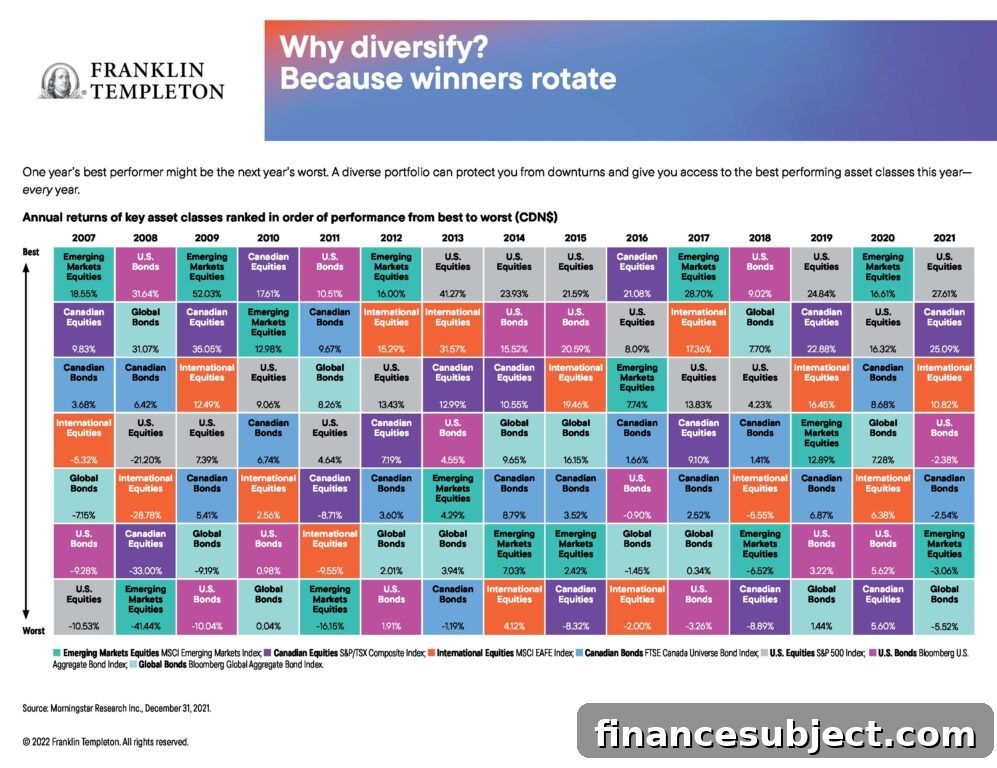
The chart presents annual returns in Canadian dollars, based on representative indexes. A clear pattern emerges: U.S. equities, as represented by the S&P 500, frequently top the list. Over the last nine years shown, the S&P 500 led five times (2013–2015, 2019 and 2021).
By contrast, bond categories often occupy the bottom positions. Between 2007 and 2021, at least one bond index was among the worst performers in seven of those years. Global bonds, U.S. bonds and Canadian bonds all appeared near the bottom in different years. That is striking because those same years are commonly viewed in hindsight as part of a multi-decade bond bull market. With interest rates having clearly bottomed and then climbed, future bond returns are likely to look different than in the past.
The chart does not include 2022, but investors experienced notable bond weakness that year, especially in long-duration bond funds and aggregate bond funds that hold significant long-term exposure. Longer-term bonds are the most sensitive to rising interest rates.
Emerging market equities (measured by the MSCI Emerging Markets Index) illustrate volatility well. Emerging markets produced outsized gains and steep losses over the sample period, topping the list five times but also finishing last in several years. For example, a roughly 41% decline in 2008 was followed by a large rebound in 2009, highlighting the dramatic cyclical swings that can occur.
Looking at the Standard Deviation of Key Asset Classes
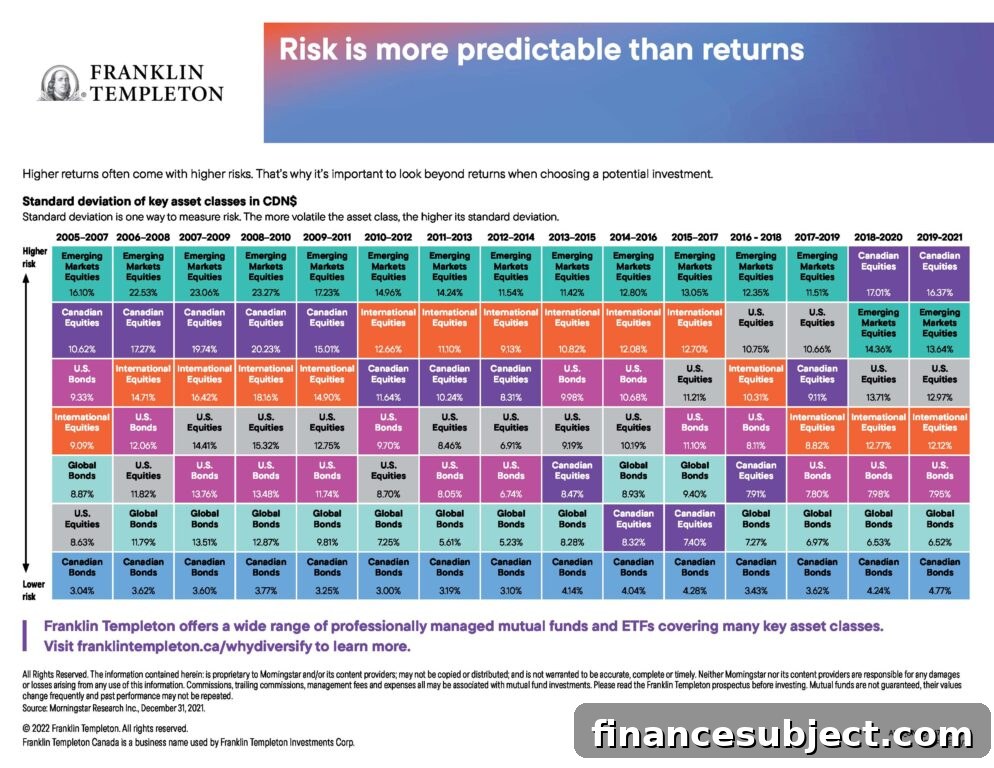
Franklin Templeton’s companion chart, titled “Risk is more predictable than returns,” ranks asset classes by volatility (standard deviation). The takeaway: higher returns typically come with higher risk, so focusing solely on past returns can be misleading when making investment decisions.
Across the 2005–2021 span, the relative risk ordering was consistent. Canadian bonds were the least volatile in every period examined, while emerging-market equities were generally the most volatile. Global bonds and international equities consistently fell toward the lower and higher ends of the risk spectrum, respectively. These risk rankings help investors understand that stability and return potential are different attributes that should be considered together when building a portfolio.
Looking outside of the chart
While these charts are valuable, they largely focus on the two dominant asset classes—stocks and bonds. That mirrors the composition of popular all-in-one asset allocation ETFs pioneered by Vanguard and replicated by other providers in Canada. Those ETFs aim for convenience and broad diversification, but they will still reflect the same rotation and volatility patterns shown on the chart.
For example, a typical 60/40 balanced fund faced a rough 2022; some broad balanced ETFs reported double-digit year-to-date declines through October. That reminds us that even seemingly conservative, diversified portfolios can suffer in market stress.
What I find missing from the classic “Why diversify” presentation is a fuller look at alternative asset classes—gold and other precious metals, real estate and REITs, commodities, inflation-linked bonds and even cryptocurrencies. Ray Dalio’s All-Weather portfolio and other multi-asset approaches incorporate several of these exposures to spread risk across environments. Some new asset-allocation ETFs have even experimented with small allocations to crypto, though that exposure has proven volatile.
Gold and other traditional inflation hedges deserve a place in the conversation. In 2022, gold did not fall as sharply as many other assets, though it did not surge either. The Franklin Templeton chart includes gold-related stocks indirectly through equity categories and REITs through real estate allocations, but it would be useful to see these alternatives shown as distinct categories so investors can better evaluate how they behave relative to stocks and bonds.
Jonathan Chevreau is the Investing Editor at Large for MoneySense. He is the founder of the Financial Independence Hub, author of Findependence Day and co-author of Victory Lap Retirement. He can be reached at [email protected].
Read more Retired Money:
- The 60/40 portfolio: A phoenix or a dud for retirees?
- How might inflation impact your retirement plans?
- Tontines in Canada: Moving from theory to practice as a solution to our retirement crisis
- Delaying CPP and OAS to age 70: Is it worth the wait?