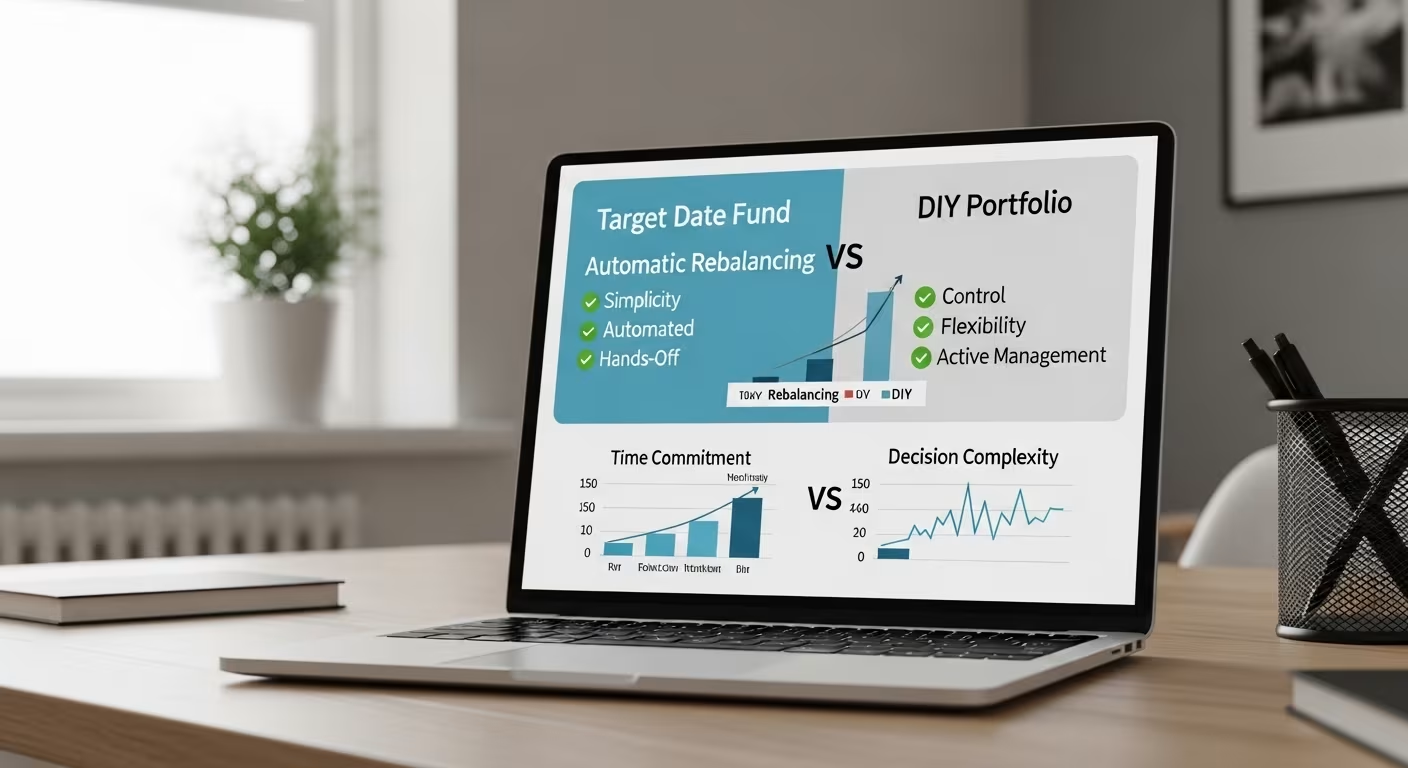
When it comes to investing for retirement, you have two main approaches: the simplicity of target-date funds or the control of building your own portfolio. Both can work well, but one is likely better suited to your situation. Here's how to decide.
Target-Date Fund vs. DIY: The 2026 Comparison
| Factor | Target-Date Fund | DIY 3-Fund Portfolio |
|---|---|---|
| Expense ratio | 0.08-0.75% | 0.03-0.07% |
| Rebalancing | Automatic | Manual (1-2x per year) |
| Glide path | Automatic (shifts conservative over time) | Manual adjustments |
| Customization | None | Full control |
| Tax-loss harvesting | No | Yes (if you know how) |
| Time required | 0 minutes/year | 2-4 hours/year |
| Historical performance | Matches market (minus fees) | Matches market (minus lower fees) |
The honest assessment: Target-date funds are excellent for 90% of investors. The additional 0.05-0.70% in fees is the cost of automation and guaranteed rebalancing. A Vanguard Target Retirement 2060 Fund (0.08% expense ratio) is nearly as cheap as DIY and requires zero maintenance.
Choose DIY if: You enjoy managing investments, want tax-loss harvesting opportunities, prefer a different allocation than the target-date glide path, or want to minimize fees to the absolute lowest level.
Choose target-date if: You want simplicity, worry you will not rebalance regularly, prefer 100% hands-off investing, or tend to panic-sell during market downturns (automatic rebalancing prevents this).
The Behavioral Advantage
Research from Vanguard found that target-date fund investors earned roughly 1.5% higher annualized returns than DIY investors—not because target-date funds perform better, but because DIY investors make behavioral mistakes (panic selling, performance chasing, under-rebalancing). The best investment is the one you will not tinker with. ## What Are Target-Date Funds?
The Concept
A target-date fund (TDF) is a single mutual fund designed to be your complete retirement portfolio. You choose a fund based on your expected retirement year—2040, 2050, 2060—and the fund handles everything else.
Example: Vanguard Target Retirement 2050 Fund (VFIFX)
What's Inside
Most target-date funds hold:
- US stock index funds
- International stock index funds
- US bond index funds
- International bond index funds
- Sometimes: REITs, TIPS, commodities
Typical allocation for 2055 fund (30 years out):
- 54% US stocks
- 36% International stocks
- 7% US bonds
- 3% International bonds
The Glide Path
Target-date funds automatically become more conservative as you approach retirement.
Example progression:
- 30 years out: 90% stocks, 10% bonds
- 20 years out: 80% stocks, 20% bonds
- 10 years out: 65% stocks, 35% bonds
- At retirement: 50% stocks, 50% bonds
- Post-retirement: Gradually more conservative
No action required from you.
What Is a DIY Portfolio?
Building Your Own
DIY investors select individual funds to create their desired allocation.
Classic three-fund portfolio:
- US total stock market index fund
- International stock index fund
- US bond index fund
Example allocation for 30-year-old:
- 60% US stocks (VTSAX/VTI)
- 25% International stocks (VTIAX/VXUS)
- 15% Bonds (VBTLX/BND)
What DIY Requires
- Choosing your asset allocation
- Selecting specific funds
- Rebalancing periodically (annually)
- Adjusting allocation over time
Head-to-Head Comparison
Simplicity
Target-Date Fund: Maximum simplicity
- One fund
- No decisions after initial selection
- Automatic rebalancing
- Automatic glide path
DIY Portfolio: Moderate complexity
- 3-5 funds typically
- Annual rebalancing needed
- Manual allocation adjustments
- More decisions
Winner: Target-date funds
Cost
Target-Date Fund expense ratios (2026):
- Vanguard: 0.08-0.13%
- Fidelity: 0.00-0.12% (some free)
- Schwab: 0.00-0.08%
DIY Portfolio expense ratios:
- Vanguard index funds: 0.03-0.05%
- Fidelity index funds: 0.00-0.02%
- Schwab index funds: 0.00-0.03%
The difference:
- TDF: ~$100-$130/year per $100,000
- DIY: ~$30-$50/year per $100,000
Lifetime impact on $1M portfolio:
- TDF: ~$1,000-$1,300/year in fees
- DIY: ~$300-$500/year in fees
- Difference: ~$500-$1,000/year
Winner: DIY (slightly)
Control
Target-Date Fund: Limited control
- Can't adjust allocation within fund
- Glide path is predetermined
- One provider's philosophy
DIY Portfolio: Full control
- Set exact percentages
- Choose specific funds
- Adjust based on your risk tolerance
- Change allocation whenever you want
Winner: DIY
Behavioral Protection
Target-Date Fund: Built-in guardrails
- Harder to panic sell individual components
- Automatic rebalancing removes emotion
- "Set and forget" prevents tinkering
DIY Portfolio: Exposed to behavioral risks
- Temptation to time the market
- May skip rebalancing
- Can over-optimize and hurt returns
Winner: Target-date funds
Tax Efficiency
In tax-advantaged accounts (401k, IRA): No difference
In taxable accounts:
- TDF: Less tax-efficient (rebalancing triggers gains)
- DIY: Can place bonds in tax-advantaged, stocks in taxable
Winner: DIY (for taxable accounts)
Customization
Target-Date Fund: One-size-fits-all
- Same allocation for everyone retiring in 2055
- Can't tilt toward value or small-cap
- Can't exclude certain investments
DIY Portfolio: Fully customizable
- Exact allocation you want
- Can include factor tilts
- Can add REITs, international bonds separately
- Reflects your specific risk tolerance
Winner: DIY
When to Choose Target-Date Funds
Ideal For
Beginners: Just starting to invest, learning the basics
Hands-off investors: Don't want to think about investments
401(k) investors: When plan has good TDF but limited other options
Those prone to tinkering: Simplicity prevents harmful behavior
Single account investors: All retirement savings in one place
When TDFs Work Best
- You want "set and forget" simplicity
- You don't want to learn investment details
- You might otherwise hold too much cash
- Your 401(k) has a good low-cost TDF
- You're okay with average (not optimized) allocation
Best Target-Date Funds (2026)
Lowest cost:
- Fidelity Freedom Index funds (0.00-0.12%)
- Schwab Target Index funds (0.00-0.08%)
- Vanguard Target Retirement funds (0.08-0.13%)
Avoid: High-fee TDFs (over 0.50%)—many 401(k)s have expensive options.
When to Choose DIY Portfolio
Ideal For
Cost-conscious investors: Want lowest possible fees
Those who enjoy investing: Find portfolio management interesting
Investors with taxable accounts: Need tax-efficient placement
Those with specific preferences: Want to tilt toward certain factors
Multiple account holders: Need to optimize across accounts
When DIY Works Best
- You understand asset allocation basics
- You will actually rebalance (annually)
- You won't panic during downturns
- You have multiple account types
- You want maximum control over costs
Simple DIY Portfolios
Two-Fund Portfolio:
- 80% Total Stock Market (VTI/VTSAX)
- 20% Total Bond Market (BND/VBTLX)
Three-Fund Portfolio:
- 55% US Total Stock (VTI)
- 25% International Stock (VXUS)
- 20% US Bonds (BND)
Four-Fund Portfolio (add international bonds):
- 50% US Stocks
- 25% International Stocks
- 15% US Bonds
- 10% International Bonds
The Hybrid Approach
Using Both
In 401(k): Target-date fund (if low-cost) In IRA: DIY three-fund portfolio
Why this works:
- 401(k) may have limited options but good TDF
- IRA gives access to any fund you want
- Simplicity where options are limited, control where available
Transitioning Approaches
Starting with TDF, moving to DIY:
- Begin with TDF to start investing immediately
- Learn about asset allocation over time
- Eventually transition to DIY if desired
- No rush—TDFs work well indefinitely
Making the Decision
Questions to Ask Yourself
1. Do I want to spend time on investing?
- No → Target-date fund
- Yes → Consider DIY
2. Will I actually rebalance annually?
- Probably not → Target-date fund
- Definitely → DIY is fine
3. How would I react to a 30% drop?
- Panic and sell → Target-date fund (fewer decisions to make)
- Stay the course → Either works
4. Do I have multiple account types?
- Just 401(k) → Target-date fund is fine
- 401(k), IRA, taxable → DIY may optimize better
5. Are my 401(k) TDF options low-cost?
- Yes (under 0.15%) → TDF is great choice
- No (over 0.50%) → DIY from available index funds
The Honest Answer for Most People
Target-date funds are fine for most investors most of the time.
The fee difference between a 0.10% TDF and 0.03% DIY portfolio is ~$70/year per $100,000. For simplicity and behavioral protection, that's often worth it.
DIY is better if:
- You genuinely enjoy managing investments
- You need tax-efficient asset location
- You'll consistently rebalance
- Your 401(k) TDFs are expensive
Taking Action
If You Choose Target-Date Fund
- Select fund matching your retirement year
- Invest 100% of your retirement savings in it
- Continue contributing
- Check once per year to confirm
- That's it
If You Choose DIY
- Decide on asset allocation (stocks/bonds split)
- Choose 3-4 low-cost index funds
- Set up initial purchases
- Rebalance annually (calendar reminder)
- Adjust allocation every 5-10 years toward bonds
If You're Still Unsure
Start with a target-date fund. You can always transition to DIY later if you develop interest and knowledge. The important thing is to start investing now rather than waiting for the "perfect" decision.
Both approaches—done consistently with low-cost funds—lead to retirement success. The best portfolio is the one you'll stick with through good markets and bad.
The honest recommendation for most readers: If you are reading this article trying to decide, choose the target-date fund. The 0.05% fee premium over DIY is approximately $50/year per $100,000 invested—a trivial cost for guaranteed rebalancing, automatic glide path management, and protection from your own behavioral mistakes. You can always switch to DIY later once you have more knowledge and confidence. But never let the perfect be the enemy of the good—the worst portfolio is the one you never open because you could not decide between options.
The One-Fund Solution: Target-Date Funds for Every Situation
| Your Situation | Recommended Fund | Why |
|---|---|---|
| 20s-30s, aggressive growth | Target Retirement 2060-2070 | 90% stocks, maximum growth time |
| 40s, balanced approach | Target Retirement 2045-2055 | 80% stocks, beginning to moderate |
| 50s, moderate | Target Retirement 2035-2040 | 70% stocks, balancing growth and stability |
| Near retirement | Target Retirement 2025-2030 | 50% stocks, capital preservation focus |
| Already retired | Target Retirement Income | 30% stocks, income and stability |
Provider comparison: | Provider | Expense Ratio | Glide Path Style | Minimum | |----------|--------------|-----------------|---------| | Vanguard | 0.08% | Through retirement (keeps shifting) | $0 | | Fidelity Freedom Index | 0.12% | To retirement (stabilizes) | $0 | | Schwab | 0.08% | To retirement | $0 |
All three are excellent. If your 401(k) offers any of these at these expense ratios, you can set your investment allocation in 60 seconds and never think about it again. The mental energy you save by not managing investments yourself can be redirected toward earning more money, spending time with family, or simply enjoying life without portfolio anxiety.
Comments (0)
No comments yet. Be the first to share your thoughts!
Leave a Comment