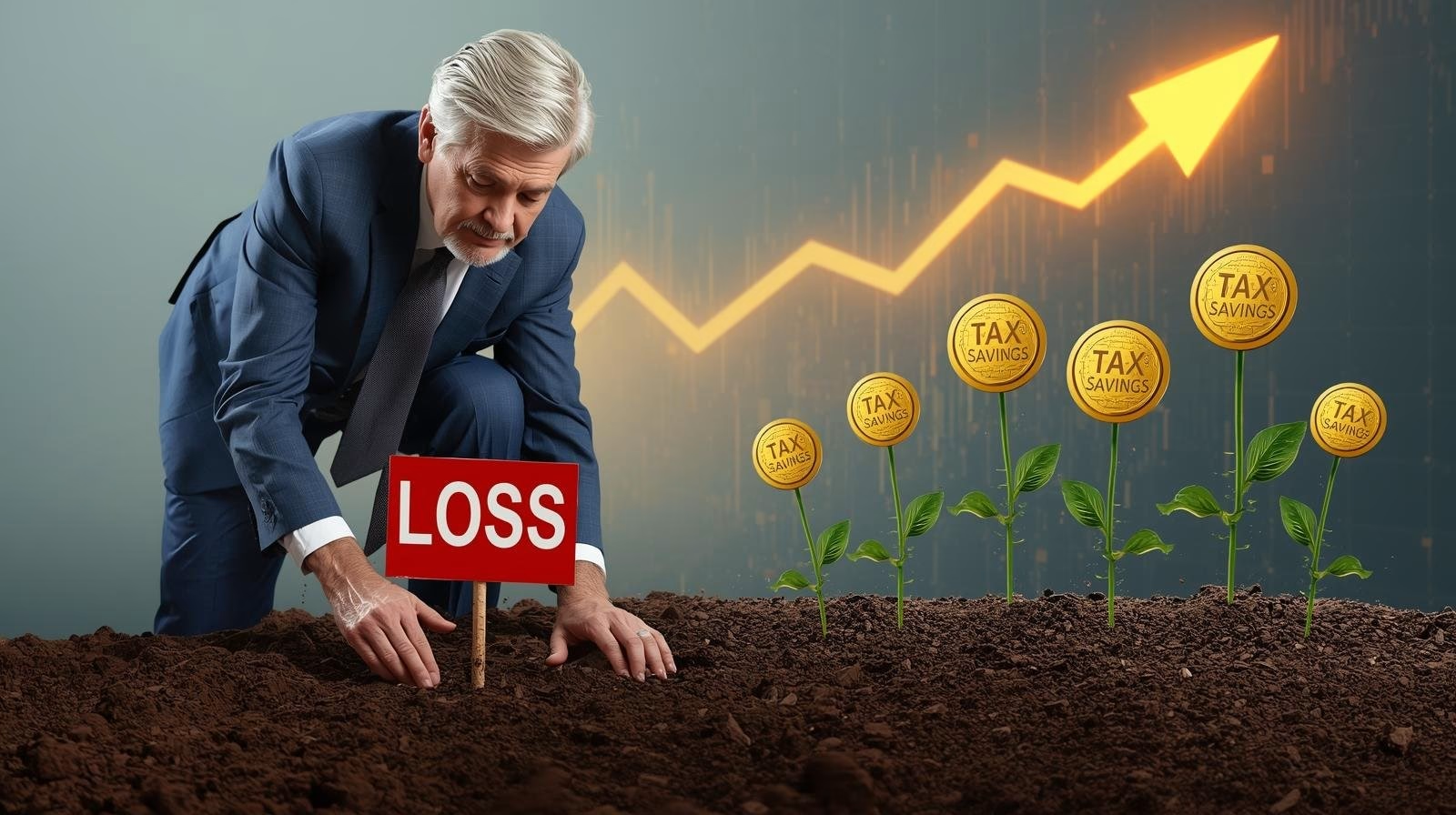
You don’t need a market crash to make money in investing.
Sometimes, you just need a dip.
If you know how to play it right, it does not count as a loss. It’s a gift. There is a covert way to reduce taxes, rebalance portfolios and amplify long-term returns without any change in strategic direction, it has IRS approval.
It’s called tax-loss harvesting.
And no, it is not just for hedge funds or day traders with Bloomberg terminals. If you are an elderly person, side hustler or a late bloomer who is on the right track, it is for you.
I have used this strategy to help clients save $8,000–15,000 in taxes each year—money that does not disappear into the IRS dark hole, but goes back into their portfolio to compound for decades.
In this guide, I’ll show you.
- How tax-loss harvesting really works (no jargon, no fluff).
- The wash sale rule trap — and how to avoid it without breaking a sweat.
- How to pair it with your retirement budget hacks to free up cash without panic-selling.
- How a 60-Year-Old Couple Used a 15 Percent Drop in the Market to Save $11,000 in Taxes.
- One of my favorites is the “Tax Swap Ladder” — a way to harvest losses while leaving your asset allocation just as it was.
This isn’t tax evasion. It’s tax optimization — legal, ethical, and surprisingly overlooked.
Let’s turn your losses into leverage.
🎯 What Is Tax-Loss Harvesting? (And Why You Shouldn’t Just Rely On A Bear Market)
Tax-loss harvesting is simple.
You can sell an investment that is down to lock in the loss and utilize the loss to offset capital gains or may be ordinary income. Next, use the money from your sale to buy a similar asset.
You’re not exiting the market. You’re not giving up on your strategy. You’re just using the tax code to your advantage.
You are not Sellng You're Swapping
Many believe taking losses means to leave. Not true. It means “getting smarter.”.
Example.
- You purchased $50,000 in VTI (Vanguard Total Stock Market ETF) in
- Today, it’s worth $38,
- ($8,000 loss).
- You sell VTI, realize the $8,000 loss.
- Buy SCHB (Schwab U.S. Broad Market ETF) — virtually identical exposure right away.
- You still put full faith in US equities. But now you’ve got $8,000 in tax losses to use.
That $8,000? It can offset $8,000 in capital gains elsewhere. It can also lower your ordinary income up to $3,000 if you have no capital gains and allow you to carryover the rest.
Outcome: You converted a paper loss into genuine tax savings, all without altering your market exposure.
Be Careful of the One Trap: The Wash Sale Rule
The IRS isn’t stupid. They’re not going to let you sell and rebuy the same stock so you can book a loss.
Enter the wash sale rule.
Your loss will be disallowed if you purchase “substantially identical” securities 30 days prior to and 30 days after the sale.
“Substantially identical” means issuers with the same ticker.
- ✅ VTI → SCHB? Totally fine. Different issuers, slightly different holdings. ✅ VTI → ITOT? Also fine. Core S&P Total U.S. Stock Market iShares. ❌ VTI → VTI? Wash sale. Don’t do it.
Make a list of things you’d swap when shopping
Keep a cheat sheet of equivalent ETFs.
- The U.S. stocks are VTI, SCHB, and ITOT.
- Use the VXUS to IXUS to SPDW pairing for international hedged investing.
- Bonds: BND is same as AGG and SCHZ.
When the market goes down, you simply swap — no panic, no research, no mistakes.
How To Harvest Losses Like A Pro (Step By Step Playbook)
Step 1: Identify Losers
Log into your brokerage. Use the “Unrealized Gain/Loss” filter to sort your holdings. Look for anything down 5% or more.
Step 2: Next, work out your tax offset
- Offset capital gains first (short-term or long-term).
- Leftover losses? Deduct up to $3,000 against ordinary income.
- Carry forward excess losses indefinitely.
Step 3: Execute the Swap
Sell the loser. Buy the substitute. Same dollar amount. Same day.
Step 4: Track & Document
Keep records. Your broker will issue a 1099-B. You will have to report the loss on schedule D and form8949.
Step 5 Rebalance back (Optional)
After 31 days, you can reverse your original holding — if you so wish. Or just stick with the new one.
$10,000 Worth of Losses Saves You Over $3,700 in Taxes
You fall in the 24% Federal tax bracket plus 5% state tax.
You harvest $10,000 in losses.
- Saved $870 from offsetting $3,000 against ordinary income at 29% rate.
- You can Offset Future gains with Carry forward of $7,000. That is $7,000 x 29% = savings of $2,030 when you realize your gains.
- Total potential savings: $2,900+.
And what if you're doing this to counter short-term capital gains (taxed like ordinary income)? Even bigger win.
Tax-Loss Harvesting, Building Your Larger Financial Plan, What To Layer
Link #1: Combine with your Retirement Budget Hacks.
If you are retired and need cash, do not sell winners. Losses from your harvest can offset taxes. You can spend the cash on whatever you like!
I avoided some tax from my RMD with tax loss harvesting; I’ve put the saved amount into my home repair fund. Just one move, get two wins --- Client case, 2024. Retirement budget hacks: easy spending tweaks.
Link #2: Get a layer of protection with umbrella insurance.
Tax-loss harvesting can help increase your cash flow and lessen your taxes, but don’t allow a lawsuit to erase your winnings. Layer it with liability protection.
Last year I harvested losses, I saved $9000 in taxes. I used $500 of it to bump my umbrella policy to $2M. Rest up like a Lambo.” — M.D., Austin.
People Ignore Cheap Protection from Umbrella Insurance
External Site: IRS guidelines for capital losses
To find information on capital losses, carryforwards, and wash sale adjustments, the IRS Topic No. 409 (Capital Gains and Losses) will provide the official word and be clear and concise.
How That Plays Out In Real Life
🎯 Scenario 1: The Retiree Is 68 Years Old
- Portfolio: $1.2M taxable account.
- Needs $40,000/year for living expenses.
- Instead of selling winning stocks and paying tax, she harvests losses on underperforming tech stocks for $15,000.
- Uses loss to offset RMD taxes + $3,000 ordinary income.
- Reinvests proceeds in SCHB. Stays fully invested.
- Tax savings: $4,350. Uses it to fund her travel sinking fund.
🎯 Scenario 2: A 52-Year Old Who Engages In Side Hustles
- Sells $20,000 of crypto gains (short-term, taxed at 32%).
- Harvests $20,000 in stock losses from his brokerage.
- Net gain: $0. Tax owed: $0.
- Reinvests in ITOT. Keeps compounding.
🎯 Scenario 3: The Late Bloomer (Age 45).
- Just maxed out his 401(k) and HSA.
- Has $50,000 in taxable account, down 10% ($5,000 loss).
- Harvests loss, offsets freelance income.
- Tax savings: $1,450. Reinvests it immediately.
People Often Ask These Questions
Why would I harvest tax losses if I won’t sell my winners?
Can I harvest losses in my IRA or 401(k)?
What if I don’t have any capital gains to offset?
How long can I carry forward losses?
Can I harvest losses on mutual funds?
What is the most common error with tax-loss harvesting?
Should I harvest losses every year?
Can I harvest losses if I’m retired and not earning income?
Does tax-loss harvesting work for crypto?
What’s the best time of year to harvest losses?
Can I harvest losses and still keep my asset allocation?
Do I need a financial advisor to do this?
What if I accidentally trigger a wash sale?
Should I harvest small losses?
Can I use tax-loss harvesting to offset rental income?
What is one thing not to do with tax-loss harvesting?
🧭 Final Thoughts
While there may be loses one should think about it as a fuel for gaining points.
The market doesn’t care about your feelings. It dips. It crashes. It grinds sideways for years.
But with tax-loss harvesting, you’re not at its mercy.
You’re playing 4D chess.
Every dip is an opportunity. Every loss is a lever. Switching investments takes strides toward a smoother financial construction.
So don’t fear the red numbers. Celebrate them.
Because in the hands of a savvy investor? A loss isn’t the end of the story.
It’s the beginning of a tax-free comeback.
Comments (0)
No comments yet. Be the first to share your thoughts!
Leave a Comment