
David Sawyer is a regular guest contributor at Monevator and has written several pieces for us since publishing his debut book, RESET. He returns here to explain how to use the UK budgeting tool Money Dashboard — one of his nine underrated tools for people pursuing financial independence.
Sitting through a long meeting. Persistent eczema. That strange repetitive clicking noise your nine‑year‑old makes. Chopping onions. Giving a staff member a “could try harder” at appraisal.
Mild annoyances
Modern life is full of small irritations and tasks we’d rather avoid. After a long day at work we often choose distraction and relaxation: scrolling social media, watching box sets, listening to podcasts. Even when we do pick something self‑improving, we usually opt for low resistance — reading an article or catching a podcast — rather than doing truly tedious things such as opening a spreadsheet and tracking every transaction.
We’ve all heard the advice — look after every penny — but tracking personal finances feels laborious. I used to feel that way too, until a few years ago when I finally faced up to how much my family was spending on things we didn’t need. Over several months in 2017 we cut our outgoings by around £900 a month and redirected that money into investments. That change was primarily driven by using Money Dashboard alongside Martin Lewis’s Budget Planner.
Why most people don’t budget
It’s curious that while most organisations employ someone — a finance director — to watch the books, very few of us do the same for our personal finances. When I point this out, the common objections I hear are:
- I don’t know how to use spreadsheets.
- Life is for living — why obsess over every pound?
- We usually have enough, so why track every expense?
- It’s boring.
I sympathised with those answers for much of my adult life. But once you start tracking, the benefits are clear: a proper budget lets you see, for the first time, where your money actually goes. And with the right tools, what started as a chore can become straightforward, even satisfying.
Budgeting — it’s worth the boredom
Budgeting can feel dull, but it gives you control. Money Dashboard transforms this process by bringing all your non‑invested money into one place and making tagging and categorising simple.
David’s 13‑point plan to master your budget with Money Dashboard
There are other apps — Mint and You Need a Budget are well known in the US — but in the UK I found Money Dashboard the most reliable for syncing multiple bank accounts. Below is a practical 13‑step plan I use to get the most from Money Dashboard and Martin Lewis’s Budget Planner (the spreadsheet version).
#1 Get Martin Lewis’s Budget Planner
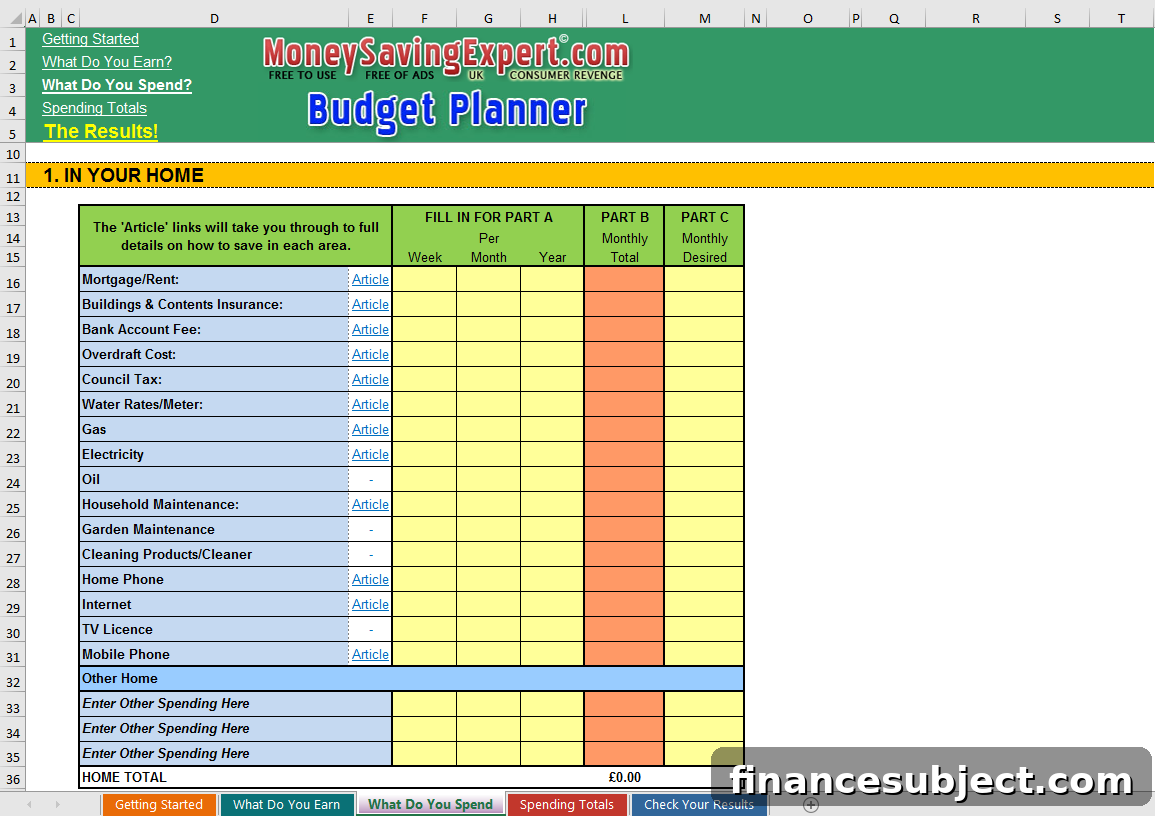
Download the spreadsheet version of the Budget Planner from MoneySavingExpert. It’s an Excel file divided into 13 categories and around 90 subcategories. You can add a few extra subcategories per main category if you need further detail. Save a copy to your computer, Dropbox or Google Drive.
Martin Lewis’s Budget Planner spreadsheet
#2 Analyse your current account
Review a year of statements from your current account, online or on paper. Use the ‘What you spend’ tab in the Budget Planner to assign amounts to the appropriate subcategories. Save this version — it captures “spendy you”.
#3 Create an aspirational budget
Now plan changes. Look at each line, discuss with your partner or family, and decide where you can cut back or reallocate spending. Save this second version as “aspirant you”.
#4 Sign up to Money Dashboard
- Money Dashboard is free to use.
- It’s secure: data is encrypted.
- Know that anonymised data may be used for market research.
#5 Sync all your accounts
Link every current account, savings account and mortgage account to Money Dashboard. It usually works smoothly; the main delay is finding all the passwords.
#6 Recreate your Budget Planner categories in Money Dashboard
Using your “aspirant you” sheet, create matching budgets and tags in Money Dashboard. Click “add budget” for each category, then “add tag” for the subcategories. Consistent naming and colours help when cross‑referencing the spreadsheet and the app.
Name a budget category, set its limit, and assign tags
#7 Understand Transactions
The Transactions tab shows every inflow and outflow across your linked accounts. Money Dashboard gives you a consolidated “one‑pot” view of the cash that’s not invested. It isn’t yet a full service for investment and pension accounts, though more providers are being added over time.
#8 Tag transactions regularly
Every few days, or weekly, tag transactions. Use the “Tag similar transactions” option to automate recurring items. For varied vendors like Amazon, tag each purchase manually to ensure accuracy.
#9 Split large transactions
For mixed purchases — for example, a supermarket trip that includes household items, seasonal goods and birthday presents — use “split transaction” to allocate parts of the total across different tags. It keeps your budgets accurate.
Splitting a transaction into multiple categories
#10 Use “Offline Sources” accounts
Offline Sources are manually added accounts for items that don’t sync: VAT owed, invoices outstanding, cash in the house, pocket money, rental income or tax liabilities. These let you reflect the true availability of funds and model more complex financial situations. You can even use them as a simple net worth tracker by adding investment value and home equity as offline accounts.
Pocket money can be tracked with an offline account
#11 Hide accounts from totals
If you want to see an account in the sidebar but exclude it from your overall balance, edit the account and toggle off “include in total balances”. This is useful for monitoring items like mortgages separately from your liquid cash total.
#12 Check balance history
Use the balance history feature occasionally to see trendlines for your overall balance and individual accounts — a quick visual check on progress.
#13 Reconcile with your Budget Planner
After using Money Dashboard for a while, compare actual spending to your “aspirant you” Budget Planner. Some people check monthly; I recommend waiting three months to gather meaningful data, or do a full annual review if you prefer. Use the Transactions filter to view a full year and compare each subcategory to the spreadsheet, then adjust budgets and spreadsheet figures accordingly.
Use filters to review tags across a full year
Money Dashboard’s minor annoyances
A few limitations are worth noting. The budgeting history currently only goes back six months in the budget view, which makes annual comparisons clumsy. You also cannot add transactions manually, so cash spending requires a workaround. Finally, syncing speed varies between providers, so balances or transfers between linked accounts can appear temporarily inconsistent.
Wrapping up
What you measure becomes your focus. Tracking every pound that enters and leaves your household is a simple habit that builds financial awareness, improves efficiency and helps you reach long‑term goals faster. Using Money Dashboard with Martin Lewis’s Budget Planner makes the process far less painful and helps you spend more intentionally, reduce guesswork and accelerate saving or investing for financial independence.
Codicil
For the record, I did manage a guest post without mentioning my book — but only briefly. I wrote RESET: How to Restart Your Life and Get F.U. Money. If you’d like to read more of my writing, I publish a weekly newsletter and have written other articles for Monevator.
David’s Book
David wrote the UK’s first financial independence book, RESET: How to Restart Your Life and Get F.U. Money.
Do you track your spending? Have you tried Money Dashboard or another budgeting app? Share your experience in the comments.
- In case you’re wondering, I’ve never received any payment from the Edinburgh‑based company.[↩]