

Kyle Prevost, editor of Million Dollar Journey and founder of the Canadian Financial Summit, highlights the week’s financial headlines and explains what they mean for Canadian investors.
The Shaw & Rogers merger approved — finally
Federal regulators last week approved Rogers Communications’ (RCI.B/TSX) acquisition of Shaw Communications (SJR/TSX), clearing a deal valued at roughly $26 billion when debt is included. The long-running transaction carries several conditions intended to protect competition, consumer pricing and regional investment. Here are the key takeaways for consumers, shareholders and the broader telecom market:
- The transaction took more than two years to reach a conclusion. Shaw shareholders received $20 billion in equity and had about $6 billion of debt removed from the balance sheet, equivalent to $40.50 per share — a substantial premium over pandemic lows and a notable uplift from pre-announcement prices.
- Shaw’s wireless arm, Freedom Mobile, must be sold to Quebecor’s Vidéotron for $2.85 billion. Rogers will retain a small number of Shaw Mobile customers in Alberta and British Columbia.
- Industry Minister François‑Philippe Champagne attached 21 conditions focused on affordability and access to wireless services, and pledged to monitor compliance closely.
- Rogers committed to invest $1 billion in the next five years to expand high-speed internet in underserved areas and to maintain a Calgary headquarters for at least 10 years. Penalties of up to $1 billion for Rogers and $200 million for Vidéotron were set if the parties fail to meet the conditions.
Industry Minister François‑Philippe Champagne announced the merger approval and outlined the conditions attached to the deal.
Governments and supporters argue that selling Freedom Mobile to Vidéotron creates a stronger fourth national wireless competitor, which should help encourage competitive pricing. Consumer groups remain skeptical: OpenMedia called the transaction “the largest blow to telecommunications competition and affordability we’ve ever seen.” The market reaction has been mixed — Rogers shares have edged down since approval while Bell and Telus ticked up, and Quebecor’s stock has been one of the biggest winners as investors anticipate benefits from acquiring Freedom Mobile.

In short, the deal reshapes the Canadian telecom landscape and includes commitments aimed at protecting consumers and regional jobs. Whether those safeguards will deliver better long-term competition and lower prices remains to be seen, but investors are already pricing the likely winners and losers.
OPEC+ cuts production
OPEC+ announced a voluntary production cut of 1.16 million barrels per day until the end of the year, adding to an earlier reduction of 2 million barrels per day. The move pushed West Texas Intermediate (WTI) crude above US$80 per barrel, and some analysts are again speculating about the possibility of oil reaching US$100 if demand holds and supplies remain constrained.
Quick facts about OPEC+
- OPEC (Organization of the Petroleum Exporting Countries) is a group of major oil-exporting nations formed in 1960. Its membership includes countries such as Saudi Arabia, the United Arab Emirates, Iraq and Venezuela.
- OPEC+ expands coordination to a wider group of producers, including Russia and several other non-OPEC nations, bringing the total to about 23 countries that work together to influence oil supply and prices.
For Canadian investors, higher oil prices can boost energy sector profits and increase the likelihood of special dividends or dividend raises from producers. For consumers, the downside is higher gasoline and heating costs, which reduce disposable income and can feed into broader inflation pressures. The Canadian dollar has strengthened alongside oil’s rise, which offsets some cost increases but not all.
Higher energy prices complicate central bank policy. While economists often focus on core inflation measures that strip out volatile energy costs, real households feel fuel-price increases immediately. That pressure can force central banks into tougher choices: tolerate higher inflation or tighten policy further, risking stress in other parts of the financial system.
Businesses and consumers in Canada are cautious
With a major Bank of Canada rate decision approaching, recent surveys of businesses and consumers show muted optimism. Businesses expect slower sales growth over the next year and many say inflation will remain elevated through 2025. About half of firms surveyed foresee a mild recession in the coming months.
Consumers expect inflation to average roughly 4.3% two years from now, and one in three respondents said they plan to cut back on discretionary spending such as travel, dining and entertainment in the next 12 months. Those attitudes persist despite modest GDP gains earlier in the year.
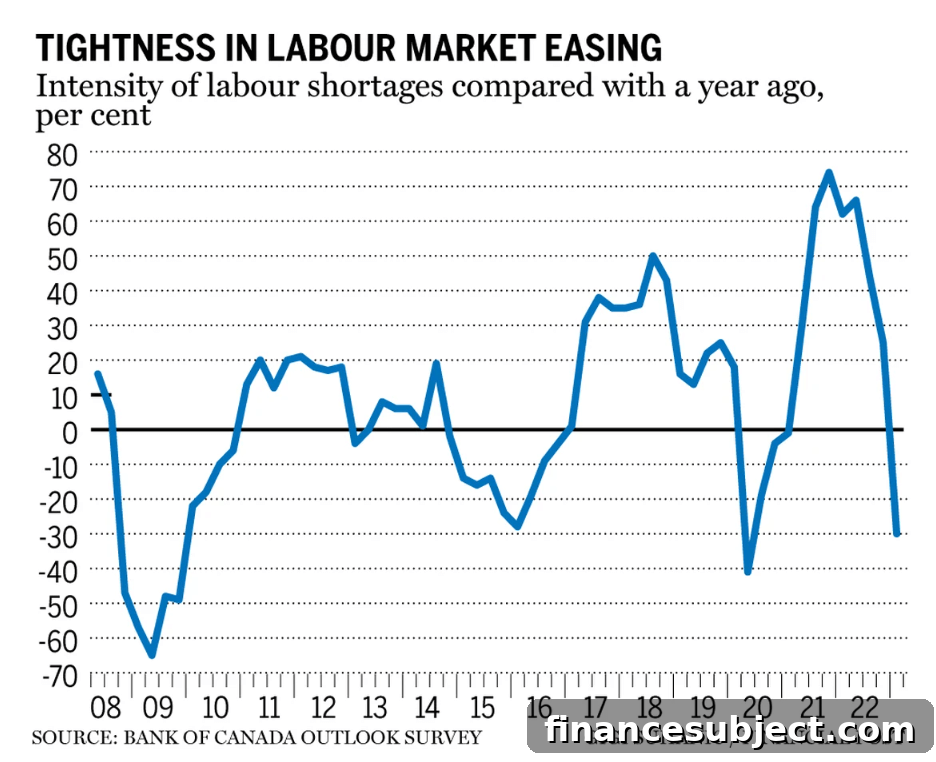
While headline sentiment is cautious, labour market resilience and continuing GDP growth suggest a deep economic collapse is not imminent. That said, the combination of higher energy costs and stubborn inflation expectations means households and businesses will remain sensitive to interest-rate moves.
U.S. labour market cooling may ease Fed pressure
In the United States, the Job Openings and Labor Turnover Survey (JOLTS) showed job openings fell below 10 million for the first time in nearly two years, a drop of roughly 630,000 from January. The decline in openings, together with weaker factory orders and a widening trade deficit, points to a cooling in demand that could give the U.S. Federal Reserve room to pause on further rate hikes.
Sector details show the largest job losses in professional services, while construction added jobs. The unemployment rate held at 3.6%, indicating the labour market remains relatively tight despite a slowdown in openings. A softer labour market would reduce wage pressures and could gradually ease inflation, but the timing and magnitude of any disinflation remain uncertain.
Investors must weigh two key questions going forward:
- How much of the economic slowdown is already reflected in current asset prices?
- Will the slowdown be sufficient to bring down inflation and persuade central banks to relax their restrictive monetary stance?
Inflation remains the dominant variable shaping monetary policy, corporate profits and consumer behaviour across both Canada and the United States.
Kyle Prevost is a financial educator, author and speaker. When he’s not on a basketball court or in a boxing ring recapturing his youth, he helps Canadians with their finances at MillionDollarJourney.com and organizes the Canadian Financial Summit.