
What caught my eye this week.
A lot has changed since Westminster could expect a chancellor to stick to a plan for a year.
Rachel Reeves didn’t manage to keep to hers.
Since the October Budget — and despite earlier intentions to return to a single annual fiscal event — the numbers shifted enough that the government felt compelled to act again.
In the Spring Statement we learned that medium-term growth expectations edged up, but this year’s forecast was revised down sharply: GDP growth for 2025 is now projected at 1%.
As Paul Johnson of the Institute for Fiscal Studies observed:
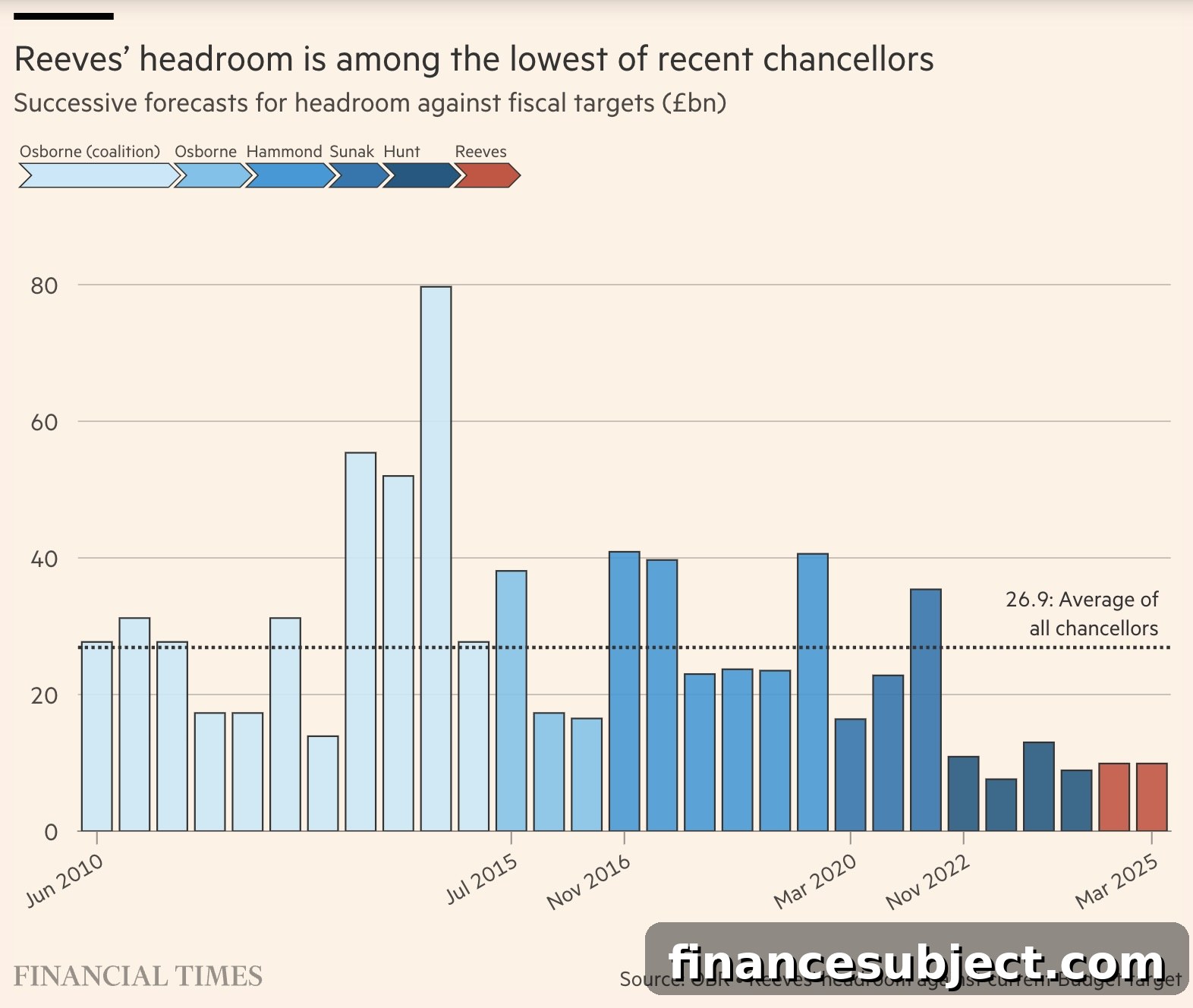
The fact that a fairly run-of-the-mill change to the forecast forced her to cut her spending plans reflects the tiny amount of headroom she chose to leave against her targets last October.
That observation captures the problem: the chancellor left almost no margin for error. What looks like strict fiscal discipline can easily become what I’d call “iron rule theatre” — insisting on tight rules that leave no flexibility when forecasts wobble.
In practice the so-called headroom now looks like a cosmetic adjustment in Number 11’s spreadsheets:
Source: FT
Home and away
Reeves bears some responsibility. By ruling out increases to major revenue-raising levers before the election, the October Budget ended up leaning on a sector already squeezed by recent shocks. The National Insurance rise, for example, risks depressing employment by making jobs more costly and has damaged business confidence.
With the Office for Budget Responsibility cutting its 2025 growth projection from 2% to 1%, there isn’t much of an economic tailwind to rescue public finances.
The West Wing
At the same time, global politics are reshaping business and markets. The US administration’s renegotiation of long-established norms — on defence, trade and alliances — is forcing Europe to reconsider spending, partnerships and strategic priorities. The resulting uncertainty affects inflation, bond yields and investment choices, and it’s not yet clear where policy and markets will settle.
Some argued a Trump win in the US was foreseeable last autumn. Even so, the unpredictability of geopolitical moves makes it impossible to forecast how tariffs, Ukraine policy, and macroeconomic variables will evolve. That uncertainty adds to the fragility of tight domestic fiscal plans.
Neighbours
Labour’s technocratic reforms could produce growth over time. The construction sector, for example, has welcomed planning changes intended to speed housebuilding. Across Europe, pressure from the US to stand more independently may encourage regulatory reform, particularly in tech.
Still, rapid economic recovery feels unlikely. A pickup could arrive if Germany loosens fiscal restraint, the Ukraine conflict eases, inflation falls faster than expected, or interest rates decline sooner. But the baseline outcome remains slow growth.
And Brexit continues to weigh heavily on the UK economy, even if it’s become less fashionable to talk about.
Independent estimates put the economy some £100–140bn smaller than it would otherwise be, and the OBR estimates Brexit reduces annual receipts by around £30–40bn. To put that in perspective: the fiscal “headroom” Reeves fretted about was only about £10bn.
When tax rises or welfare cuts arrive, remember Brexit’s permanent drag on productivity and public revenue. Its effects are structural, not temporary.
Auf Wiedersehen, Pet
Many commentators expect further tax measures later in the year. If that proves correct, the measures will likely be incremental: longer freezes on personal allowances, cuts to ISA limits, or tweaks to capital gains rules. Large headline tax hikes would be politically and economically fraught.
Options for raising meaningful revenue are limited. Capital gains and other allowances have been pared back; pension-related changes and inheritance tax adjustments have already been applied. Higher rates on wealth or CGT could be proposed, but they raise practical and political challenges and may not deliver large sums.
Some on the left advocate a wealth tax, but high-net-worth individuals are already relocating or reconsidering residency in response to policy changes. That migration reduces the potential yield from such measures.
Lower-income households are likely to feel the greatest squeeze, but the middle class is also showing resistance to further tax increases.
Eldorado
One policy that could both stimulate growth and address a pressing social need is a bold housing push. Cutting stamp duty to a low flat rate, for example 1%, combined with a faster, better-funded housebuilding programme could unlock jobs and boost demand in the short term while increasing supply over time.
Reeves did announce a £13bn infrastructure package in the Spring Statement, including funding to train up to 60,000 construction workers. Even so, delivering 1.5m new homes will require an almost wartime-level mobilisation of trades and logistics — a scale of coordination modern governments rarely achieve.
For most people, the practical response remains the same: protect your own future prosperity by using tax-advantaged wrappers where appropriate — ISAs, pensions — because you cannot rely on policy miracles.
More Spring Statement highlights and coverage:
- Government confirms a review of cash ISA arrangements — Morningstar
- Five takeaways from the Spring Statement — Which
- Expectations of further tax rises in the autumn — FT
- Self-employed to face tougher penalties for late tax payments — This is Money
- NS&I adjusts financing targets announced in the Spring Statement — This is Money
Have a great weekend!
From Monevator
Should you keep your NS&I Index-linked Savings Certificates? — Monevator
The pain game — Monevator [members]
From the archive: Reasons to buy a house instead of renting — Monevator
News
Note: Some headlines link to paywalled sources. Consider using private browsing to avoid cookies, and subscribe to sites you read often if you can.
Inflation eased to 2.8% in February, with risks of renewed spikes — Sky
UK board members prepare for a potential wave of takeover bids — CityAM
FCA publishes a five-year strategy focused on supporting growth — FCA
UK fintech investors narrow their focus on likely winners — FT
Mortgage-free homeowners rise as some borrowers clear loans — This is Money
Why London’s property market remains broken — The Standard
The case for alternative investments in an uncertain world — Trustnet
Products and services
Buyers’ market emerges as a surge of homes hits the market — This Is Money
Monzo launches a bill-splitting feature — Which
NS&I, smart meter compensation, investment platform offers and consumer finance stories feature among recent announcements and promotions.
Comment and opinion
Wide-ranging opinion pieces cover behavioural finance, the limits of growth, and debates about wealth taxation and recession-proof investments — sources include This Is Money, Morningstar and independent commentators.
US un-exceptionalism mini-special
Analysis of US market dynamics, the sustainability of US outperformance, and the role of currency risk in global portfolios — perspectives from market commentators and investment researchers.
Crypt-o-crypto
Crypto headlines include partnerships between media and crypto firms, academic research on coordinated pump-and-dump schemes, and continued debate over large holders and memecoin markets.
Robot overlord roundup
AI coverage highlights calls to adopt AI as an intelligence amplifier, explores why many jobs remain resilient to automation for now, and assesses AI’s implications for language professionals and junior roles.
Not at the dinner table
Essays and briefings discuss European strategy, US energy sentiment, renewable responses to geopolitical conflict, and other policy debates shaping the coming years.
Happy talk mini-special
Selected pieces on happiness, relationships and life satisfaction offer readable summaries and practical takeaways for personal wellbeing.
Off our beat
General-interest items cover China’s economic challenges, resilient media platforms, cultural trends, and occasional space-related oddities.
And finally…
“Intensity is the price of excellence.”
– Warren Buffett, The Snowball
If you enjoy these curated links, consider subscribing to receive them weekly. Some items referenced include affiliate links and recommended reading options.