
Can you tell when someone is talking nonsense about money? Hopefully yes — because research shows that the ability to detect financial nonsense predicts better financial well-being.
That conclusion comes from a study titled Individual Differences in Susceptibility to Financial Bullshit, published in the Journal of Behavioral and Experimental Finance. The researchers developed a way to measure how readily people accept impressive-sounding but meaningless financial statements and linked that susceptibility to financial knowledge, behaviour, and well-being.
The paper reports that younger, higher-income men were more likely to be taken in by financial-sounding nonsense. These individuals also tended to be overconfident about their financial knowledge. Conversely, older women with lower incomes were the most sensitive to financial nonsense.
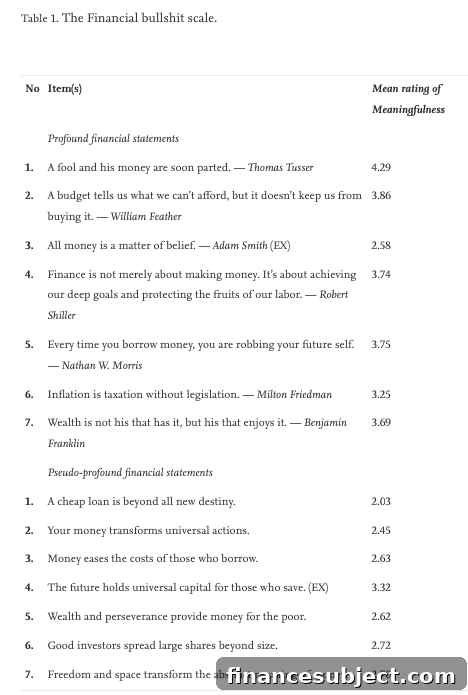
The research team created what they call a Financial Bullshit Scale to test how gullible people are when faced with superficially impressive financial language. The test presented participants with both genuine, historically recognised financial quotes and pseudo-profound statements produced by an online “bullshit generator.” Participants rated each statement for meaningfulness on a six-point scale:
- 1 = not meaningful
- 2 = hardly meaningful
- 3 = slightly meaningful
- 4 = rather meaningful
- 5 = meaningful
- 6 = very meaningful
Participants’ scores for the pseudo-profound statements were subtracted from their ratings of the genuine financial quotes to generate a financial bullshit score. A lower score indicates a greater tendency to be impressed by empty, jargon-filled financial language.
Distinctively synergise competitive vortals
The Financial Bullshit Scale mixed classic financial wisdom — quotes attributed to figures like Adam Smith and Benjamin Franklin — with nonsense items generated from the internet. The goal was to see whether people could reliably distinguish meaningful financial advice from verbose but vacuous jargon.
Beyond the bullshit scale itself, the study assessed participants on several other dimensions: objective financial knowledge, financial management behaviour, numeracy, and cognitive reflection. The researchers then analysed correlations between bullshit susceptibility and real-world financial outcomes.
Scalably reconceptualize market-driven architectures
Financial behaviour was measured using a checklist of common money-management activities, scored on a five-point frequency scale (1 = never; 5 = always). These activities included budgeting, saving, paying bills on time, managing debt, and comparing financial products.
The study also used a short quiz to test objective financial knowledge with true/false items about common financial concepts and products.
Holistically drive high-yield wins
Overall, the findings are reassuring in that most people can detect nonsense to some extent. The study found several clear patterns:
- Women were, on average, better at spotting financial nonsense than men.
- Lower-income participants displayed a stronger sensitivity to bullshit than higher-income participants.
- Higher numeracy, better cognitive reflection (the ability to question intuitive responses), and stronger objective financial knowledge were associated with lower susceptibility to financial nonsense.
The authors suggest that as income rises, consumers may become less vigilant about everyday financial decisions and more prone to being impressed by polished, status-flattering language. That may explain why some higher-income individuals fall for schemes that appeal to prestige and exclusivity.
Participants with higher levels of numeracy, cognitive reflection, and objective financial knowledge were less susceptible to financial bullshit.
But the study also highlights a hidden risk: people who are overconfident — that is, those with low objective financial knowledge but high subjective confidence — were the most vulnerable to financial nonsense. In short, confidence without competence is a liability.
Overconfident consumers (i.e., low objective but high subjective financial knowledge) were most susceptible to financial bullshit.
Proactively actualizing user-centric functionalities
Other noteworthy results included:
The financial bullshit score did not correlate significantly with financial anxiety.
Having a keen bullshit detector did not necessarily make people feel less or more anxious about their finances. However, a lower bullshit score (greater susceptibility) was negatively related to objective measures of financial security. In other words, being easily impressed by empty financial language was linked to weaker financial outcomes.
The researchers speculate there may be an “ignorance-is-bliss” effect for subjective financial well-being: some people may feel fine about their finances despite having lower objective security.
Importantly, being good at spotting nonsense didn’t automatically translate into perfectly disciplined financial behaviour. It did, however, help people judge financial products and marketing claims that rely on fluffy language and buzzwords.
Dynamically delivering organic bovillus faeces?
The authors hope future research will explore ways to improve individuals’ ability to interpret financial communication and navigate the financial landscape. Their broader aim is to inform interventions that boost financial literacy and reduce the impact of misleading marketing.
There is also a practical implication for firms: reducing the use of puffed-up language and excessive jargon may help customers make better decisions and feel more secure. At the same time, businesses could misuse insights from bullshit research to design subtler persuasion tactics, so vigilance remains important.
From experience, the corporate world has a seemingly endless appetite for impressive-sounding language. That makes research into financial bullshit both timely and necessary.
Take care,
The Accumulator
P.S. Please share your favourite examples of financial nonsense in the comments.
P.P.S. The corporate BS generator was helpful in crafting some of the playful subheads used here.
- Published 22 June in the Journal of Behavioral and Experimental Finance.