

If you are retired or approaching retirement, there’s a good chance your principal residence is paid off or close to being paid off. At the same time, many retirees have adult children who are struggling to save a down payment and break into the housing market.
Even though home prices have softened since interest rates began rising in 2022, mortgage affordability remains a challenge for many younger Canadians starting their careers. That makes the new first home savings account (FHSA) — scheduled to begin on April 1, 2023 — especially timely. The FHSA has generated a lot of discussion among financial bloggers and advisors for combining features of existing tax-advantaged accounts.
For retired parents who want to diversify family assets into residential real estate or help children get a foothold on the property ladder, the FHSA is worth understanding. In many households, exposure to real estate beyond the family home comes only through REITs held in ETFs. That avoids landlord responsibilities, but if a family prefers more direct ownership, helping a child acquire a second property could be an option.
One of the key advantages of a principal residence is that it can be sold later without triggering capital gains tax. That tax benefit does not apply to a second property such as a vacation home or a rental, which is an important distinction when families consider intergenerational property transfers.
How retired Canadians can combine the FHSA with HBP, TFSA and other tools
The FHSA joins two well-established programs that retirees and their children can combine to save tax-efficiently for a down payment. The Home Buyer’s Plan (HBP), introduced in 1992, allows first-time buyers to withdraw from RRSPs for a home purchase, and the TFSA, launched in 2009, provides tax-free growth and withdrawals that can be used for any goal, including a down payment.
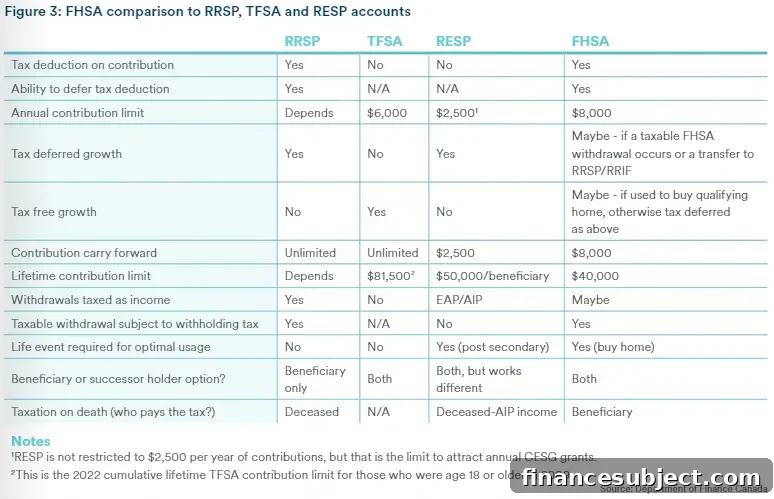
The FHSA is designed specifically for first-time home buyers. Eligible account holders must be at least 18 years old and Canadian. Contributions are tax-deductible like RRSP contributions, up to $8,000 per year with a $40,000 lifetime limit. One important detail is that contributions made within the first 60 days of a calendar year cannot be attributed to the previous tax year, unlike RRSP contributions.
An FHSA can remain open for up to 15 years, until the end of the year the holder turns 71, or until the end of the year after a qualifying FHSA withdrawal is made — whichever happens first. If an account holder opens an FHSA but ultimately does not buy a home, unused funds can be transferred to an RRSP or RRIF on a non-taxable basis, subject to applicable rules. Those transferred funds will be taxed when withdrawn later.
Financial planners describe the FHSA as blending the best features of the RRSP and TFSA: tax-deductible contributions with tax-free qualifying withdrawals. It removes one of the main drawbacks of the HBP, which requires repayment of the withdrawn amount over 15 years and can strain a new homeowner’s budget.
Advisors estimate that with maximum annual FHSA contributions, reasonable investment returns and coordinated use of the HBP and TFSA, a single saver or a couple could accumulate significant down-payment resources over several years. Tax refunds generated by RRSP and FHSA contributions can also be directed into TFSAs to add further tax-free savings potential.
Who qualifies for the FHSA?
Eligibility is straightforward: Canadian residents aged 18 or older who are first-time home buyers. Contributions are limited to $8,000 annually and $40,000 in total. The account offers an immediate tax deduction for contributions, making it attractive for savers who want both a tax break today and tax-free withdrawals when buying a qualifying home.
Account holders who do not end up purchasing a home can avoid penalties by transferring funds to an RRSP or RRIF without triggering immediate taxation. That flexibility can make the FHSA a useful long-term savings vehicle even if plans change.
How parents can help — BOMAD, TFSAs and coordinated strategies
Not every young couple will have the income to fully maximize the FHSA, HBP, and TFSA. Parents who are able and willing to assist can help in different ways, from direct contributions to TFSAs on behalf of adult children, to matching their children’s savings. Some families “top up” a child’s TFSA to reach the annual contribution limit, and those funds can later be moved into an FHSA when appropriate.
It is generally permissible to withdraw money from a TFSA and contribute it to an FHSA. The TFSA withdrawal restores contribution room only on January 1 of the following year, so timing should be considered to avoid over-contributing. Using the TFSA as a short-term reservoir while taking advantage of FHSA tax deductions and subsequent refunds is a strategy many advisors endorse, provided contribution limits are respected.
Even for people who plan to remain renters, the FHSA can have value. Unused FHSA balances transferred to an RRSP or RRIF do not require existing RRSP contribution room, effectively adding up to $40,000 of additional RRSP-convertible capital — a potential estate or retirement planning consideration.
Helping adult children is admirable — but protect your retirement first
Retirees often face a tension between supporting grown children and preserving their own financial security. Advisors urge parents to ensure their retirement needs are fully met before committing significant capital to help others. Assisting earlier in a child’s savings life may have a larger impact than a late-life inheritance, but that assistance should never jeopardize the parents’ financial independence.
One estate-planning nuance to be aware of is how FHSAs are treated at death. Unlike RRSPs or RRIFs, where the plan’s value may be taxed on the deceased’s final return if the beneficiary is not a spouse, tax on an FHSA that passes to a non-spouse may be payable by the beneficiary. Spousal rollovers and successor-holder options do exist and should be considered within overall estate plans to avoid unintended tax consequences.
Although targeted at first-time buyers, the FHSA is an important tool for retirees to understand. It offers a new way to support adult children’s path to homeownership while providing flexibility if plans change and important estate and tax implications that parents should consider as they weigh contributions or transfers.
Jonathan Chevreau is the Investing Editor at Large for MoneySense. He is also founder of the Financial Independence Hub, author of Findependence Day and co-author of Victory Lap Retirement. Contact: [email protected]
Related topics:
- Should you help your adult children to buy real estate?
- Inflation and investments: what retirees should watch
- How much money do you need to retire in Canada?
- The 60/40 portfolio and retirement investing