
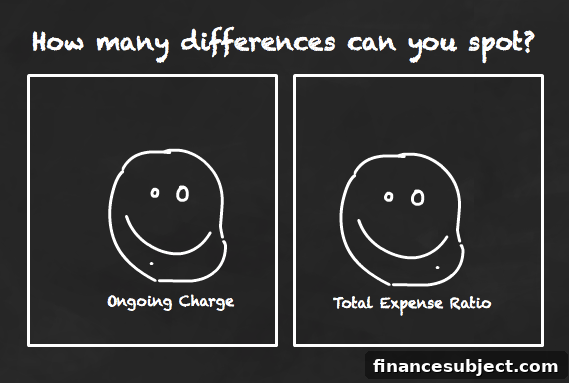
It feels a little like a scene in a movie where the main character is swapped for a near-identical double with a mole in a different spot. While many investors carry on with their routines, the familiar Total Expense Ratio (TER) is being phased out and replaced by the Ongoing Charge.
Both metrics aim to do the same job: give investors a single comparable figure for the cost of owning a fund so different funds can be compared. In practice, though, the difference between them is minor—more a change in presentation than substance.
You’ve got to be KIIDing
The Ongoing Charge appears in the Key Investor Information Documents (KIIDs) that accompany common retail funds such as ETFs, unit trusts, and OEICs. It represents the percentage of a fund holding that is effectively consumed by annual fund costs.
For example, if you hold £1,000 in the fictional Magical Unidirectional Gain ETF (MUG) and the Ongoing Charge is 0.5%, you would effectively pay £5 a year in charges:
£1,000 × 0.005 = £5
That fee is taken from the fund’s returns rather than charged directly to your bank account, and it does not include every cost associated with investing (for instance, broker commissions or platform fees are separate).
In practice, the Ongoing Charge’s list of included expenses mostly mirrors what the TER covered, with only a few technical differences. A quick look at a sample of popular index funds and ETFs shows that Ongoing Charges and TERs are, in most cases, almost identical.
One notable exception is a group of HSBC index funds where the Ongoing Charge is higher than the previously quoted TER. The most pronounced example is a Pacific fund whose Ongoing Charge is 0.46% compared with a TER of 0.37%.
Given how small the differences are, many fund providers even continue to use the terms TER and Ongoing Charge interchangeably on their websites.
The price is not right
The Ongoing Charge was introduced as part of regulatory efforts to simplify investor information and reduce confusion around fund costs. The idea is that a consistent figure shown prominently in the KIID would be clearer than a range of inconsistent cost disclosures. That said, the Ongoing Charge is still not a complete tally of every expense an investor might face.
Significant costs that are typically excluded from the Ongoing Charge include:
- Performance fees – Fees that some active managers charge if they beat a benchmark. These are uncommon for index funds but can be material for active strategies.
- Entry and exit charges – Charges sometimes referenced in fund literature when you buy or sell units. Retail investors usually pay broker dealing costs rather than a separate retail entry charge.
- Trading costs – Broker commissions and other transaction costs incurred when the fund buys and sells holdings. These are often visible only in the annual report under metrics like Portfolio Turnover Rate (PTR).
- Stamp duty – A tax on certain UK equity transactions that shows up in tracking error and annual statements for funds holding UK shares.
Because these items remain outside the Ongoing Charge, the figure is still an approximation rather than a complete “all-in” cost of ownership. It’s useful for quick comparisons between similar funds—especially passive index trackers—but it should not be treated as the only measure of cost.
Think of the Ongoing Charge like the headline price on a low-cost airline ticket: it gives you a starting point, but additional unavoidable costs are often added on later. For investors, that means reading annual reports, PIIDs/KIIDs, and disclosure documents to understand trading costs, performance fees, and any platform or broker charges that will affect net returns.
In short, the move from TER to Ongoing Charge is a step toward clearer disclosure, but it is primarily cosmetic. It helps standardize what appears in the KIID, but it does not by itself deliver a definitive, all-encompassing measure of the total cost of investing.
Take it steady,
The Accumulator
These funds are regulated by the UCITS directives that help create a common market in European investment products.