
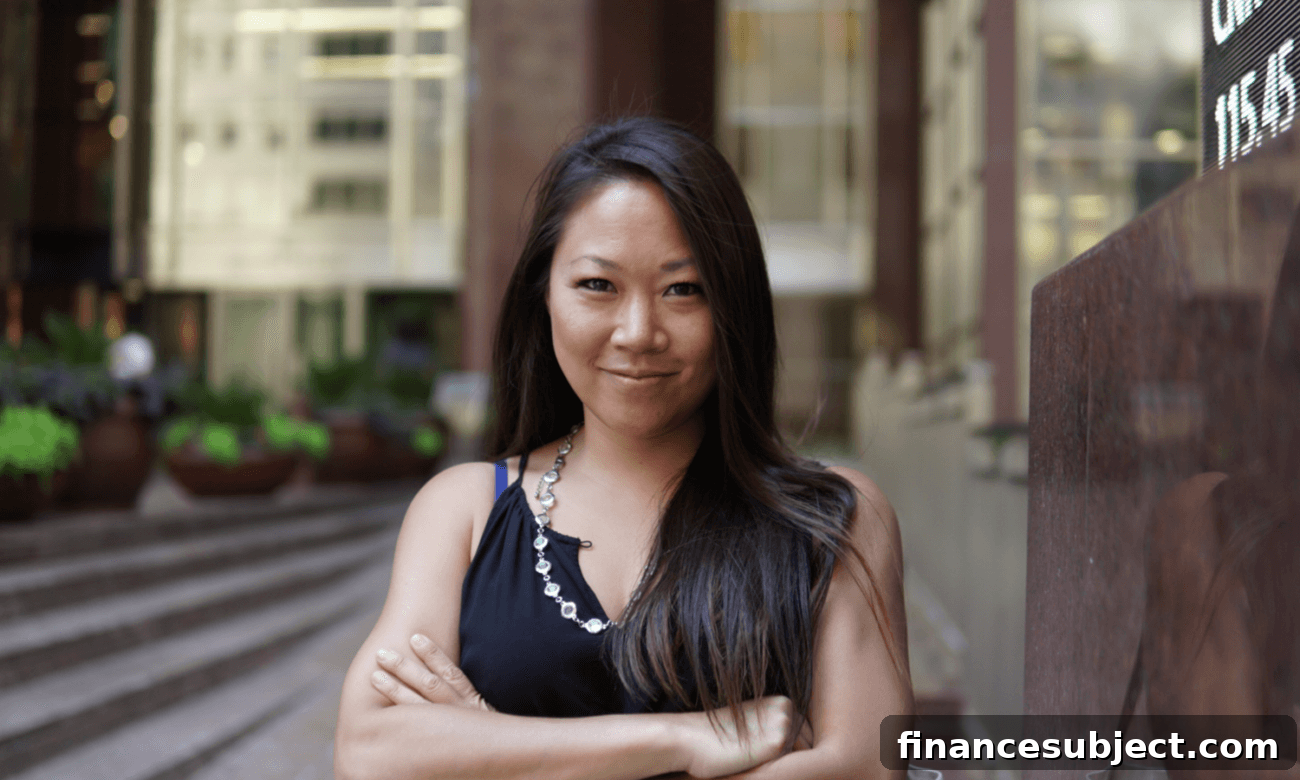
Michelle Hung, known as The Sassy Investor, is a Chartered Financial Analyst and certified financial planner who has authored two books. She discovered her professional worth the first time she confidently asked for a raise. Her latest book, Investing for Teens: How to Save, Invest, and Grow Money (Rockridge Press, 2022), introduces young readers to practical investing and core personal finance concepts. Her earlier workbook, The Sassy Investor (Friesen Press, 2019), is a visual, step-by-step guide to building an investment portfolio. Below, Hung shares her perspectives on money—how to ask for a raise, handle difficult financial conversations with a partner, and tackle credit card debt.
Who are your investing heroes?
My cousin played a huge role in getting me started. He encouraged me to read the work of investors like Warren Buffett and Peter Lynch, which helped me learn the basics of stock investing. He studied business at university and, though I’m not sure how he first became interested in investing, his influence was the catalyst for my own journey.
How do you like to spend your free time?
I enjoy spending time with my partner, family and friends. I practice hot yoga and play soccer several times a week. I also prioritize self-care—simple routines like reading and taking a relaxing facial help me recharge.
If money were no object, what would you be doing right now?
I’d be on a beach in Bora Bora, but I’d still run my business. Personal finance and investing are passions of mine, and I view my work as helping people gain knowledge and confidence—so even with financial freedom, I’d keep contributing in that way.
What is your earliest memory about money?
On a school trip to the zoo, my mom gave me money for McDonald’s and I remember keeping it safe in a small wrist wallet. I was very careful because I knew if I lost it I wouldn’t have money for lunch. It taught me a simple, early lesson about responsibility with cash.
What’s the first thing you remember buying with your own money?
As a child I didn’t buy much, but I remember spending on small outings—movies and meals out with friends were typical early purchases.
What was your first job?
I worked as a cashier at a drugstore/supermarket. I recall immediately depositing my first paycheck at the bank and using part of it to buy a shirt on sale.
What was the biggest money lesson you learned as an adult?
Using buy-now-pay-later options and credit cards irresponsibly is stressful and costly. As a student I accumulated credit card debt and learned the hard way to treat credit cards as payment tools—not as a piggy bank. If I hadn’t had the money, I shouldn’t have made the purchase. Interest charges can be crippling, so using a debit card and living within your means would have been better.
What’s the best money advice you’ve ever received?
Know your value and ask for what you deserve. Early in my corporate finance career I discovered I was being paid less than a peer with less experience. I scheduled a meeting with management and, after a short conversation, they corrected the oversight. I went into that conversation prepared with a clear summary of my contributions, and that preparation is exactly what I now coach clients to do when negotiating raises. Helping people—especially women—advocate for themselves is a major focus of my work.
What’s the worst money advice you’ve ever received?
When I was 17 and a camp counsellor, a colleague advised me to max out his credit card and pay it off with his next paycheck. I followed similar behavior for a while and ended up with debt my paycheques couldn’t cover. That strategy was damaging and taught me to avoid depending on future income to justify current overspending.
Would you rather receive a large sum of money all at once or a smaller amount of money regularly for life?
I’d choose a large lump sum. I prefer to manage a sizable amount directly and decide how best to allocate and invest it.
What do you think is the most underrated financial advice, tip or strategy?
People often believe they must choose between the stock market and real estate, but that’s a false dichotomy. They’re different asset classes with different benefits, and they can coexist in a diversified portfolio if you have the means. Both can play a role in long-term wealth building.
What is the biggest misconception people have about growing money?
Many assume you need a lot of money to get started. Today’s platforms allow people to begin investing with very small amounts—sometimes as little as $20. Growth is slow at first, but consistent investing benefits from compound interest over time. Exchange-traded funds (ETFs) are a low-effort, cost-effective way to build diversified exposure and grow wealth gradually.
Can you share a money regret?
I regret lending money to an ex-partner during university. I helped him financially many times, and even after he secured full-time work, he didn’t repay me. We never had clear conversations about money, and when I asked for repayment he became defensive. I was young and hopeful, and that lack of boundaries cost me financially and emotionally. The unpaid balance, adjusted for lost potential growth, is still a painful reminder.
What does the word “value” mean to you?
Value is the joy or utility something provides relative to its cost. It can be as simple as a satisfying meal or a restorative vacation. Occasionally I’ll purchase a high-quality item—like a designer purse—that lasts a decade. When you amortize the cost over years of use, it can represent excellent value.
What’s the first major purchase you made as an adult?
While at university I bought a house instead of paying rent. I wanted rental income from students to offset costs, and with my parents’ support I researched the market, worked with an agent and made sure the numbers and location made sense. Home prices were much lower then, and I was careful to ensure the investment would perform.
What’s your take on debt?
Less debt is generally better, but there is a distinction between good and bad debt. Borrowing to invest in appreciating assets—like a home, education or a business—can be sensible. Conversely, taking on debt to fund everyday expenses is risky. Families facing rising living costs sometimes rely on credit to meet short-term needs, which highlights the importance of budgeting, saving and living below your means whenever possible.
What was your most recent splurge?
An all-inclusive vacation to Jamaica.
What is the last money-related book you read?
100-Baggers: Stocks that Return 100-to-1 and How to Find Them by Christopher Mayer. As an active stock picker, I’m always looking to refine my strategy and learn from experienced investors.
What is something you always have in your wallet?
I carry one debit card and one credit card, plus a backup set at home. Having a debit card lets me withdraw cash if needed, and a secondary card protects me if my primary credit card is locked while travelling. I also keep two wallets so I always have a spare set of cards if one is lost.
What is your favourite possession?
A teddy bear I’ve had since childhood. If I had to grab only a few things in an emergency, I’d take that bear and a photo album of my dog who passed away eight years ago. Those items hold sentimental value that can’t be replaced.
What’s your next money goal?
To purchase a home in Toronto.
My MoneySense quick questions
Rent or own?
Rent, for now—until buying makes more sense.
Buy or lease?
Buy.
Save or invest?
Invest.
Budget or not?
Budget.
Read more My MoneySense profiles:
- Shannon Lee Simmons on emotional return on investment and personal debt
- Kerry K. Taylor on how buyer’s remorse shaped her spending
- Alyssa Davies of Mixed Up Money on CoastFIRE and valuing time
- Michele Romanow on risk-taking and betting on yourself
- How dating expert Damona Hoffman manages her relationship with money