

Annuities and Retirement: How Longevity Insurance Can Protect Your Savings

People are living longer, which is good news for longevity but a challenge for retirement planning. With defined-benefit workplace pensions becoming rarer and interest rates remaining low for long stretches, many retirees face the real risk of outliving their savings. For individuals without a traditional guaranteed pension, annuities offer a way to transfer longevity risk to an insurer and create a steady, predictable income stream for life.
An annuity works like a private pension: you give capital to an insurance company in exchange for guaranteed payments that continue for as long as you live. In that sense, defined-benefit (DB) pensions, public programs such as the Canada Pension Plan (CPP) and Old Age Security (OAS), and private annuities are all variations of guaranteed lifetime income. Other savings vehicles—defined-contribution plans, RRSPs, TFSAs and non-registered accounts—help build retirement assets but do not, by themselves, guarantee lifetime income unless you convert some of that capital into an annuity.
Many people misunderstand or undervalue annuities. New financial-technology alternatives attempt to provide similar protection under different names—peer-to-peer longevity insurance or investment funds with longevity features—but the fundamental purpose remains the same: to secure a predictable income that lasts for life. One important reason annuities can be attractive even when interest rates are low is the presence of mortality credits. Mortality credits arise because payments to survivors are effectively subsidized by the fact that some annuitants die earlier than others; this shifts value to those who live longer and boosts the actuarial income available to survivors.
Timing is a key consideration. The amount an annuity pays increases with age at purchase, because the insurer expects to make payments for a shorter average remaining lifetime. For that reason, delaying annuitization can increase monthly income. A practical rule of thumb is to consider annuitizing when expected mortality rates exceed prevailing interest rates—when the mortality credits begin to outweigh the loss of investment flexibility. For many people that tipping point occurs in the 70s rather than at retirement in the mid-60s.
Older retirees often face a conversion decision: turning an RRSP into a Registered Retirement Income Fund (RRIF) or buying an annuity. This is not necessarily an either/or choice. Many planners recommend a blended approach: use guaranteed income sources—pensions and some annuities—to cover essential living costs, while keeping other assets invested and accessible to finance discretionary spending and legacy goals. As you progress through your 70s and 80s, gradually increasing the portion of your wealth that is annuitized can reduce the risk of running out of income.
When planning annuitization, consider family circumstances. Once capital is annuitized it generally cannot be reclaimed as a lump sum, and inheritance implications differ substantially from holding liquid investments. Make sure spouses and heirs are included in planning conversations so everyone understands how annuity choices affect future legacy and survivor benefits.
There are important tax differences between registered and non-registered annuities that will affect after-tax income and estate results. Payments from registered annuities are taxed like RRIF withdrawals, and upon death the value may be subject to taxation based on the rules that apply at that time. Non-registered “prescribed” annuities are taxed differently: the interest component is taxable but a portion that represents a return of capital is not. Changes in mortality tables and tax rules—driven by increased longevity—can shift the comparative attractiveness of different annuity types over time, so stay informed before you annuitize.
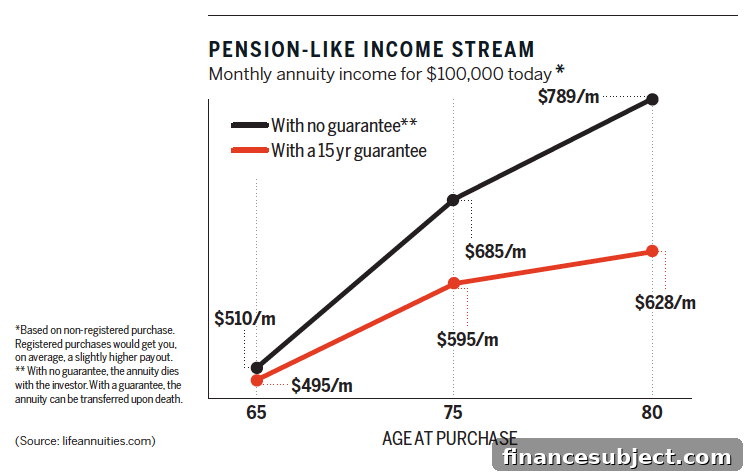
Illustrative examples show how income from an annuity rises with the age at purchase. For instance, a healthy 65-year-old male buying a registered annuity without a guarantee period would receive a lower monthly payment than he would if the same amount were annuitized at older ages; the monthly income typically increases significantly between age 65 and age 80. Similar patterns apply to non-registered annuities, although the taxable treatment differs.
When choosing an annuity, simplicity often wins. Plain-vanilla single-life annuities tend to deliver the strongest mortality credits and therefore the highest income for a given premium. Adding guarantees, minimum periods, survivorship riders or complex features reduces the mortality credits available to the annuitant and lowers monthly payments. That doesn’t mean supplemental benefits are never appropriate, but each feature comes with a trade-off between added protection and reduced income.
In summary, annuities can play an important role in retirement income planning by converting capital into guaranteed lifetime income and shifting longevity risk away from the individual. The decision of when and how much to annuitize depends on your health, family needs, tax considerations and other income sources. A balanced strategy often combines guaranteed income to cover essential expenses with remaining assets held for growth and flexibility, helping ensure a secure and dignified retirement.