Kyle Prevost, editor of Million Dollar Journey and founder of the Canadian Financial Summit, summarizes recent financial headlines and provides context for Canadian investors.
What’s driving inflation concerns? Groceries and housing
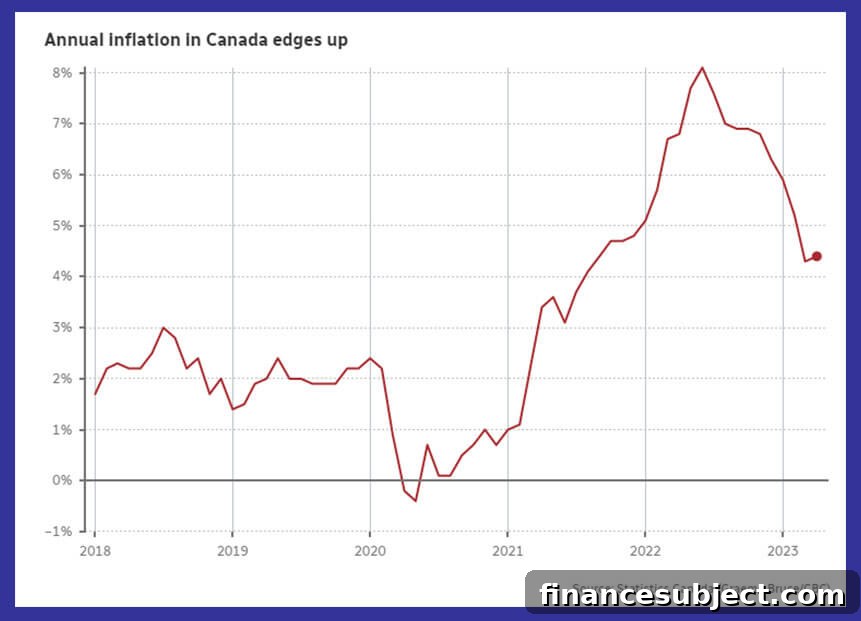
The recent run of encouraging disinflationary signals paused on Tuesday when Statistics Canada reported that the annualized inflation rate for April rose to 4.4%.
That figure is slightly higher than March’s 4.3% and notably above the roughly 4.1% most economists had expected. The move has investors worried that upward pressure on prices could strengthen over the summer—seasonal fuel-price increases being an ever-present risk—and force the Bank of Canada to consider higher interest rates to cool demand. Higher rates would weigh on both bond and equity markets; the S&P/TSX Composite Index fell 1.2%—its worst daily drop in three weeks—after the data release.
Although 4.4% is well below last June’s peak of 8.1%, it remains a meaningful burden for households. Key contributors to the elevated headline rate include:
- Groceries: up 9.1% year-over-year
- Shelter costs: up 4.9% year-over-year
- Health and personal care: up 6.4% year-over-year
- Alcohol and tobacco: up 5.3% year-over-year
Other categories such as clothing, transportation, gasoline and household furnishings experienced inflation below 3%.
The April CPI report arrived shortly after the Canadian Real Estate Association (CREA) released its housing figures showing the average home sale price in April reached $716,000—more than $100,000 higher than at the start of the year. Home prices appear to be rising fast enough that even targeted policies, such as the First-Time Home Buyer Incentive introduced in 2019, have had limited impact on affordability, according to Canada Mortgage and Housing Corporation data. Despite relatively low uptake, the government has kept the program in place through May 2025.
U.S. retailers continue to tread water
U.S. retailers delivered mixed results as they leaned into necessities and inventory control. Wal‑Mart and Target reported solid quarters driven by grocery and essential item sales, while Home Depot missed revenue expectations and warned of tougher trading conditions for big-ticket items. All figures referenced in this section are in U.S. dollars.
U.S. retailer earnings highlights
- Wal‑Mart (WMT/NYSE): earnings per share of $1.47 versus $1.32 expected; revenue $152.30 billion versus $148.76 billion expected.
- Target (TGT/NYSE): earnings per share of $2.05 versus $1.76 expected; revenue $25.32 billion versus $25.29 billion expected.
- Home Depot (HD/NYSE): earnings per share of $3.82 versus $3.80 expected; revenue $37.26 billion versus $38.28 billion expected.
For brick-and-mortar retail, Wal‑Mart continues to dominate. Its earnings beat was driven by stronger grocery and essential merchandise sales that offset weaker electronics and discretionary categories. Despite the beat, the stock gained only modestly as investors remain cautious.
Target reported a positive quarter as well, noting a significant reduction in discretionary inventory—about 25% lower—which helped its results and supported a roughly 3% rise in the share price on the announcement.
Home Depot, by contrast, missed revenue forecasts and saw its shares dip. The company said customers were postponing some large purchases such as patio furniture and grills. Still, Home Depot’s revenue remains substantially higher than pre-pandemic levels, reflecting the renovation boom during lockdowns.
Both Target and Home Depot also reported a sharp increase in organized retail theft over the past year, a worrying trend retailers attribute in part to financial pressure on consumers as prices rise.
READ NOW
Insurance equals stability, it seems
Canadian insurance companies, often less discussed than the big banks, hold a prominent place on the Toronto Stock Exchange. Due to new accounting standards this year, revenue comparisons are limited, but quarterly earnings broadly matched expectations. All figures in this section are in Canadian dollars.
Canadian insurance earnings highlights
- Manulife Financial (MFC/TSX): earnings per share of $0.79 versus $0.80 expected.
- Sun Life Financial (SLF/TSX): earnings per share of $1.52 versus $1.51 expected.
- Great West Life (GWO/TSX): earnings per share of $0.87 versus $0.89 expected.
- Intact (IFC/TSX): earnings per share of $3.06 versus $2.94 expected.
Overall, Canada’s insurance leaders continue to produce steady, predictable results that largely meet analyst expectations. Market reaction was muted, as investors appear comfortable with how these companies are positioned.
To illustrate sector performance, the CI U.S. & Canada Lifeco Covered Call ETF (FLI) is down year to date, while the iShares Equal Weight Banc & Lifeco ETF (CEW) is showing modest gains. FLI has broader geographic exposure and focuses on insurers, whereas CEW concentrates on Canadian bank and lifeco stocks.
The industry faces a headwind from recent tax changes affecting how dividends insurers receive from Canadian equities are treated. Historically, insurers could receive such dividends without additional tax, consistent with corporate tax integration. Under the new rules, those dividends are classified as business income and will be taxable. Executives have warned this could increase the effective tax burden on Canadian insurers relative to some foreign competitors; one CFO suggested the change could raise tax costs by a couple of percentage points overall, translating into millions per quarter for large insurers.
READ NOW
Canadian energy titans continue to post strong profits
Major Canadian energy producers benefited from elevated oil and gas prices and reported solid quarterly profits. All amounts in this section are Canadian dollars.
Canadian energy highlights
- Suncor (SU/TSX): earnings per share of $1.36 versus $1.27 expected; revenue $12.26 billion versus $10.61 billion expected.
- Canadian Natural Resources (CNQ/TSX): earnings per share of $1.69 versus $1.67 expected; revenue $8.63 billion versus $8.46 billion expected.
- Cenovus (CVE/TSX): earnings per share of $0.26 versus $0.29 expected; revenue $12.86 billion versus $14.16 billion expected.
Despite Suncor’s earnings beat, its shares are down year to date and considerably lower than a year ago. Canadian Natural Resources, the largest and most diversified of the group, has performed better year to date but still sits below last year’s level. Cenovus has seen declines both year to date and over the past 12 months.
Dividend investors often point out that periodic share-price moves don’t capture the full return story, since many energy companies have been paying generous dividends and, in some cases, special payouts in recent years. Commodity-driven businesses naturally experience volatility as global demand forecasts and geopolitical developments sway oil and gas prices. Overall, shareholders of large Canadian energy producers have benefited from strong profitability over recent years, even if share prices fluctuate.
Market sentiment has also been affected by ongoing debate and headlines around the U.S. debt ceiling, which can drive short-term volatility. In coming weeks, investors will be watching for developments and assessing how much downside risk the situation poses to markets.
Kyle Prevost is a financial educator, author and speaker. When he’s not on the basketball court or in the boxing ring trying to recapture his youth, he helps Canadians manage their finances at MillionDollarJourney.com and through the Canadian Financial Summit.
This article or content package is presented by an advertising partner.
It was independently produced by MoneySense and is presented with financial support from the partner.