

Kyle Prevost, editor of Million Dollar Journey and founder of the Canadian Financial Summit, summarizes current financial headlines and explains what they mean for Canadian investors.
BoC pauses rate hikes and forecasts 3% inflation this year
On Wednesday, the Bank of Canada (BoC) chose to hold its key policy rate at 4.5%, continuing its effort to bring inflation down without tipping the economy into distress. The pause was widely anticipated after February’s consumer price inflation eased to 5.2%, signaling a clear downward trend.
Most notably, the BoC now expects headline inflation to fall to about 3% by mid-2023. The central bank cautioned that predicting the timing of the final move from 3% to its 2% target will be more uncertain. If the economy manages to retain full employment and modest GDP growth, a path to 3% inflation without severe disruption looks feasible.
Governor Tiff Macklem emphasized that restoring price stability remains the Bank’s priority, noting that the job is not finished and that the BoC will remain focused on its inflation mandate. That tone reinforces the view that interest rates are likely to stay “higher for longer.”
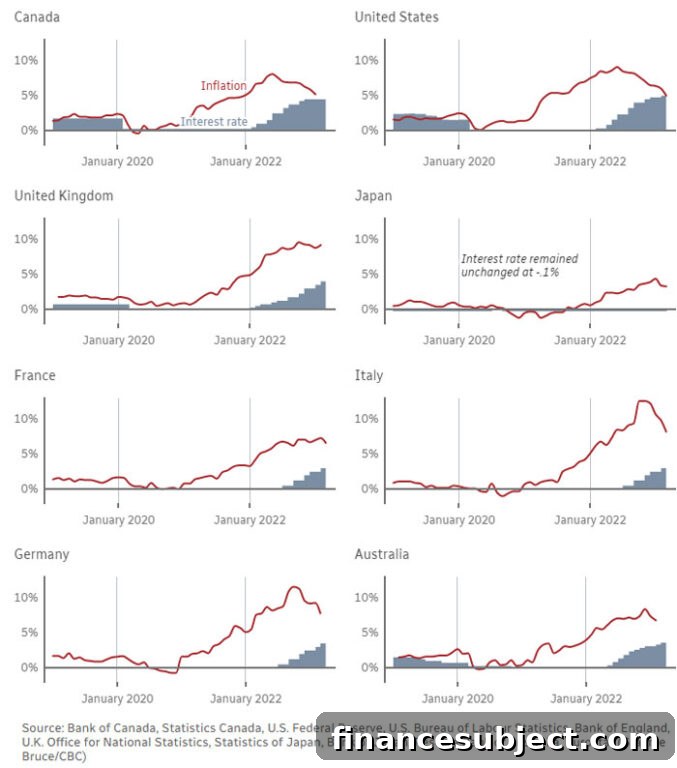
Another important but less discussed tool is the BoC’s balance sheet management—how many government bonds it holds and sells back into the market. By reducing bond holdings, the Bank withdraws cash from the financial system and allows market yields to rise to levels that attract investors without pushing the policy rate higher.
During the pandemic the BoC’s balance sheet expanded from roughly $120 billion in March 2020 to more than $575 billion at its peak in March 2021. Since April 2022 it has been shrinking that footprint by allowing bonds to mature and by selling bonds. As of February the balance sheet was about $393 billion, indicating the Bank still has significant room—sometimes called “dry powder”—to tighten monetary conditions without further hiking the policy rate.
For savers, especially Canadians who own their homes outright or retirees with limited debt, a sustained 4.5% policy rate can be welcome news because it supports attractive yields on low-risk products. By contrast, borrowers with mortgages maturing soon will feel the pressure from higher borrowing costs.
Put your money where your mouth is
If you want to track food-price volatility, resources like the Inflation Cookbook compare weekly prices for hundreds of grocery items across Canadian retailers—useful context for household inflation trends.

TINA meets TIAA: why low-risk yields matter again
Before and during the pandemic many investors assumed “There Is No Alternative” (TINA) to equities, given low bond yields and high stock valuations. With interest rates at multi-year highs and inflation showing signs of slowing, the landscape has shifted: there now appears to be an attractive low-risk alternative to owning stocks—what some call “There Is An Alternative” (TIAA).
Higher yields on short-term fixed-income products—GICs in Canada, CDs and Treasury bills in the U.S.—have driven renewed interest in low-risk savings. Search trends for terms like “yield,” “Treasury bill,” “certificate of deposit,” and “money market” have surged, indicating more investors are exploring safer yield-bearing options.
As money flows down the risk spectrum, some capital will likely move out of dividend-paying equities into GICs and bonds. Whether inflows into dividend stocks from riskier corners of the market—such as growth shares or cryptocurrencies—will offset those outflows remains to be seen. For Canadians considering low-risk income options, I’ve written about the best conservative investments and how to balance fixed income within a diversified portfolio.
U.S. inflation eases as monetary pressure builds
The U.S. Labor Department reported that the consumer price index (CPI) rose just 0.1% in March and was up 5.0% year over year. This marks a notable slowdown from the peak inflation levels seen last year and reflects cooling price pressures in several categories.
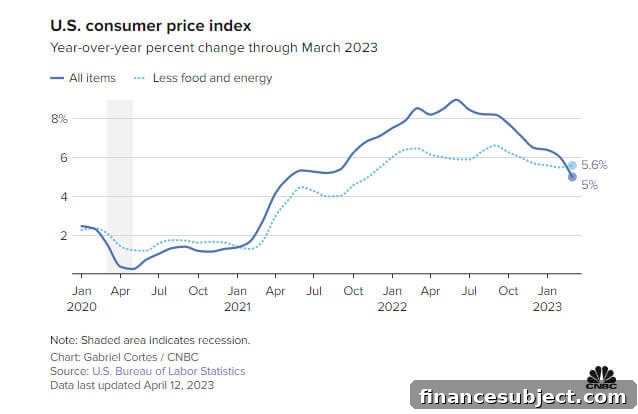
Key takeaways from the U.S. CPI release included:
- Shelter costs remained elevated, up 8.2% year over year.
- Food prices fell 0.3% in March—the first monthly decline since September 2020—but are still 8.4% higher than a year ago.
- Used vehicle prices dropped 0.9% in March and were down 11.2% year over year.
Following the report, U.S. equities rose and Treasury yields eased as markets reduced expectations for further aggressive rate hikes from the Federal Reserve. Still, surveys of consumer inflation expectations show near-term concerns remain elevated, highlighting the challenge central banks face in anchoring public expectations and bringing inflation down to the 2% goal.
U.S. bank stress and what it means for Canadian banks
As the Fed’s campaign to tame inflation reduces the need for additional rate hikes, pressure on U.S. bank balance sheets should ease. However, regional banks with a high share of uninsured deposits remain more vulnerable than larger, diversified institutions.
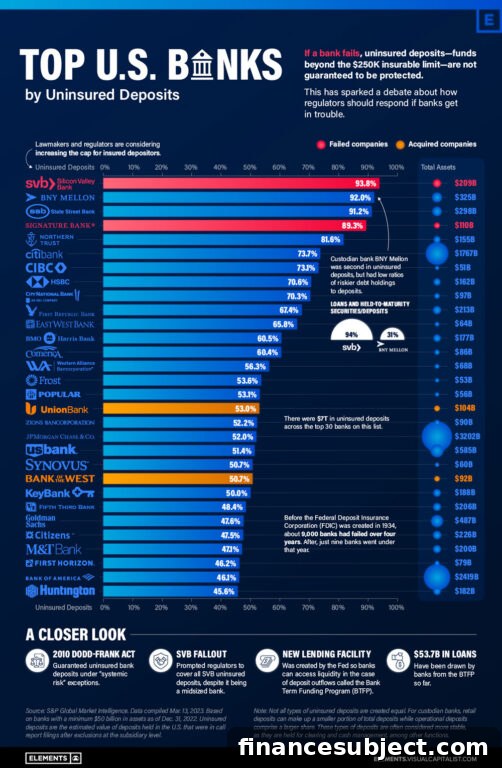
Canadian bank exposure to the U.S.
From a Canadian investor’s perspective, a few cross-border exposures are worth noting:
- CIBC’s U.S. unit, CIBC Bank USA, is a subsidiary acquired in 2017 and represents one of the more significant U.S. exposures among Canadian banks.
- City National Bank, acquired by RBC in 2015, also holds a meaningful level of uninsured deposits.
- BMO’s U.S. presence includes Harris Bank (owned since 2010) and the ongoing integration of Bank of the West.
- TD’s proposed acquisition of First Horizon has drawn scrutiny, and recent U.S. banking turbulence has been cited in discussions about the deal terms.
These U.S. operations are generally smaller parts of the Canadian banks’ overall businesses, but stability in the U.S. financial system is reassuring for Canadian bank investors. A more stable U.S. outlook reduces the tail risk that cross-border banking exposures could present to Canadian bank earnings and capital.
Kyle Prevost is a financial educator, author and speaker. When he’s not on a basketball court or in a boxing ring trying to recapture his youth, he helps Canadians with personal finance at MillionDollarJourney.com and through the Canadian Financial Summit.