

With an average management expense ratio (MER) of about 0.09% and combined assets under management (AUM) approaching $40 billion, many exchange-traded funds provide a low-cost way for Canadian investors to access U.S. equities. Popular examples include the Vanguard S&P 500 Index ETF (VFV), the BMO S&P 500 Index ETF (ZSP) and the iShares Core S&P 500 Index ETF (XUS). These ETFs give broad exposure to the U.S. large-cap market, though Canadian investors should be aware of dividend withholding tax and other considerations when choosing a fund.
Yes, holding these U.S.-listed equity ETFs means a 15% withholding tax on dividends for Canadian residents, but many investors accept that trade-off to gain exposure to the S&P 500—a benchmark that has historically outperformed a large portion of active U.S. large-cap managers. Still, VFV, ZSP and XUS are not the only routes into U.S. equities, nor are they always the lowest-cost options.
Tools
MoneySense’s ETF Screener Tool
Exploring cheaper alternatives
Beyond the well-known S&P 500 ETFs, there are lower-fee alternatives that track different U.S. large-cap indices. Two notable examples are the TD U.S. Equity Index ETF (TPU) and the Desjardins American Equity Index ETF (DMEU). TPU launched in March 2016 and DMEU in April 2024. Rather than licensing the S&P 500, these funds track Solactive indices—the Solactive US Large Cap CAD Index (CA NTR) for TPU, and the Solactive GBS United States 500 CAD Index for DMEU. The “CA NTR” designation indicates a net total return index that accounts for withholding tax, giving a clearer picture of returns for Canadian investors.
By using Solactive indices instead of a licensed S&P index, these ETFs avoid index licensing fees, which helps keep management costs low. TPU charges a management fee of 0.06% and reports a total MER of 0.07%. DMEU lists a management fee of 0.05%; as a newer fund its full-year MER is still being established but is expected to be competitively low.
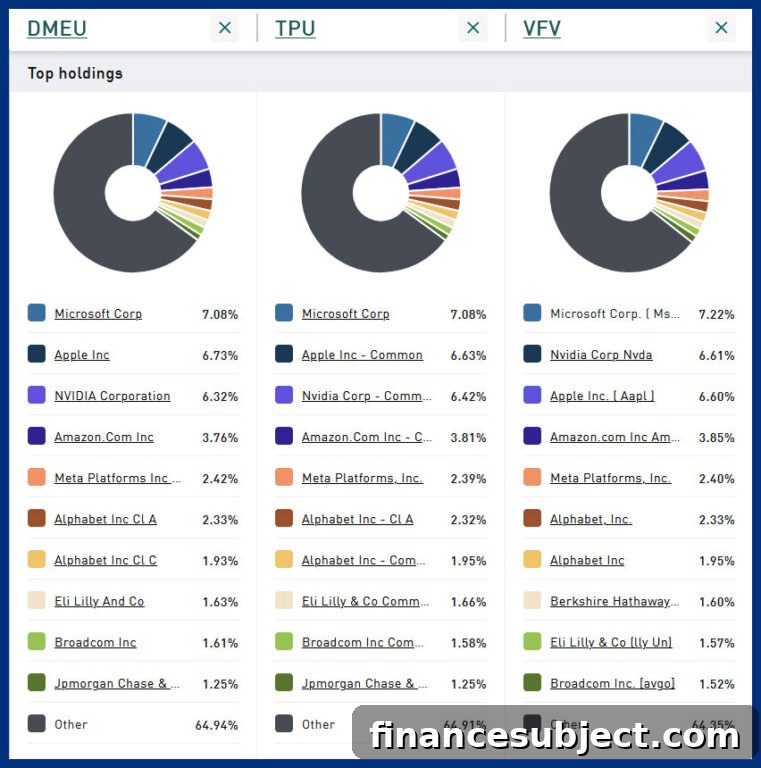
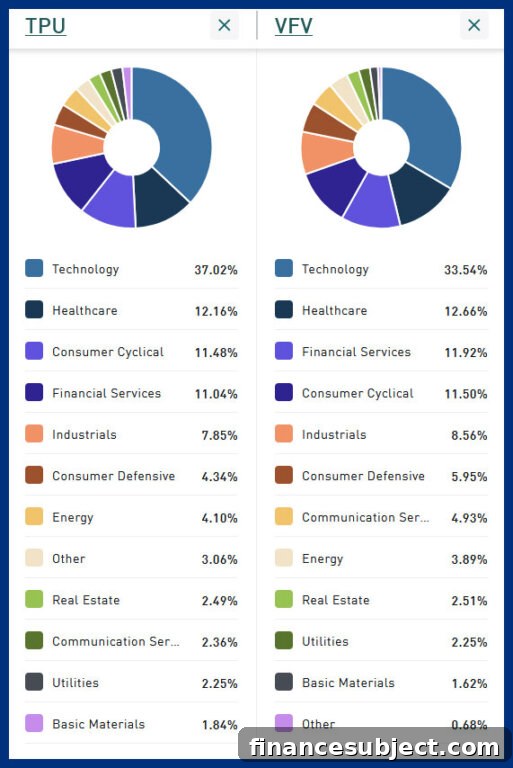
What’s the difference between VFV, TPU and DMEU?
On the surface, VFV, TPU and DMEU look very similar. Their top holdings and sector weightings mirror each other closely because all three funds target the largest U.S. companies. That means most investors will see broadly similar long-term performance across them, with only small deviations arising from index methodology and tracking differences.
Where the funds differ is the index construction. The S&P 500 is a rules-based index overseen by a committee; inclusion requires meeting criteria such as market capitalization, liquidity, public float and positive earnings. That committee oversight introduces an element of discretion beyond simple market-cap weighting.
Solactive indices used by TPU and DMEU take a more mechanical approach: they track the largest 500 U.S. stocks by market capitalization with minimal extra screening. This leads to a more purely passive index methodology compared with the committee-guided S&P 500.
Do the differences matter for Canadian investors?
For most long-term Canadian investors, the practical answer is: not much. Over time, TPU, DMEU and VFV are all likely to deliver similar returns, with only minor statistical differences. Liquidity should not be a major concern either. Although TPU and DMEU trade at lower volumes than VFV, the underlying holdings are highly liquid U.S. large-cap stocks, which typically keeps bid-ask spreads narrow—often just a few cents—so trading costs remain low.
A more important distinction for taxable accounts is how these ETFs interact with tax-loss harvesting rules. Because TPU, DMEU and VFV track different indices, they are not considered “substantially identical” for Canada Revenue Agency superficial loss rules. That means an investor can sell one ETF to realize a capital loss and reinvest immediately in a different ETF with materially similar exposure without triggering the 30-day superficial loss restriction. This allows investors to remain invested while capturing tax losses for later use against gains.
What is tax-loss harvesting?
Tax-loss harvesting is a strategy used in non-registered accounts to reduce taxes by selling investments that have declined in value, creating capital losses that can offset capital gains. Losses can also be carried back or forward according to tax rules. When deploying this strategy, investors should be mindful of the superficial loss rule and use non‑substantially identical ETFs if they want to maintain market exposure immediately.
The value of brand versus cost for ETFs
The S&P 500 has strong brand recognition, and many investors choose ETFs that explicitly track it because of familiarity and its historical track record. That preference has value, but it can come at a small ongoing cost. Lower‑fee alternatives such as TPU and DMEU reduce expenses slightly, and over decades those savings can compound into meaningful differences in portfolio value.
Choosing between a branded S&P 500 ETF and a lower-cost Solactive-based equivalent is ultimately a personal decision. Consider fees, tax implications, index methodology, and your comfort with brand versus cost. For investors focused on minimizing fees without materially changing risk or sector exposure, the Solactive-based ETFs provide a viable and cost-effective alternative.
More on ETF investing:
- Fractional trading and its role for new and younger investors
- Best ETFs in Canada for 2024—what to consider when choosing funds
- How market commentary and central bank actions can influence ETF performance
- Understanding how markets respond to U.S. Federal Reserve decisions