
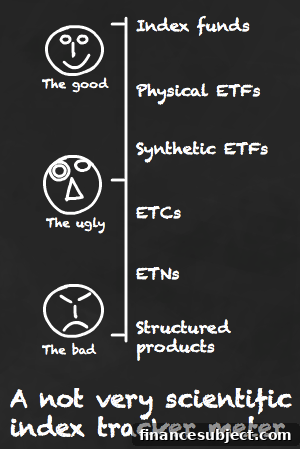
Commentators often portray index trackers as simple, vanilla funds—harmless choices even for novice retail investors. In reality the investment industry constantly evolves, producing products that look like friendly trackers but hide significant risks beneath the surface.
Many different products are marketed as index trackers. For clarity, in my own writing I usually use the term to refer specifically to index funds and ETFs. Other tracker-style vehicles exist, however, and they carry features and dangers you should understand before investing.
Index funds
Traditional low-cost index funds are the most straightforward trackers and should usually form the backbone of a passive portfolio. Key features:
- They typically hold a diversified basket of equities or bonds.
- They usually physically own the assets that make up the index, although some funds may hold a representative sample rather than every security.
- Being open-ended, their price generally reflects the value of the underlying holdings closely.
- Purchases are priced once per trading day.
- When bought through percentage-fee platforms, they usually don’t trigger separate trading charges, making them cost-efficient for long-term investors.
Physical ETFs
Physical Exchange Traded Funds (ETFs) are very similar to index funds in terms of replication but they trade on exchanges and have a few practical differences:
- You buy and sell them through brokers on the stock market.
- They trade throughout the day, so you can execute intraday transactions like with shares.
- Trading commissions and spreads can add to costs, so ETFs are often more cost-effective for larger or consolidated investments.
- There is a huge range of ETF products that allow you to fine-tune exposure across markets, sectors, or asset classes.
Synthetic ETFs
Synthetic ETFs can be more complex and carry extra risk compared with physically-replicating ETFs. They function similarly in terms of trading, but differ in how returns are generated:
- They do not directly own the underlying index securities.
- Instead, they use a total return swap or similar derivative arrangement with a counterparty to deliver the index return.
- This exposes the fund to counterparty risk if the swap provider defaults.
- Regulation in Europe generally limits direct counterparty exposure to a portion of the fund’s net assets, and collateral practices are intended to protect investors.
- Synthetic structures can be useful in markets where physical replication is difficult, but they require a full understanding of the additional risks involved.
Investment Trust trackers
Investment Trusts described as trackers are relatively rare but deserve attention. They resemble physical ETFs in that they are listed and trade in real time, yet they are closed-ended funds:
- They have a fixed number of shares in issue, so the market price reflects both the value of the underlying holdings and supply and demand for the trust’s shares.
- As a result, trusts can trade at a discount or premium to their net asset value, and this discount/premium can widen or narrow independently of the underlying index movements.
- You can therefore make or lose money based on changes in the discount even if the tracked index is static.
ETCs – commodity or currency tracking
Exchange Traded Commodities (ETCs) and Exchange Traded Currencies aim to track commodity prices or currency pairs, but their mechanics differ from equity ETFs and bring unique risks:
- Only a minority of commodity ETCs actually hold physical metals; most track futures markets rather than spot prices, and returns from futures can diverge from spot returns due to roll costs and contango/backwardation.
- Some ETCs focus on single commodities while others provide basket exposure.
- Many ETCs are structured as debt instruments to avoid certain diversification rules, which can expose investors to counterparty risk.
- ETCs typically do not pay dividends.
ETNs and Certificates
Exchange Traded Notes (ETNs) and certificates are debt instruments issued by a bank or similar entity that promise to return the performance of an index. They can be inexpensive and provide access to niches that might otherwise be hard to reach—but they have clear downsides:
- The issuer’s solvency matters: if the issuing bank fails you may lose your investment.
- Underlying assets are not directly owned by the product.
- Counterparty risk can be significant, sometimes up to the full value of the product.
- These instruments often achieve low tracking error relative to the index because they are structured to deliver the index return minus fees.
Structured products
Structured products that are marketed as trackers form a broad and complex group. They typically promise tailored payoffs, sometimes including principal protection if held to maturity, but their mechanics are driven by derivatives and issuer structures:
- They are usually closed-ended and have a defined lifespan.
- Any capital protection typically applies only if you hold until maturity and subject to the issuer’s creditworthiness.
- The payoffs depend on derivative contracts, creating counterparty risk.
- They often forfeit dividends and can be difficult to understand or value for retail investors.
What you track matters mightily
Even if you choose a perfectly plain index fund or a physically-replicating ETF, that does not automatically mean you have simple, vanilla exposure. Two separate decisions matter: the vehicle you use and the index the vehicle tracks.
Some funds follow mainstream indices such as the FTSE 100, the S&P 500, or a global total market index. Others track highly specialised or manager-created indices that focus on narrow themes—examples include robotics, youth-oriented consumer companies, or defence firms. These niche exposures can be speculative and often unsuitable for a sober passive investor focused on long-term diversification.
You will also encounter leveraged ETFs that attempt to double daily upside or downside, and these are generally inappropriate for buy-and-hold investors because they reset daily and can produce unexpected long-term results.
More conservative variations include factor-based or “smart beta” indices that target return premiums by tilting toward value, profitability, or other factors. These funds aim to boost long-term returns modestly, but they come with their own risks and potential underperformance periods, so research and a clear understanding of objectives are essential.
In short: choose both your tracker vehicle and the index it replicates with care. Vehicle structure determines risks such as counterparty exposure, trading costs, and pricing mechanics; the index determines the economic exposure and long-term return potential.
Take it steady,
The Accumulator