
What now? Money-weighted? That might sound like a new humblebrag — as if you’ve got so much money it needs weighing. In reality, “money-weighted” is a practical, widely used way to measure investment performance for everyday investors.
I use the money-weighted return method to track the Slow & Steady passive portfolio. If you’ve asked for a copy of the Slow & Steady portfolio tracker spreadsheet over the years, here’s the cleaned-up version I use. Copy the template and adapt it to your own needs.
Why focus on the money-weighted return? Because headline figures such as “The FTSE 100 has gone nowhere for 20 years” rarely match an individual investor’s experience. The financial industry typically reports time-weighted returns for funds and indices, but different methods serve different purposes. A money-weighted return better reflects your personal performance because it takes your actual cash contributions and withdrawals into account, capturing the effect of behaviours such as regular monthly investing (pound-cost averaging) or large market-timing moves.
Money-weighted vs time-weighted returns
Think of it as a clash of accounting approaches:
Time-weighted returns – This is how indices and many funds report performance. Time-weighting neutralises the impact of investor cashflows in and out of the portfolio, treating each time period equally. That makes sense for a fund manager who wants to show how an underlying strategy performed regardless of client subscriptions or redemptions.
Money-weighted returns – This method includes the timing and size of contributions and withdrawals. Periods when you had more capital at risk carry more weight in the calculation. For individual investors who add, for example, £500 a month rather than a single £6,000 lump sum at the start of the year, money-weighted returns are often a more accurate reflection of the personal experience.
If you made a large withdrawal to avoid a market fall, or bet big on an anticipated surge, comparing your money-weighted return to your time-weighted return can tell you whether your timing added or reduced performance.
XIRR: the money-weighted annualised return formula
XIRR is the standard spreadsheet formula for calculating a money-weighted rate of return on an annualised basis. All you need are dates and amounts for contributions and withdrawals, plus the current value of the portfolio or holdings. Because XIRR accounts for the timing of cashflows it produces a personal return specific to your account history — two investors holding the same fund may see different XIRR results if they contributed and withdrew at different times.
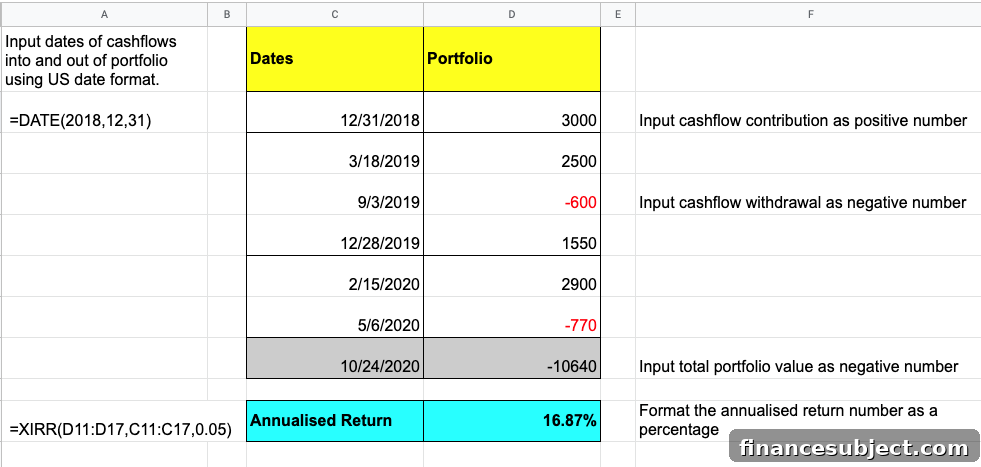
To use XIRR, list each cashflow (positive for contributions, negative for withdrawals) alongside the corresponding date, and include the current total portfolio value as a final cashflow on its date. The XIRR function in Excel or Google Sheets will then return an annualised rate. In the spreadsheet example, XIRR produced an annualised return of 16.87% for that set of cashflows and valuation.
Keep the dates column formula consistent and ensure the XIRR range includes all cashflows plus the ending portfolio value row. The final rows in the XIRR range should point to the total portfolio value line in your sheet.
XIRR: what counts as cashflow
- Do not include dividends as positive cashflows when you are measuring total return and you reinvest them. Their impact is already reflected in the portfolio’s market value.
- Dividends you withdraw from the account do count as negative cashflows, because they reduce the portfolio’s total value.
- Platform fees, dealing fees and other expenses taken from the account do not need to be listed separately as negative cashflows if they were paid from the account: the cash you originally added covers them and the portfolio value will already be lower as a result. If you pay fees from a separate account, then include those payments as negative cashflows.
- Selling an investment to cash and immediately reinvesting within the same portfolio is not a cashflow for XIRR purposes. Withdrawing cash from the portfolio is a negative cashflow.
You can aggregate multiple accounts into a single XIRR figure by pooling all cashflows and values in one sheet. That makes it straightforward to produce a consolidated money-weighted return across accounts.
XIRR: trouble-shooting and practical tips
Make sure positive and negative signs are entered correctly. A common error is the spreadsheet showing a #NUM! result — this often indicates the ending total portfolio value cell wasn’t updated or that the XIRR formula ranges weren’t adjusted after adding new cashflow rows. Another cause is the XIRR function’s initial guess parameter; try different guesses between -0.1 and 0.1 if you encounter errors.
Remember that XIRR annualises returns. Short-term gains can look huge on an annualised basis: a 10% gain in a single month equates to a very large theoretical annualised return if extrapolated. For practical tracking, consider using a year-to-date XIRR calculation for partial-year performance, then switch back to the standard annualised XIRR once you’ve completed a full 12-month period.
There are variant XIRR formulas that account for specifics such as leap years if you need precise day-counting. To convert a nominal XIRR to a real return, subtract the average annual inflation rate for the same period from the annualised result.
XIRR is a robust and accessible measure for most investors, but it is not perfect. If you find yourself in an unusual situation or need detailed forensic accounting of returns, other measures and deeper discussions exist in specialist forums.
Practical resources and templates
The Slow & Steady portfolio tracker template demonstrates how to track annualised money-weighted returns across multiple funds — see the Cashflows tab to understand how XIRR is applied. Building a personalised spreadsheet tailored to how you think about your finances is a useful exercise and helps you stay engaged with your investments.
There are many community-created trackers and portfolio managers that offer both money-weighted and time-weighted calculations. If you prefer a ready-made tool, use it to learn and then adapt ideas from it to your own customised spreadsheet.
How do you track your returns? Share your approach with other investors and consider using money-weighted returns alongside time-weighted figures to get a fuller picture of performance.
Take it steady,
The Accumulator