


When I began my quest to become a so-called “millennial millionaire,” I didn’t expect it to be this simple. All it took was opening a practice investing account through an online broker. The practice account came loaded with more than a million dollars in simulated Canadian and U.S. currency—enough to try out investing strategies without risking real cash.
I had to use a practice account because my primary bank doesn’t offer a demo option, and the brokers that do tend to require an active client relationship. That said, getting started was straightforward: the practice account gives you 30 days for a trial, and many platforms let you open another trial afterward if you want to keep practising.
Missed an article? Catch up on Making Bank here
Opening the account was the easy part. The platform itself felt overwhelming at first — tickers everywhere, columns labeled “Mkt value,” “order type,” and “limit price.” If you’re new to investing, that interface can feel like a foreign language. I had a short moment of panic, too. Fortunately, my job gave me some familiarity with the terminology, though I double-checked a few things just to be sure.

Once I got the hang of the interface, I had to decide how to allocate the simulated funds. I split the Canadian portion of my practice cash—$500,000—into a “couch potato” style portfolio using ETFs. Specifically, I assigned 40% to the BMO Aggregate Bond Index ETF (ZAG) and 20% each to the iShares Core S&P/TSX Composite Index ETF (XIC), iShares MSCI EAFE IMI Index Fund (XEF), and the Vanguard Total U.S. Market ETF (VUN).
I chose that mix because I wanted to experiment with ETFs rather than a single balanced or mutual fund. ETFs typically have lower management expense ratios (MERs), which matters when you’re hypothetically managing a large sum. The ETF portfolio I built has an estimated MER of 0.13%, which on $500,000 equates to about $650 a year. By comparison, the balanced fund where my real money sits likely has an MER closer to 2%, which would amount to roughly $10,000 a year in fees on the same principal.
In real-life investing, those fee differences can seriously affect long-term returns, so trying different fee structures in a practice account is a useful exercise. That said, the simplest couch potato option—putting all your money into a single diversified fund such as those offered by some robo-advisors—remains attractive for hands-off investors. You set up automatic contributions, and over time you build wealth with minimal effort and little anxiety about day-to-day market moves.
For the purpose of this experiment, though, I opted for a slightly more hands-on ETF approach. It requires more setup and monitoring than a one-fund solution, but it’s cheaper and gives more control over asset allocation. With half a million in simulated Canadian dollars allocated to the couch potato mix, I used some of my remaining practice funds to take more concentrated risks.
On the U.S. side of the practice account I invested roughly US$95,000 in Apple (AAPL). Apple dominates my social circle’s phone choices, and I decided to test how a concentrated bet on a major tech company would perform as part of a broader mock portfolio.
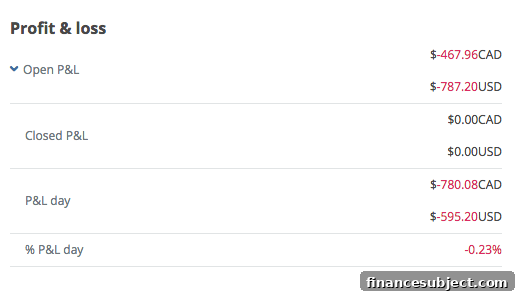
After the first day of trading, my practice portfolio showed a small loss. The account was down around $780, which could be the result of market movement, trading costs, or initial spreads. Even though the money is virtual, seeing a loss still stings. It’s a useful reminder that short-term volatility is normal and that the right perspective for most investors is long-term holding rather than reacting to daily swings.
The practice account gives you room to make mistakes and learn without financial consequence. It’s an excellent environment for testing allocation strategies, comparing fee structures, and becoming comfortable with trading mechanics and order types before you commit real money. If you’re considering moving from a single diversified product to a DIY ETF approach, a simulated account is a low-risk way to evaluate whether the extra effort is worthwhile for your goals.
Read more about Prajakta’s investing journey in the Making Bank series.
Read more about investing:
- How to choose ETFs for your investment portfolio
- Who wants to raise a millionaire?
- ETFs aren’t just for passive investing anymore
- Switching from mutual funds to ETFs
This article is presented by an advertising partner.
This is an editorially driven article or content package, presented with financial support from an advertiser. The advertiser has no influence on the creation of the content.