


Phil and Candace Ranjan are well-educated, hardworking young chiropractors living in London, Ont. Between them they hold four university degrees and earn a combined annual income of $110,000. Still, despite their promising careers, the couple faces heavy debt: $47,000 in student loans, $94,000 on a line of credit and a $400,000 mortgage they took on when they bought a $431,000 bungalow last year. After accounting for assets, they start married life with net liabilities of about $96,800. “We have huge expenses and absolutely no spending money,” says Phil, 29. “We’re professionals but we’re not earning to our fullest potential. We know we need to pay down our debt but aren’t sure which way is best. And we’d love to start investing but we just can’t seem to save any money. It’s frustrating.”
The couple, whose names have been changed to protect their privacy, married last fall. They saved for two years to cover wedding costs and managed to put $31,000 down on a 1950s red-brick bungalow. “It’s a fixer-upper but it’s near nature trails and we really love that,” says Candace, 28. They plan gradual improvements—about $2,000 this spring to lay tile—and expect to make small renovations over several years.
Starting a chiropractic practice has added unexpected expenses. Both currently work under Phil’s father, who plans to retire in 10 years. New chiropractors generally work with an associate and often give up a significant share of their early income; Phil explains his situation as a favorable family arrangement: “My dad is only having me give up 20% and Candace none at all. That’s a good deal for us.”
Living rent-free in Phil’s parents’ basement from 2011 to 2013 helped them save for the wedding and down payment. Phil, who graduated a year earlier than Candace, used that advantage to reduce his student debt from $30,000 to $15,000. “I’ve always wanted to be debt-free,” he adds. But the couple admits they didn’t fully analyze their combined finances until they moved into the house last October.
Most of their current debt comes from Candace’s education costs. Tuition for chiropractic college was around $22,000 per year for each of them. Phil’s parents contributed $10,000 annually toward his schooling while he covered the rest with loans; Candace received less family support and relied more heavily on borrowing. She now carries $94,000 on a line of credit—mainly for tuition and related expenses—and $32,000 in student loans.
“My biggest worry is Candace’s line-of-credit debt,” says Phil. “We feel trapped by it.” Their priority is paying off student loans that carry a 5.5% interest rate, but they’re uneasy about the variable nature of the line of credit, which currently carries about a 3% rate and could increase. Phil admits he hasn’t fully understood the product details because he doesn’t want to seem pushy asking questions, but he’s considering whether refinancing might secure a lower fixed rate.
Unexpected professional costs compound their situation. The couple pays roughly $3,126 a year in malpractice insurance, nearly $2,000 in disability insurance, and $1,669 in critical illness coverage for two policies, each with a $100,000 benefit. “I like the idea of getting $100,000 right away in case one of us gets critically ill,” Phil says. “And if by age 65 we haven’t used it, we get our premiums back. It’s like a forced savings plan for us.”
They also carry two whole life policies costing $1,850 per year, each valued at $100,000. “It’s permanent insurance,” Candace explains. “We pay the premiums for 10 years, then don’t have to pay any more.” Annual professional association fees for the Ontario Chiropractic Association, the College of Chiropractors of Ontario and the Acupuncture Council of Ontario add about $5,000. “Combined with other insurance costs, that totals more than $13,000 per year,” Candace says. “That’s a huge expense that crept up on us.”
Despite the strain, Phil and Candace have strong work habits. Phil saved through part-time jobs during school and tended to summer work in his hometown of London. Candace worked summers in a steel factory and held part-time jobs through university. They met while studying kinesiology at university—Phil says he even attended a class he wasn’t supposed to take just to meet her—and both entered chiropractic college in consecutive years.
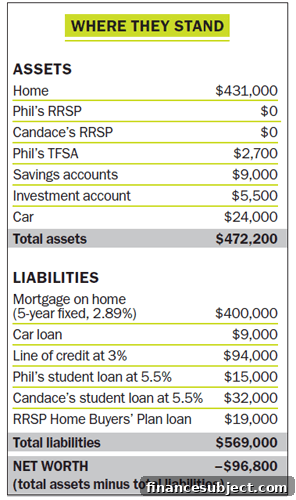
Around questions of savings and investing, the couple is uncertain whether to focus solely on debt repayment or begin building investments through RRSPs and TFSAs. Last summer they withdrew $19,000 from RRSPs under the Home Buyers’ Plan and are repaying it on a 12-year schedule. They have $9,000 set aside for home repairs, an emergency fund of $5,500 in guaranteed investment certificates (GICs) and $2,700 in Phil’s TFSA. Phil plans to add $600 to the TFSA this year. “We really want to get started with a savings program,” he says. “I just don’t know if we should start now, or after the line of credit and student loans are paid off. It’s hard to say what’s best in the long run.”
One advantage is their tax situation: because they’re self-employed and still have education-related tax credits, their combined tax bill is relatively low—about $12,000 per year. After expenses, they expect a net disposable income of roughly $8,000 this year.
They’re also thinking about longer-term goals, like learning to invest more effectively and possibly buying a rental property once their finances improve. “Real estate is a great investment when we can afford it,” Phil says. “I love the idea of having someone else help pay off my mortgage. But for now, I still have a huge one of my own so I probably shouldn’t get ahead of myself.”
Their primary goal is to be debt-free in 15 years. It’s ambitious, but they expect incomes to rise as their practices grow. Phil predicts that in five to seven years he could be earning about $200,000 and Candace about $150,000. “That’s heartening,” he says. The couple would also like to start a family soon. “We’re looking forward to being parents,” Candace says. “It’s the key to a happy life for us. We can’t wait.”
What the experts say
Financial professionals praise Phil and Candace’s progress and caution that a few targeted changes could improve their cash flow and reduce long-term costs. Annie Kvick, a fee-for-service planner with Money Coaches Canada, calls their progress impressive: “They’ve graduated, started careers, married and bought a home in a short period. That’s amazing.” Independent broker Jack Bendaham points out potential savings in their insurance program: “They need the right policies at the right cost.”
To meet their goal of eliminating debt within 15 years while beginning to invest, experts suggested a few priorities:
Pay off student loans first. With student loans at a 5.5% interest rate, Kvick recommends paying down Candace’s $32,000 student loan within five years, then addressing Phil’s loan. Once student loans are cleared, the funds should be redirected to the line-of-credit balance.
Kvick also advises not to panic about possible rate fluctuations on the line of credit: “Keep paying bills on time and improve your credit score; increases will be minimal.” She recommends directing half of any future salary increases toward debt repayment, which could eliminate their non-mortgage debt in about 12 years.
Revisit insurance. The couple pays more than $5,400 annually for disability, critical illness and life insurance. Bendaham suggests replacing expensive whole life policies with term insurance to cut costs—canceling whole life could save about $1,850 a year. He recommends sufficient life coverage to pay off debt plus at least five times annual income; since children are planned, a joint 20-year term policy of $1 million could cost roughly $900 a year for two young, healthy adults. For critical illness coverage, removing a “return of premium” rider could save about $300 annually.
Contribute to RRSPs. Kvick notes the couple can invest about $8,270 each year: she suggests splitting $4,000 into Phil’s RRSP and $4,000 into a spousal RRSP for Candace, with an asset mix of roughly 80% equities and 20% fixed income given their long horizon. She recommends using the TFSA for emergency savings and allocating a portion of the tax refund from RRSP contributions toward the TFSA and the remainder toward student debt.
Consider professional guidance. If they want ongoing support, Kvick suggests finding a fee-for-service planner and scheduling annual financial checkups to stay on track. By following this plan, they could become debt-free in 15 years, then consider investments such as rental properties once their financial position is stronger.
If you’d like MoneySense to consider your financial situation for a future Family Profile, email [email protected]. If we use your story, your name will be changed to protect your privacy.
Julie Cazzin is an award-winning business journalist and personal finance writer based in Toronto.