

Exchange-traded funds (ETFs) have become a favorite tool for do-it-yourself investors. Today, more than 4,300 ETFs trade on Canadian and U.S. exchanges, issued and managed by a wide range of fund sponsors.
Like mutual funds, ETFs fall under the oversight of provincial and territorial securities regulators. These authorities require clear disclosure of investment details and pricing. ETF issuers must prepare and update several regulatory documents—such as ETF Facts sheets and prospectuses—that summarize objectives, fees, holdings and risks. Savvy investors can and should use these publicly available reports to assess whether a given ETF fits their portfolio.
This article explains the main disclosure documents ETF sponsors publish, where to find them and what to look for when deciding which ETFs to buy or sell.
What are the different types of disclosures and reports?
ETF sponsors must prepare and maintain several core documents that summarize fund features, performance and governance.
- ETF Facts: A concise, four-page summary similar to a mutual fund’s Fund Facts sheet. It highlights the fund’s inception date, total net asset value, management expense ratio (MER), fund manager, distribution timing, ticker symbol and exchange, investment objective, asset allocation, top holdings, historical performance and a risk rating. The ETF Facts sheet is designed to give individual investors a quick, accessible snapshot of the fund.
- Prospectus: The long-form prospectus offers a detailed view of the ETF. It discloses legal structure, fees and expenses, investment objectives and strategies, performance history, qualified risk factors, distribution policy and tax considerations. The prospectus is essential when you want to understand the mechanics and legal terms that govern the ETF.
- Quarterly, interim and annual financial reports: These filings provide balance-sheet-level detail on the ETF and the securities in its portfolio.
- The quarterly portfolio disclosure lists the asset mix, the largest holdings and the fund’s total net asset value.
- An interim financial report covers a period shorter than one year—typically six months—and shows the ETF’s financial position, performance and explanatory notes; interim reports are not usually audited.
- The annual financial statements present a full, audited picture, including the statement of financial position, income statement, changes in net assets, cash flows and comprehensive notes.
- Proxy voting policies and records: ETF issuers publish policies that guide how they vote shareholder proxies for securities held in the fund. These policies explain how the sponsor approaches governance issues such as director elections, auditor appointments, executive compensation and shareholder rights. Annual proxy voting records show how votes were cast on specific resolutions.
How often are these reports updated?
Regulatory and financial documents for ETFs are updated on a regular schedule:
- ETF Facts sheets must be refreshed at least once a year and whenever a material change to the fund occurs.
- The prospectus is updated annually.
- Financial statements are filed quarterly (interim statements) and annually (audited statements).
- Proxy voting records covering the 12-month period ending June 30 are typically posted by August 31 each year.
Where can investors find these documents?
These regulatory documents are publicly available on each ETF sponsor’s website. Most fund managers maintain a regulatory documents or legal documents section where you can download the ETF Facts sheet, prospectus, periodic financial reports and proxy voting records for a specific fund. Note that a single prospectus or financial statement may cover multiple ETFs offered by the same sponsor.
Which figures and data matter most to investors?
Many investors get the most value from the ETF Facts sheet because it compiles the essentials in one place. Bobby Argitis, business development manager at a Canadian discount brokerage, notes that the ETF Facts sheet highlights the key items DIY investors look for: the management expense ratio (MER), the stated investment objective, top holdings and recent performance.
Beyond fees and returns, liquidity metrics matter. Look at the fund’s total assets under management, the average daily trading volume and the average bid-ask spread. Small funds with low trading volume can have wider bid-ask spreads and higher trading costs when you buy or sell shares. Those hidden transaction costs can erode returns, especially for active traders or those placing market orders in less-liquid ETFs.
Other useful items to check
Reading the full set of financial reports and disclosures can reveal important details you might miss from a quick search. For example, a fund name that contains the word “Active” signals an active management approach, which may not track a well-known passive index. An ETF labeled as “active” may carry a different risk profile, strategy and fee structure than a passive S&P 500 tracker. The ETF Facts sheet usually includes an explicit note that clarifies whether the fund aims for passive index exposure or follows an active strategy.
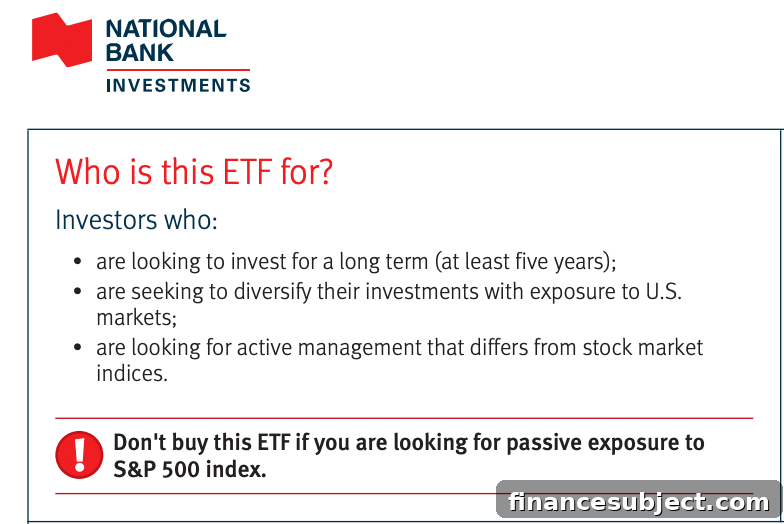
Proxy voting records can also be enlightening. They show how a fund voted on shareholder proposals, including issues such as executive pay, diversity and workplace policies. Reviewing proxy votes gives investors insight into how a fund’s manager approaches environmental, social and governance (ESG) issues and corporate governance more broadly.
Final thoughts
Regulatory filings and financial disclosures provide far more than simple fee and performance data. They let investors look under the hood at an ETF’s structure, holdings, tax treatment, trading characteristics and governance behaviour. For most investors, the ETF Facts sheet supplies the essential information needed to evaluate a potential purchase. But for more complex or niche ETFs, reading the prospectus and financial statements is a prudent step to understand strategy, risks and potential costs.
Your brokerage or investing platform can make these documents easy to find and may offer tools to filter funds by management style, fees, industry exposure and other criteria. Many brokerages also produce educational content—articles, videos, tutorials and seminars—to help investors learn how to research and select ETFs. Mobile trading apps typically let you create watchlists, set alerts, transfer funds and place trades.
Independent rankings and reviews sometimes highlight platforms that are convenient for ETF investors. Some brokerages have offered commission-free trading promotions and resources tailored to ETF research. Be sure to verify any promotional offers directly with the provider when you open an account.
Sign up now
Further reading about ETFs:
- How to choose ETFs for your investment portfolio
- Which type of ETF investor are you?
- What seasoned investors look for in an ETF prospectus
- How to use ETFs in a registered education savings plan (RESP)
- Pros and cons of a one-ETF portfolio
This article is sponsored.
This is a paid post that is informative and may feature a client’s product or service. These articles are written, edited and produced with assigned freelancers.