
When I’m doing my slightly mischievous work of active investing, I look for gaps between how real-world markets are behaving and how the stock market is pricing companies that represent those markets.
For example, gold mining stocks weakened well before the gold price slid. Likewise, UK housebuilders began to falter before the wider housing market showed signs of strain a few years back. In that instance their share prices also recovered sooner than the wider market, exactly as I expected at the time.
Another notable disconnect today appears to be between the stock market’s increasing skepticism about the housing sector and the steady stream of optimistic commentary about the economy: low unemployment, strengthening activity and, until recently, upbeat views on house prices—particularly in London.
It’s true that house prices have cooled from their hottest levels, but equity markets started pricing in a slowdown many months earlier. Investors now seem to be pricing in the possibility that the UK-wide housing recovery will stall seriously. Before judging whether that’s right, let’s look at a few parts of the market to see what the price action has been telling us.
UK housebuilders
The government’s support schemes, combined with low interest rates and a financial sector that stopped getting worse, helped housebuilders perform strongly in recent years. I wrote in November 2011 that the government wanted more houses built and that planning changes and continued buyer demand could make housebuilder shares outperform general house price inflation.
The government clearly wants more houses to be built—and many buyers were prepared to pay high prices. No guarantees, but housebuilder shares looked likely to be more upwardly mobile than general house price inflation over the following years.
After that point, many major housebuilders went on to rally dramatically. Yet 2014 showed a period when their shares stalled or fell before a modest recovery in recent weeks. The important takeaway is that positive press about UK house prices only became common in 2013. In other words, share prices had already moved ahead of the market.
UK estate agents
The performance among listed estate agents has been even more volatile. High-profile names that enjoyed strong runs have seen sharp reversals in their share prices in recent months. Some floated at high valuations and climbed quickly, only to retreat substantially later.
Even firms less exposed to the prime London market have seen share price weakness, suggesting investor concern is not limited to a single submarket.
UK residential home ownership proxies
There are relatively few pure stock-market ways to own UK residential property directly, but some companies operate as imperfect proxies. Firms that hold portfolios of UK residential property, while discounted for various reasons, provide useful signals about investor expectations.
For example, one company that’s a reasonable proxy for London property hasn’t fallen far from its mid-2014 highs and remains up over the year. Another larger and more diversified landlord has followed a different trajectory, reflecting its broader exposure.
What does it all mean for the UK housing market?
So what should active investors make of this divergence between stock prices and the narrative around the real estate market? Is now a time to buy listed housebuilders and agents, or to sell? Should we let stock market gyrations reshape our view of where real-world UK property is heading?
I’m not ready to revise my view on the underlying housing fundamentals. I still believe the UK lacks enough of the right homes in the right places. The recent pick-up in housebuilding has barely dented that shortage, particularly when you factor in inward migration. On that basis I think the medium-term prospects for housebuilders remain solid, assuming interest rates don’t surge and the economy doesn’t falter.
So why the share price wobble? It doesn’t look like a simple valuation problem: while price-to-assets ratios have risen, many builders still look reasonably priced on earnings metrics. The market may be doubtful that strong conditions can persist given potential rises in building or financing costs. That view could be short-sighted given some builders’ commitment to dividend policies, which may help smooth returns and reduce boom-to-bust risk for investors.
There are also shorter-term factors at work that help explain recent softness.
Time to vote
Earlier in the year, consensus expected interest rates to rise, and that rhetoric hit sentiment for the housing-related names—even though bond yields later fell. Tighter mortgage lending rules introduced by the Bank of England last spring have had a more tangible effect on buyers’ ability to finance purchases.
Bank of England commentary has even suggested the market cooled more than expected after regulators tightened conditions, indicating policy moves themselves slowed activity.
Arguably the most immediate drag on activity is political uncertainty ahead of the UK General Election. Estate agents and housebuilders have cited election-related caution—from speculation about mansion taxes to questions over Europe—as deterring buyers, and foreign demand in the London new-build market could be particularly sensitive to such worries. Several builders have also warned that local planning decisions could be affected by the election, delaying projects until after the vote.
All this points to a likely near-term slowdown. Yet some listed property proxies still show investors do not expect large house price falls, even in London. That suggests the current weakness could be temporary.
For patient investors, the recent share price weakness might present an opportunity. A six-month pause in activity matters little to a housebuilder’s prospects over a five-year horizon, and pent-up demand typically translates into a faster recovery once uncertainty fades. Estate agents are a less clear bet, but their dividend yields could be attractive if the current weakness is merely a hiccup.
That said, London and South East prices still feel exposed at their highs, which tempers my enthusiasm somewhat. Ultimately, the right approach depends on your time horizon and risk tolerance.
What’s your view?
Disclosure: I currently hold shares in Henry Boot and Redrow, and I am considering positions in other housebuilders and some estate agents mentioned above.
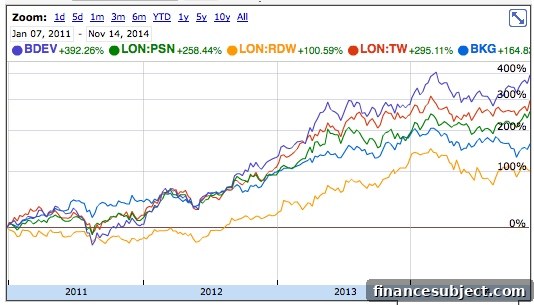
Squint a bit, and you’ll see how the lines plateau in 2014.
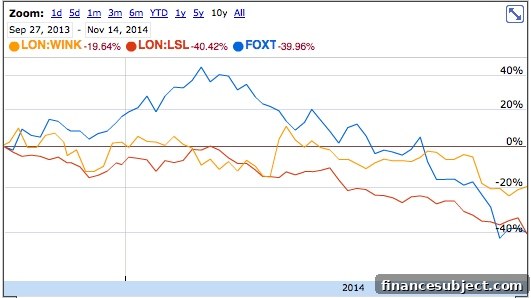
Investors in the listed UK agents have been gazundered.
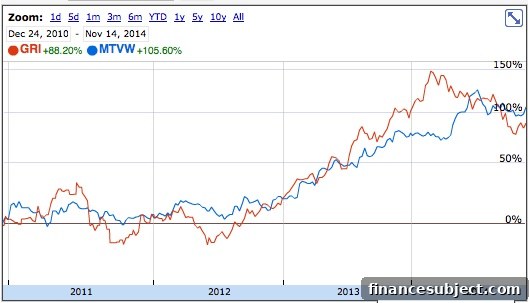
Mountview is a fair proxy for London property.