
This article on the equity risk premium is by former hedge fund manager turned author Lars Kroijer, an occasional contributor to Monevator. He is the author of Investing Demystified.
We’ve previously calculated the historical equity risk premium as roughly 4.3% for the period 1900–2014. That number is useful, but the practical question for most investors is: what does this mean for your own planning and expectations?
Put simply, I believe there is reasonable cause to expect global equities to outperform high-quality government bonds by around 4–5% per year in real terms over the long run. That is the kind of figure you can sensibly use in compound interest calculators and retirement planning models when you decide how equities fit into your portfolio.
A real return, but not a certain one
Some critics argue that relying on historical returns to forecast the future can be misleading. Using past averages may cause you to overestimate returns at market peaks and underestimate them after crashes. Historical return figures looked very attractive in mid-2007, and then much less so in March 2009 after the financial crisis. That observation is fair—history alone won’t predict the short-term timing of market moves, and no one has a crystal ball for crashes.
That said, when planning for the long term I think the extensive historical record across many countries and many market cycles is the best practical guide we have to the likely range of risk and return for equities. The data incorporate long secular rises, severe drawdowns, and everything between, and that breadth helps mitigate the risk of overfitting to any one moment in time.
Another practical critique is that broad, easily investable global equity products have only existed for a few decades. MSCI didn’t publish a global index until the late 1960s, and low-cost, investable global trackers arrived later still. It’s possible that the ease and low cost of global diversification today could alter investor expectations and therefore the premium. Time will tell, but for now long-term historical evidence remains a useful baseline.
Alternative approaches
There are other methods to estimate expected equity returns. Some use current dividend yields or the market’s price-to-earnings ratio combined with conservative earnings growth projections. Others run investor surveys to measure the return investors say they expect or demand.
These approaches have drawbacks. Yield- and P/E-based models rely on short-term market conditions and then require an assumed long-term growth rate, which is inherently uncertain. Surveys capture sentiment that can be heavily influenced by recent market moves and may reflect wishful thinking rather than a sober assessment of expected returns. For long-term planning I prefer a simple, historically informed baseline supplemented by judgement rather than models that depend on volatile short-term inputs.
Lars’ predictions
My working assumption for planning is that a broadly diversified world equity portfolio should deliver a real return of about 4–5% per year above the minimal-risk rate (for example, short-term US government bonds). That is the figure I would use when projecting long-term outcomes for retirement or wealth accumulation.
I do not expect this extra return to arrive smoothly every year. Equity returns will vary widely from year to year; the long-term premium is a probabilistic expectation, not a guarantee.
Expected future real returns
| World equities | 4.5–5.5% |
| Minimal risk asset | 0.5% |
| — | |
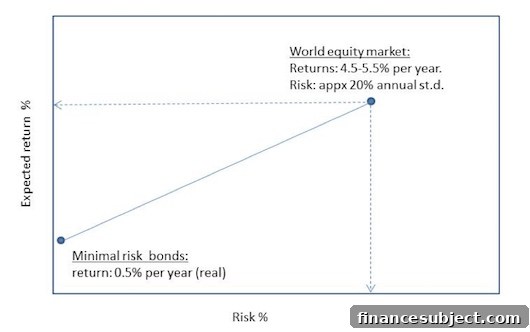
| Equity risk premium | 4–5% |
These figures compare global equities to short-term US government bonds, but the premium should be similar relative to other highly rated short-term government bonds in comparable currencies, since the expected real return on those safe assets tends to be broadly similar.
Apologies in advance
If a 4–5% premium sounds smaller than you hoped, I sympathise—but inflating the number in a spreadsheet doesn’t change reality. A sustained 4–5% real excess return compounds quickly: at that rate you can expect to double purchasing power roughly every 15 years. Whether that is “enough” depends on your goals; in any case, honest expectations are more useful than wishful ones.
Why the risk premium exists
It helps to remember that the equity risk premium is not a superstition: it reflects a straightforward economic idea. Investors demand higher expected returns to compensate for the greater risk and volatility of equities relative to safe government bonds. If equities offered no expected reward for that extra risk, rational investors would hold only safe bonds.
Nor is the premium likely to be a fixed number at every moment. The premium should vary with perceived long-term risk—investors willing to buy at times of panic will normally expect higher compensation than those who buy at times of calm. The 4–5% range I cite is therefore best seen as a long-run average based on an average level of market risk, not as an unchanging constant for every market state.
Putting the risk premium into practice
To make this practical: if you want returns above the minimal-risk rate, invest in a broad, diversified portfolio of world equities. Over the long term I would use an expected real excess return of roughly 4–5% per year above minimal-risk bonds, with the understanding that annual returns will swing widely—typical annual volatility might be around 20%.
The equity risk premium in graphical terms.
If that level of volatility is more than you want, reduce equity weight and increase high-quality government bonds. By adjusting the equity-to-bond ratio you can tailor your portfolio’s expected return and risk to match your tolerance and time horizon.
| Minimal risk | Low risk | Medium risk | High risk |
| 100% Bonds | 75% Bonds | 50% Bonds | 0% Bonds |
| 0% Equities | 25% Equities | 50% Equities | 100% Equities |
Increasing bonds in your allocation will lower volatility but also reduce expected returns. Finding the right balance is the core of portfolio design.
Simple is best
In my view, most investors are better served by a simple, low-cost portfolio than by paying high fees for active management that often underperforms. A straightforward approach—one index fund tracking your minimal-risk asset (short-term government bonds) and one tracking the global equity market—provides broad diversification, low cost, and transparency.
That two-fund combination gives exposure to many well-known companies operating in multiple currencies and jurisdictions while pairing equities with the highest-quality safe asset available. For many people, that simplicity is both powerful and sufficient.
Lars Kroijer’s book Investing Demystified is available from Amazon; he donates his book profits to medical research. He also authored Confessions of a Hedge Fund Manager.