
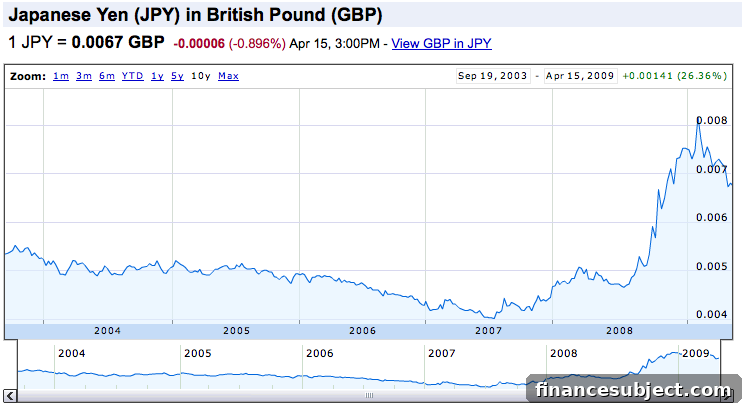
The yen has been weakening against the UK pound (click to enlarge)
(Source: Google Finance)
When I wrote earlier about currency risk and the opportunities that investing overseas can bring, I decided at the time to leave my Japanese holdings untouched rather than converting my Nikkei tracker back into UK pounds to take advantage of the yen’s strength.
At the end of March I changed course and swapped half of those Japanese holdings into a UK FTSE 100 tracker.
That decision wasn’t because I believe retail investors can consistently forecast short-term currency moves. I don’t. I know I can’t reliably predict short-term shifts in exchange rates, and in truth I executed the trade a little late when looking at the charts.
What I do rely on is reversion to the mean. The yen’s spike in late 2008 felt more like a reaction driven by market fear and the unwinding of complex international currency positions than by underlying strength in the Japanese economy. Japan’s economy was struggling at the time, particularly with a collapse in exports, so economic fundamentals didn’t justify an especially strong yen.
Since then the Nikkei has rallied and the yen has begun to weaken against the pound. With my Japanese allocation one of the few recent bright spots in my portfolio—largely due to currency gains—I decided not to push my luck and took profits by reallocating half to the FTSE 100.
Choosing to switch only half reflects a couple of considerations. First, the relationship between the yen and Japanese equities is clear: a weaker yen benefits exporters, which can push the Nikkei higher and could cause the Japanese market to outperform the FTSE if the yen falls further. Second, Japanese stocks have underperformed for decades and still trade at relatively low valuations, so I didn’t want to eliminate exposure entirely. By trimming rather than selling out I aimed to balance capturing gains while retaining upside exposure.
Another practical reason for the partial switch relates to tax-efficient accounts. My Nikkei tracker was held inside an ISA. Japanese equities typically pay low dividends, so the ISA’s tax-free dividend benefit is less valuable for that holding. I prefer to hold higher-dividend funds—like a FTSE 100 tracker that automatically reinvests income—inside the ISA and reserve the limited allowance for assets where tax sheltering makes a bigger difference. My ISA provider lets me switch between index trackers within the same account without fees, which made this reallocation straightforward. It’s a convenient feature, though it’s worth resisting the temptation to over-trade simply because switching is inexpensive and easy.
What about the pound versus the dollar?
Before the switch my dollar exposure was smaller than my Japanese allocation; after the change it’s roughly comparable. Much of my US exposure comes through technology-focused funds and trackers. These positions have performed well and I remain optimistic about the long-term prospects for many technology companies: they typically have strong cash positions and comparatively modest valuations by historical standards. For those holdings, making changes based on short-term GBP/USD fluctuations would feel like needless tinkering.
That said, there’s potential for sterling to strengthen against the dollar, which would reduce the pound value of US investments. If a UK investor had 20% or more of their portfolio in dollars, it would be sensible to consider trimming that exposure. A move back to $2:£1, for example, would cut the sterling value of US holdings by roughly 25%.
If you’re a US investor, conversely, a stronger pound can present opportunities to buy UK blue-chip stocks at a relative discount. Companies such as BP, Vodafone or Tesco—names often cited as undervalued and yielding in the 3–7% range—may be more attractive when a dollar buys more pounds. Of course there are no guarantees that currency movements will continue in any given direction, but from a US investor’s perspective the timing can sometimes be favorable to pick up UK-listed shares.
One knock-on effect of sterling strengthening against the dollar is that the reported pound-denominated profits of multinational UK companies that earn in dollars—BP and HSBC among them—will fall when translated back into sterling. That translation effect can in turn weigh on the FTSE 100 index.
Personally, I find these currency dynamics are best managed at the portfolio level through diversification and sensible allocation rather than frequent trading. Currencies matter for investors, but primarily for diversification and the potential for broad directional shifts rather than for precise short-term calls.
If you’re new to this area, read up on currency risk and how overseas investing can diversify a portfolio before making decisions. Understanding the interplay between exchange rates, corporate earnings and valuation can help you make more deliberate reallocations rather than being driven by short-term market noise.
The US dollar clearly spiked up versus sterling (click to enlarge)
(Source: Google Finance)