
The main reason people try to keep up with the Joneses is the status games we all play.
Humans are social animals, and across our evolutionary history it has been vital to know where we stand in the tribe. Status could affect access to food, mates, safety, and resources. In modern life it also determines things like who gets the VIP pass and who ends up camping near the toilets.
Status signals appear everywhere. Even those with few material possessions find ways to display status: the student who adopts a moral posture, a child coveting rare trainers, or the thrifty saver who frames frugality as virtue. These signals help people position themselves within their social circles.
As you do
But there is a more constructive reason to pay attention to others: imitative learning. We copy people to fit in and to learn practical skills. That basic social learning underpins how we handle everything from fitness routines to parenting strategies and workplace behaviour.
If you doubt this, spend an hour in a kindergarten and watch how quickly children notice and respond to social norms. We like to think we’re independent, yet the default is to observe what others do before diverging.
Much of life follows familiar scripts: school, jobs, taxes, marriage, mortgages, children, pensions, retirement, and eventually death. Observing how others navigate these stages gives us useful shortcuts.
All fluffed up
Some habits are easy to copy: exercise patterns or how to calm a toddler. Other things happen behind closed doors and remain opaque, leaving us guessing about the inputs behind others’ outputs.
That curiosity extends to many areas. People consume media to see how others behave in private, and they benchmark their own lives against the visible signs of success — even when those signs may be misleading.
We rarely know another family’s full financial picture: their income, savings, debts, or investments. We see the outward displays — the car, the renovation, the holiday photos — and form comparisons that can be inaccurate or incomplete.
So when you encounter someone who appears better off, remember you’re usually judging the published outputs without access to the underlying inputs.
Size matters
Judging someone’s success by possessions can mislead. The ostentatious display may be funded by credit, or it may conceal deeper insecurity. Conversely, modest appearances might hide robust savings and low debt.
To form better judgments we need a fuller picture: how people save, how they invest, and how they structure their finances. Those traits tell us more about long-term success than material proxies.
This is why interviews and case studies that focus on behaviour and asset allocation can be more informative than surface-level comparisons. Understanding what people actually hold in their portfolios matters far more than seeing their staged living rooms.
Behind the numbers
Surveys and data offer a glimpse into what is otherwise invisible. For example, simple polls can reveal demographic patterns among readers or investors: who pays higher taxes, who holds more assets, and how net worth skews across audiences.
Context matters when interpreting comments or advice online. A wealthy reader losing a modest sum is not in the same position as someone for whom that money would be life-changing. Personal context transforms good advice into bad outcomes or vice versa, so approach online financial opinion with constructive scepticism.
Knowing the commenter’s age, income, dependents, and net worth would drastically improve interpretation of their views — but such context is rarely available. That’s why long-term, consistent contributors are usually more reliable than anonymous, one-off comments.
How people invest their pensions on one online platform
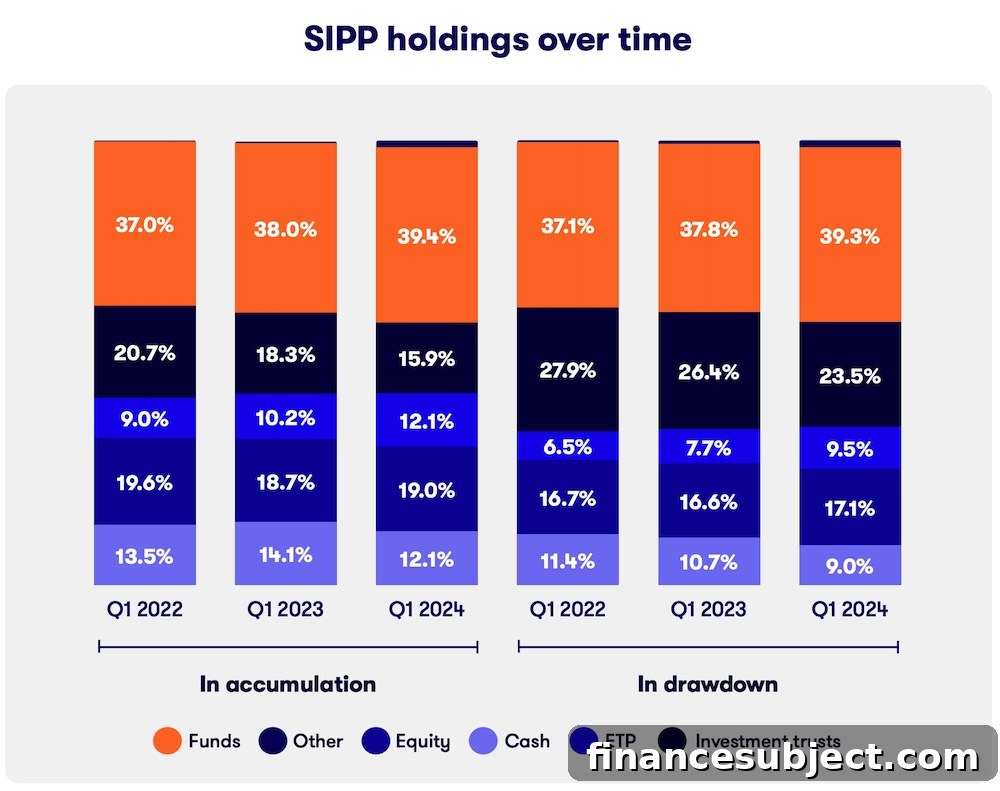
Interactive Investor recently launched a SIPP index that aims to show how some retail investors allocate pension money. The report provides a snapshot of what product types customers hold in their SIPPs during accumulation and drawdown phases.
At first glance this sounds promising, but the report only reveals which types of products (for instance, funds, trusts, or direct equities) are held, not the underlying assets those vehicles actually own. That omission limits the insight the report can provide.
For example, the report shows more funds and direct equities during accumulation and a higher share of investment trusts during drawdown, but without a look-through to underlying assets we can’t tell whether those funds are equity-heavy or bond-heavy.
Source: Interactive Investor
Knowing product popularity is useful for firms and marketers, but it doesn’t reveal investors’ true asset allocation or risk exposure. A fund wrapper can hide a very different mix of equities, bonds, or alternative assets.
It’s what we invest pensions into that matters
What would be far more valuable is a look-through analysis that aggregates the actual holdings inside funds and trusts. Summing exposures across all products would reveal the real equity, bond, property, and cash allocations for ordinary investors and show how those allocations shift as people move into retirement.
Without that level of detail, a list of popular fund names is mostly a marketers’ view of investing rather than a true picture of investor behaviour.
Trend spotting
Still, the report offers a few high-level observations worth noting: passive funds and ETFs have gained ground, younger investors tend to prefer ETFs, and collective fund ownership appears to explain why some groups have achieved higher returns over recent years. Younger accumulators have enjoyed stronger returns than older investors in drawdown, which is consistent with differing risk profiles.
These trends are promising and the index could become more useful if future editions include look-through asset data.
Rich pickings: how the wealthy do it
Seeking a broader view, other reports provide additional clues. Studies of wealth distribution show that as wealth rises, exposure to cash declines and risk-taking tends to increase. Yet many of these reports separate pensions from other financial assets, making comparisons tricky.
Pensions, property, and non-pension financial assets all interact to shape an individual’s overall risk tolerance and investment choices. For instance, a large pension pot may make an investor comfortable taking more risk in their taxable brokerage account.
Lies, damned lies, and pension statistics
Official statistics from national sources can be mined for a look-through of pooled pension investments. Recent data for occupational pension schemes shows pooled investment allocations across equities, fixed interest, property, mixed assets, and other categories.
| Asset class | Percentage |
| Equity | 35% |
| Fixed Interest | 10% |
| Property | 2% |
| Mixed asset | 35% |
| Hedge | 1% |
| Private equity | 0% |
| Money market | 4% |
| Other* | 13% |
Source: ONS. *‘Other’ pooled investment vehicle asset types include cash, commodity/energy, structured products, unknown and with-profits.
That table is informative but not definitive. Large allocations labelled “mixed asset” or “other” obscure precise exposures. The aggregate picture suggests a material equity weighting overall, with meaningful allocations to bonds and smaller positions in property and cash. But exact percentages depend on how mixed-asset funds are composed.
Funds finding favour
Another useful lens is industry-level fund allocation data, which shows where pooled investments are directed. These surveys reveal trends such as declining allocation to domestic equities and rising interest in international markets and passive products.
Source: The Investment Association
Such charts help illustrate broad flows of capital, though they combine holdings by institutions and individuals, which can skew the picture toward the behaviours of very large investors.
We (mostly) don’t invest pensions in pie-in-the-sky
In short, a review of available data suggests that most pension assets are broadly diversified across equities, bonds and other asset classes, and allocations shift with age and retirement status. While headlines obsess over cryptocurrencies, meme stocks, or the latest tech craze, the bulk of wealth tends to be held in diversified portfolios designed for longevity.
That practical, steady approach to pension investing is likely the best model for most savers: broad diversification, sensible risk control, and a long-term focus rather than chasing fads.