
Index trackers are the preferred investment vehicle for passive investors. They offer a low-cost way to build a diversified portfolio and, over time, tend to outperform the average active investor.
Many respected figures in investing recommend index trackers for their clarity and cost efficiency. As an example, Yale’s endowment fund manager David Swenson summed up their main advantages:
“With all assets, I recommend that people invest in index funds because they’re transparent, understandable, and low cost.”
Safety in numbers
Tracker funds pool money from many investors, which increases buying power and reduces the cost and risk an individual would face alone. A single global tracker can provide exposure to markets around the world, making broad diversification simple and affordable.
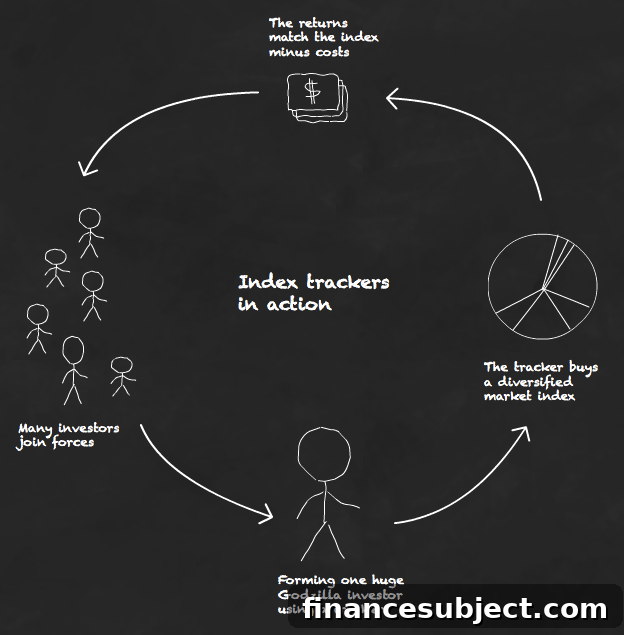
Because trackers hold large, diversified baskets of stocks or bonds, they reduce the idiosyncratic risk of single-stock investing. While a tracker will not beat the market benchmark, it typically stays close to the market return and avoids the large underperformance that many active managers suffer from after fees.
Indexes in (just a little) detail
The core aim of a tracker fund is to reproduce the returns of a specific market index. An index is simply a representative basket of securities—shares, bonds, or other assets—that reflects a segment of the market.
Well-known indices include the FTSE 100, the Dow Jones Industrial Average, and the Nikkei 225. Think of an index as a financial poll: it samples a portion of the market to show how the broader market is behaving.
There are many niche indices, but most investors only need to focus on the major ones. To choose an appropriate tracker, you should know:
- The market you want to track (for example, UK domestic equity).
- Which indices represent that market and how those indices differ.
For example, UK equity exposure can be achieved via several indices. The FTSE 100 tracks the 100 largest listed UK companies and represents a substantial portion of the UK market’s value. The FTSE All-Share covers a much broader slice—roughly the entire listed equity market by including large, mid and small caps—so it offers more diversification.
If you want the widest single-index coverage of UK stocks, the All-Share is the natural choice. If you prefer to focus only on Britain’s largest firms, the FTSE 100 is the simpler option. A tracker’s fund factsheet tells you exactly which index it follows and how it is constructed.
Gain with less pain
A tracker’s role is modest and precise: deliver the return of its index. Most trackers achieve this by holding the same securities in similar proportions to the index. Some replicate the entire index, some hold a representative sample, and others use derivatives to mirror index performance. These methodological choices affect tracking error—the small difference between a tracker’s return and that of its benchmark in any given year.
Trackers do not try to pick individual winners or time the market. Their disciplined approach means they will not outperform the index dramatically, but they also avoid the higher fees and inconsistent results that cost many active funds their edge. Because index trackers are cheaper to run, they often outperform pricier active funds over the long term.
Types of trackers
Tracker funds generally come in two main forms:
- Index funds – These are traditional pooled funds designed to match an index. They are well suited to regular savers and small investors, often structured as open-ended investment vehicles.
- Exchange-traded funds (ETFs) – ETFs package index exposure into a tradable share listed on a stock exchange. ETFs offer a wider range of exposures and sometimes access to niche markets, but buying and selling them incurs trading costs that can be significant for small, regular contributions.
A less common option is the investment trust tracker, which is typically more complex and often more expensive, so it is less relevant for most passive investors.
When choosing between index funds and ETFs, consider factors such as your investing frequency, platform fees, trading costs, and the precise index tracked. Read the fund factsheet and compare ongoing charges and historical tracking error to make an informed decision.
Index trackers simplify investing, reduce costs, and provide broad diversification—qualities that make them an ideal core holding for many long-term, passive portfolios.
Take it steady,
The Accumulator
- In terms of the total market capitalisation[↩]
- These differences in methodology are one reason for differing ‘tracking error’, which is the percentage amount by which a tracker fails to accurately track its index in any particular year[↩]
- Some investors keep close tabs on investment trust trackers to see when their value deviates from their underlying value, but that’s not really what passive investing is all about![↩]