
Important: What follows is not a recommendation to buy or sell The Edinburgh Investment Trust. I’m a private investor sharing notes. Read my disclaimer.
Name: The Edinburgh Investment Trust
Ticker: EDIN
Business: Investment trust
More: Trustnet / Morningstar
Official site: Invesco Perpetual
One of the UK’s most prominent fund managers, Neil Woodford, announced in October 2013 that he planned to leave his employer, Invesco Perpetual, in 2014. The announcement produced a flood of commentary across the financial press, with pundits replaying his career highlights, questioning whether investors should remain in the funds he runs, and speculating about the future for those vehicles.
Woodford has been a well-known figure in British investing for decades, widely followed by individual investors and the media alike. That reputation helps explain why his decision to depart prompted such strong reactions: the funds he managed attracted large sums, and his stewardship became a selling point for many shareholders.
Not about personality investing
This piece is not meant to be a paean to Woodford or a guide to chasing star managers. Monevator is not about following fund managers religiously. While I do engage in active investing myself, I usually avoid putting faith in a single manager as the basis for an investment. Even when I have invested in family-backed or well-run trusts, my decisions have been driven by measurable factors such as discounts to net assets or exposure to niche asset classes, rather than celebrity managers.
Picking winning stocks is difficult; identifying a manager who will outperform consistently over many years is even harder. Academic and industry studies broadly show that past fund performance rarely guarantees future results. Moreover, successful managers often face growth and scale issues that can make maintaining edge challenging. Fees also erode potential outperformance, so the bar for a manager to justify active fees is high.
For most investors a diversified, low-cost approach will outperform the concentrated risks inherent in betting on a few active funds or star managers. That said, a very small number of fund managers may demonstrate genuine skill, but finding them early and sticking with them long-term is a rare feat.
Woodford’s record and market perception
I do think Neil Woodford has a record that deserves attention. Many investors point to long-term performance charts and two-decade-plus track records to argue he beat the market over time. But even with that track record, relying solely on a manager’s reputation to make investment decisions is risky. Fame can bring inflows and scale that change the nature of a fund, and even excellent managers can encounter setbacks.
Rather than asking “What would Woodford do?”, a more constructive question for most investors is whether the underlying investment case for a fund or trust remains intact regardless of its manager’s fame.
The market reaction and closed-ended trusts
Woodford’s exit prompted a sharp reaction among his investors, and in some cases heavy selling followed the announcement. That flow of sell orders created problems for open-ended funds carrying large, concentrated holdings because redemptions can force managers to sell underlying assets at disadvantageous times.
But that immediate liquidity issue did not apply in the same way to The Edinburgh Investment Trust. Edinburgh is a closed-ended investment trust, meaning it issues a fixed number of shares that trade on the stock market. When nervous shareholders sold their holdings, the trust did not have to liquidate assets. Instead, the market price of its shares dropped to reflect changing sentiment — a move from trading at a modest premium to net asset value down to a small discount.
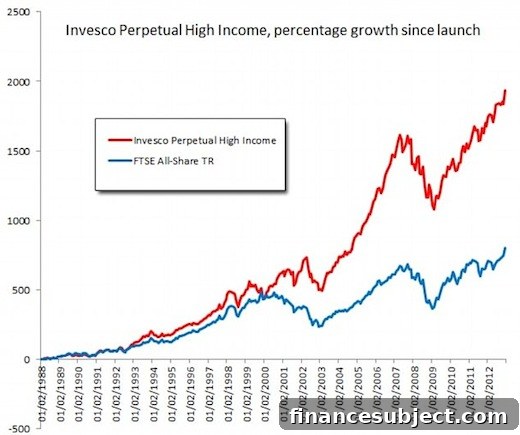
This graph (from Hargreaves Lansdown) shows how Woodford has delivered.
In practical terms, a sell-off in Edinburgh’s shares created an opportunity: the underlying portfolio did not necessarily change in value, but the market price for the trust’s shares fell, opening a discount to net assets that did not reflect a forced liquidation or a change in holdings.
Why I bought into the wobble
When the market punished Edinburgh, I saw a chance. Closed-ended trusts frequently trade at premiums or discounts driven by investor sentiment rather than fundamental changes to the portfolio. Many lesser-known income trusts trade at premiums simply because investors chase yield. That shows a name does not need global recognition to command investor demand and for premiums to reappear.
My view was that the sell-off was emotional and temporary: some shareholders were leaving primarily because the manager’s future was uncertain, not because the assets themselves had deteriorated. As a result, I bought shares after the price fell, expecting the gap to narrow again. A trust that had been trading at a premium could return to that position once sentiment stabilised, or when a successor manager is appointed and confidence returns.
The Edinburgh Investment Trust’s share price: Can you see when the news broke?
There were other reasons to be optimistic. The trust’s board could choose to reappoint Woodford if he wished to manage it after departing Invesco, or appoint a successor with a similar investment style. Even if a different manager took over, the underlying income-generating assets remained intact. And because the market price now implied a higher yield relative to the trust’s asset base, income-seeking investors might find it attractive.
Emotional markets and rational opportunities
One reader told me he avoids investment trusts precisely because their share prices can swing with other investors’ moods. That is a reasonable position; closed-ended trusts do expose investors to market sentiment as well as portfolio performance.
But sentiment-driven moves can also present rational buying opportunities. When a trust’s market price diverges from net asset value because of fear or uncertainty, long-term investors can profit if the divergence later corrects and fundamentals remain sound.
Edinburgh (blue) has already bounced off its post-news low; it may narrow the gap with peers over time.
My plan was straightforward: buy at the widened discount and sell if the discount narrows or the premium returns. It’s a tactical trade based on mispricing, not a bet on any single individual’s performance.
Conclusion
News about managers creates headline risk and emotional reactions, but it does not always change the underlying investment case. Closed-ended investment trusts can offer opportunities when market sentiment diverges from fundamentals. For investors willing to analyse a trust’s holdings and governance and accept the distinct risks of a listed vehicle, temporary sell-offs can be a chance to buy income-generating assets at a more attractive price.
I’m not claiming this is advice for everyone — it’s a personal trade based on my assessment of the Edinburgh Investment Trust’s structure and prospects. For most people, a diversified, low-cost strategy remains the most reliable route to long-term investment success. I simply wanted to capture the mispricing when it appeared and then reassess as the situation evolves.
Me? I just want to make a bit of profit.