
A year ago I published the article below, highlighting two obscure, illiquid securities that could perform well if and when interest rates rise.
One is a Nationwide PIB1, and the other is a preference share issued by Investec’s UK arm.
In the 12 months since that post, the Nationwide issue has risen about 10% and the Investec preference has gained roughly 34%.
On the face of it that seems odd: official interest rates haven’t increased, so the floating elements of their coupons haven’t yet moved higher. Instead, higher prices have reduced the running yields for anyone buying now — these securities now trade at roughly 3% on a purchase basis.
My view is that investors are placing a higher value on the built-in floating-rate protection. A UK rate rise, once considered unlikely, now looks more plausible as the economy stabilises.
Unemployment is approaching the Bank of England’s 7% threshold for considering rate rises, and the UK economy shows tentative signs of recovery. It’s uneven and shaky, but it is improving.
Gilt yields have reacted: after the ten-year gilt yielded below 2% in spring 2013, it briefly exceeded 3% this month.
I don’t expect Governor Mark Carney to raise rates imminently, but if the economy continues to heal, rates will eventually move up — and that should be positive for these floating-rate instruments.
I’ve therefore republished the original piece for readers who want to consider these securities ahead of any rise.
Please note:
- I have not updated the numbers in the original article. At the time of writing CEBB traded around 85.25p and INVR about 525p. Do your own calculations before making any decisions.
- Some of my earlier price speculation has already played out; both securities have risen. I continue to think that market sentiment is now valuing the optionality embedded in their floating coupons more highly.
- The bid/offer spreads are very wide — in some cases near 10%. These are very small issues and highly illiquid. If you overpay, you could be facing losses for years.
- The Fixed Income Investor website covered INVR in October, at a price roughly 60p lower than back then.
- I own small positions in both securities.
I believe these issues are interesting precisely because they’re too small to attract large institutional traders. They can add diversification for long-term investors who accept the credit risk — but they’re illiquid and expensive, so they’re only appropriate for sophisticated investors. You have been warned.
— Original article from 24 January 2013 begins —
Note: This is not a recommendation to buy any securities mentioned (including CEBB and INVR). I am a private investor sharing my thoughts for informational purposes. Please see my disclaimer and do your own research.
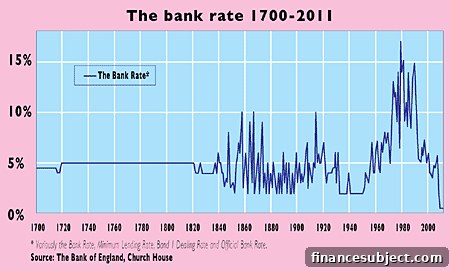
The Bank of England’s base rate is at rock-bottom levels: 0.5% at the time of the original piece.
Rates are so low that the economy can feel like a patient on life support. This is unprecedented in modern times — a 300-year chart of UK bank rates shows we haven’t seen anything like it.
The chart spans centuries and covers many economic regimes: times of empire, war, boom and bust. Even so, rates have rarely if ever been this low.
With consumer inflation above 2.5%, a 0.5% base rate offers little real return for savers.
Central banks deliberately set low rates to push down borrowing costs across the yield curve, encourage lending and investment, and to prevent critical institutions from failing. That policy helped create a steep yield curve and supported risky assets like equities.
Hunting for value in a low-yield world
As I expected back in December 2009, a steep yield curve has helped drive a long equity rally. Central banks want savers and investors to move from cash into riskier assets — and they have.
I’ve been heavily invested in this bull market since March 2009. Even so, with markets near multi-year highs it’s sensible to look for diversification beyond equities and plain cash.
Cash yields are barely positive after inflation. UK government bonds are safe but offer very low returns: the ten-year gilt was yielding around 2% at the time.
I’ve had gains from higher-yielding preference shares such as Lloyds’ LLPC, but I’m cautious about concentration and am always seeking alternatives.
In the less-frequented corners of the market I found two obscure floating-rate securities that looked interesting and, to my eye, attractively priced.
Two illiquid and obscure floating-rate securities
Both securities — one from Nationwide and one from Investec — pay floating coupons instead of fixed coupons. That means the interest paid increases when base rates rise and falls when they fall.
Both are perpetual securities: undated instruments that are not redeemable at the issuer’s option, so they pay interest for as long as the issuer can and does honour the payments.
Important warning: These are subordinated and illiquid securities. If Nationwide or Investec faces severe trouble they could suspend payments, or you could lose part or all of your investment. These are not covered by deposit protection.
Nationwide is the UK’s largest building society and played a stabilising role during the crisis, but it remains exposed to the UK housing market. Investec is more geographically diversified, with substantial South African exposure — which carries its own risks.
Both issuers continued to pay through the crisis, and Investec kept paying ordinary dividends. I’ve allocated a small amount of capital to these securities, mindful that the risk exists of losing it all.
The benefits of a floating coupon
Do your homework before considering any bond or PIBS. What follows is a concise summary, not a comprehensive analysis. Consult bond data providers and issuer documentation before deciding.
Nationwide Floating Rate PIBS
Ticker: CEBB
Coupon: 6-month LIBOR2 + 2.4%
Duration: Undated
Bid/Offer: 70/77p3
Approximate yield on offer price: 4%
Investec Preference Shares
Ticker: INVR
Coupon: Bank of England base rate + 1%
Duration: Undated
Bid/Offer: 345/375p
Approximate yield on offer price: 4%
Both issues show extremely wide bid/offer spreads, so only buy with a long-term holding horizon. These are tiny issues; CEBB, for example, was only £10 million in size after the Nationwide’s acquisition of the Cheshire Building Society.
Calculating floating-rate yields
Running yields depend on the current base rate because the coupon is variable. For INVR, for example, with the BoE rate at 0.5%:
Interest = (BoE rate + 1%) / price = (0.5% + 1%) / 375 = ~4%
Is ~4% attractive? It’s higher than cash, but these securities carry far more credit and liquidity risk than government bonds or bank deposits. Comparable perpetuals and some preference shares can yield 6–8% currently, so these particular securities pay less for the risk being taken.
Consols — the UK government’s undated gilts — were yielding around 4% at the time, effectively risk-free in terms of payment. That raises an obvious question: why own CEBB or INVR when they offer no yield premium over government perpetuals?
Valuing the embedded option
The answer lies in the floating coupon: if base rates rise, the coupon rises and running yields increase accordingly. This feature adds value when rates are climbing — though it hurts when rates fall.
Take INVR as an example. If the BoE base rate returned to 2%, INVR (coupon = BoE + 1% = 3%) bought at 375p would yield:
3% / 375p ≈ 8%
A 1.5% increase in the base rate would roughly double the cash income on the current purchase price. If base rates did rise, market prices would likely adjust upward too, generating capital gains for existing holders.
Using reasonable assumptions, one can model potential price moves. For instance, if Consols yield returned to 4.5% with base rates at 2%, INVR might command a price near 667p to produce an equivalent yield on its higher coupon. That would be a substantial capital gain from today’s quoted prices.
CEBB’s coupon includes a larger fixed margin (LIBOR + 2.4%), so its “coupon gearing” is lower and price volatility would likely be more muted compared with INVR. In normal conditions, floating-rate securities can be less sensitive to interest-rate moves because their coupons adjust automatically.
A cautious bet on higher rates
I view the price of these securities as driven by two main factors:
- Long-term interest-rate expectations (government yields)
- The market’s valuation of the option on higher bank rates in the future
At the time of writing, the market was not pricing much option value into CEBB and INVR. That may change as expectations shift.
Be mindful that credit risk has risen since 2008. For example, CEBB traded around 100p when base rates were 2% in 2008, whereas my simplified estimate would have suggested a price near 82p — showing how much issuer risk and market sentiment matter.
Credit concerns are real: PIBS and subordinated preference stock once had reputations for safety among pension funds and conservative investors, but that status has weakened. Recovery to former valuations is not guaranteed.
On the flip side, interest-rate risk from here appears limited. Even if the BoE cut rates further, the fixed portions of these coupons provide some income support, moderating downside from interest-rate moves.
Float, float on
Do I expect rates to jump to 2% or 5% soon? No — not in the immediate term. But I do believe higher rates are likely at some point in the years ahead. Until then, being paid around 4% while holding these securities is an outcome I can accept for small, carefully sized positions.
I haven’t gone large due to the credit risk and wide spreads, but I have bought small tranches of both CEBB and INVR within my ISA allocation.
Note: I am not a financial adviser. This is not personal financial advice. Do your own research before investing in illiquid or risky securities. See my disclaimer.
- Permanent Interest Bearing Share[↩]
- In normal times LIBOR is roughly the Bank of England base rate plus a small mark-up of about 0.15%[↩]
- Note: This PIBS trades clean, which means you also have to pay for the interest accrued when you buy it.[↩]