

Welcome to the Canadian Crypto Observer. In this monthly column, financial journalist and author Aditya Nain provides perspective on headlines that move markets and practical guidance to help Canadian investors navigate the cryptocurrency landscape.
Regulators sound a wake-up call to crypto exchanges
Unregulated crypto trading is becoming a thing of the past in Canada. On Aug. 6, 2024, the Canadian Securities Administrators (CSA) — the umbrella body for provincial and territorial securities regulators — issued its most forceful guidance yet on registration expectations for crypto trading platforms (CTPs). The notice reminded CTPs that they must prioritize applications to register as investment dealers and to secure membership with the Canadian Investment Regulatory Organization (CIRO).
How did we reach this point?
In March 2021, the CSA and what is now CIRO outlined the regulatory framework for crypto trading platforms operating in Canada. At that time, some CTPs were allowed to operate under a time-limited restricted dealer registration while they completed CIRO membership applications. Regulators expected the transition to take roughly two years, but progress has been uneven, prompting the CSA to warn that the interim approach will not continue indefinitely.
The CSA’s statement was deliberately measured: “Moving forward, CSA members do not intend to continue with the interim approach for time-limited restricted dealer registration for CTPs as described in the staff notice.” That signals Canada’s intent to push CTPs to fully meet securities rules or exit the market.
Some platforms have already left. For example, on Sept. 30, 2024, a U.S.-based exchange notified Canadian customers it would stop serving the market and asked users to withdraw assets by Dec. 31, 2024. For Canadian investors, this highlights the importance of checking whether the platforms they use are complying with securities rules or actively pursuing registration.
The CSA categorizes CTPs into three groups: those authorized to do business with Canadians, those that have filed pre-registration undertakings, and those that are prohibited from serving Canadian clients. Investors should confirm a platform’s status through official CSA listings or reputable industry rankings and prioritize platforms that are registered or demonstrably working toward registration.
More institutions are adopting crypto
Institutional adoption matters. As more banks, pension funds and asset managers add crypto exposure, cryptocurrencies are increasingly likely to enter retail portfolios indirectly—through ETFs, funds or via broader market effects.
A study conducted between June and December 2023 found that 39% of surveyed institutional investors had invested in crypto assets, up from 31% in 2021. That rise reflects a trend toward broader acceptance and diversified access methods beyond direct coin ownership.
Institutions gain crypto exposure in several ways:
| Held crypto directly | Through ETFs, closed-end funds or regulated products | Through crypto-related public equities | Through venture capital or hedge funds | Through crypto derivatives |
|---|---|---|---|---|
| 75% | 50% | 58% | 25% | 42% |
Why this matters for individual investors:
- Price and demand: Institutional money can drive demand for scarce digital assets such as bitcoin, supporting higher prices over the long term.
- Market maturity: Institutional participation often brings improved liquidity, stronger compliance and better investment products, which can reduce frictions and risks for retail investors.
Is Ethereum being left behind?
Over the past year, bitcoin (BTC) has significantly outperformed ethereum (ETH). As of 12 p.m. EST on Oct. 1, 2024, BTC rose roughly 122% while ETH increased about 45%. Both gains are notable, but ETH’s relative lag raises questions about drivers behind the divergence.
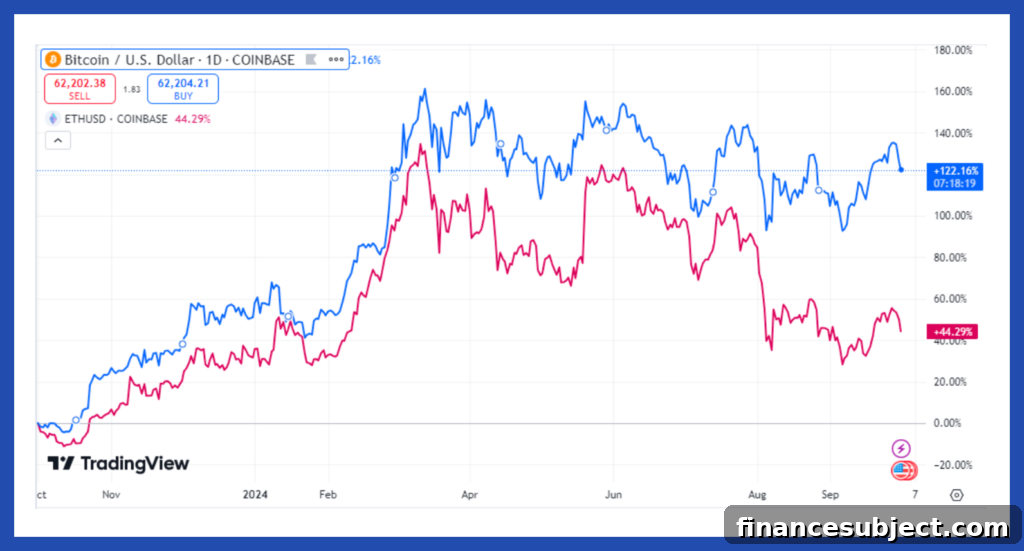
Two main reasons explain bitcoin’s lead:
- Typical bull-market dynamics: In new crypto bull markets, bitcoin often leads the rally—similar to how large-cap stocks typically drive early gains in equity bull markets. Bitcoin’s status as the market’s largest and most liquid asset tends to attract initial inflows.
- Spot bitcoin ETFs: The U.S. approval of spot BTC exchange-traded funds in January 2024 unlocked massive institutional flows by allowing investors to gain exposure without buying coins directly. Ethereum spot ETFs followed months later, so BTC benefited from earlier and larger inflows.
How will rate cuts affect crypto?
Monetary policy changes, particularly rate cuts by the U.S. Federal Reserve, can meaningfully influence crypto markets. When the Fed lowers rates, borrowing costs fall and liquidity in the financial system tends to rise. More money circulating in the economy can weaken the purchasing power of cash and push investors toward growth assets such as stocks, real estate, gold and cryptocurrencies.
One commonly cited correlation links changes in global money supply measures (like M2) with bitcoin’s price movements. If anticipated increases in money supply materialize, and if bitcoin continues to mirror those moves, lower interest rates could support higher BTC prices. That said, correlations are not guarantees; charts can suggest possible paths but cannot predict the future with certainty.
Overall, Canada’s tightening regulatory stance and rising institutional participation are constructive developments for crypto investing. Stricter oversight may push some exchanges to exit, but it also encourages platforms to comply with securities laws, improving investor protection.
As always, crypto remains a high-volatility, high-risk asset class. Even in a bull market, investors should proceed with caution and allocate only what they can afford to lose. Consider platform compliance, custody practices and diversification before committing capital.
Further reading on crypto:
- Should you consider ETFs that include crypto?
- 10 common crypto scams and how to avoid them
- How major exchanges are reshaping Canada’s crypto landscape
- How to protect your crypto from hacks
Newsletter