

Ask MoneySense
Is there a fun and engaging web tool I can use with people so they can get a solid sense of expected long-term returns for equities and bonds, both before and after inflation?
—Allan, Barrie, Ont.
That question is mine — not a reader’s — and the answer is yes. There is an excellent interactive tool that visualizes historical returns for stocks and bonds. Until recently it required a paid subscription; now it’s free for everyone. I consider it worth bookmarking if you follow investing, asset allocation, or financial planning.
What makes this tool useful is how quickly it presents stock and bond returns over long stretches of history. Seeing how markets behaved in different decades helps set realistic expectations for future returns and can reduce anxiety when markets fall. It can also help inform allocation choices that may improve expected returns or better align risk with goals.
Here I refer to the Index Matrix, an interactive data visualization that displays annual returns across many asset classes. When you open it you’ll see a heatmap-style chart like the one below.
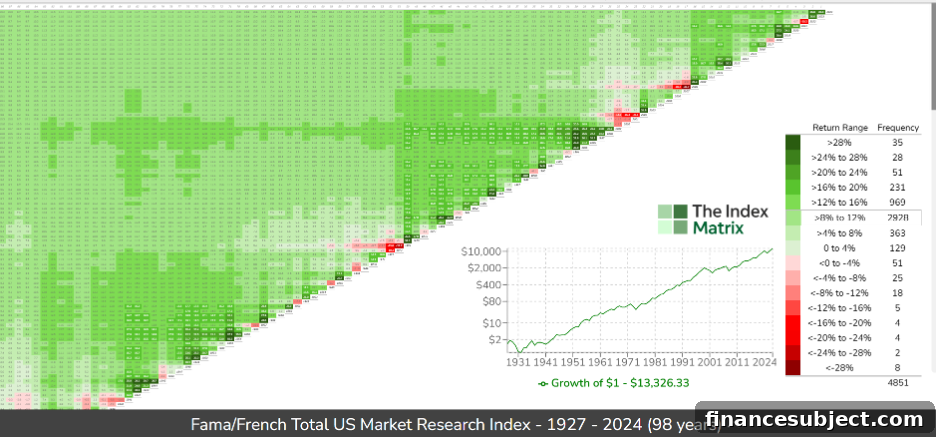
The chart uses color to show yearly performance. In the example above the S&P 500 is displayed from 1927 through 2024, with green indicating positive annual returns and red indicating negative ones. Darker shades reflect larger gains or losses. The diagonal axis marks the starting year for an investment. Move vertically from a given start year to see how long it took for annual returns to become positive: think of the diagonal as the wire fence you need to climb before your investment enters the green pastures of positive returns.
A reminder of market realities
Try this: place your cursor on the red cell for the year 2000, which shows an S&P 500 return of about −11.7%. Slide upward to 2010 and you’ll see the average annualized return for the decade was roughly 1.1% — effectively a decade of little to no growth in nominal terms for the S&P 500. That perspective can be sobering and useful when planning time horizons for equity investments.
Now change the asset class to Canadian equities using the dropdown menu. For 2000–2010, Canada’s market produced a much stronger average annual return (about 11.6% in the example). U.S. small-value stocks — small-cap companies with a value orientation — returned roughly 11.9% for the same period. That contrast shows how diversification across markets and factors can materially change outcomes and reduce the risk of relying on a single index.
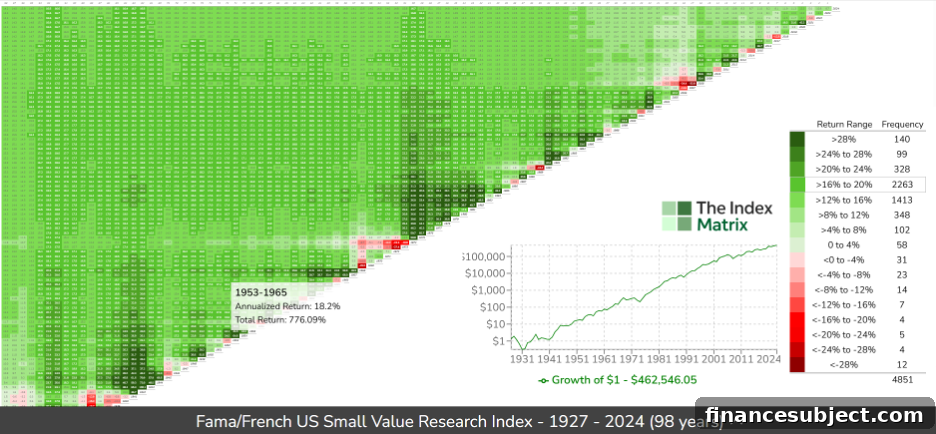
Long-term investors may already know that small-value stocks have historically outperformed large-cap indices over extended periods. The heatmap highlights that tendency: darker green blocks appear more often for small-value series compared with the S&P 500. However, performance varies by cycle; since about 2003 the S&P 500 outpaced U.S. small-value, reminding us that past premiums can go dormant for long stretches.
The problem with bonds
Another instructive view is bonds after inflation. On the bond heatmap you’ll find some green years, but also many red ones—negative real returns for an asset class often considered “safe.”
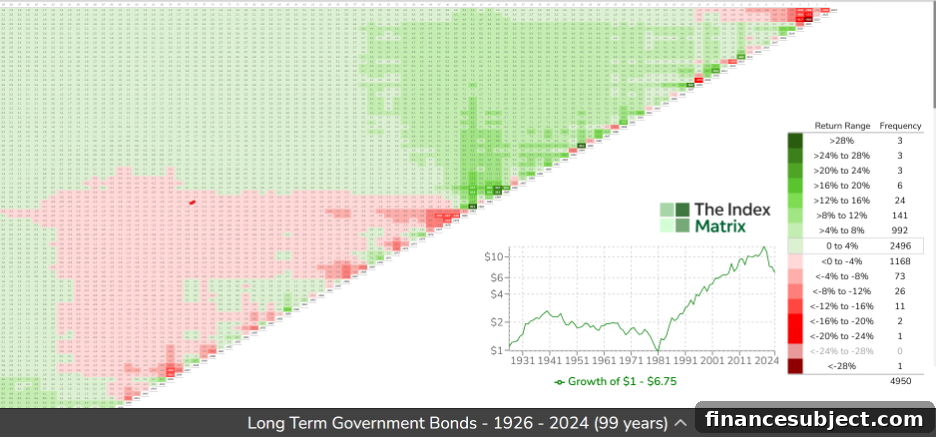
If you trace the diagonal upward, you’ll notice bonds delivered equity-like returns for a stretch roughly from 1982 to 2014. That period followed the peak in interest rates in the early 1980s and a multi-decade decline in rates that boosted bond prices. Before 1981, however, bonds produced far more modest returns: from 1926 to 1981 the average annual return on bonds was near 3% before inflation and essentially 0% after inflation. Understanding this history helps explain why bonds offered unusually strong returns during the late 20th century and cautions against assuming similar future outcomes.
The app contains many other revealing charts and filters. Explore different asset classes, time spans, and return measures using the dropdown menus. The visual format makes it easy to test “what if” scenarios and to communicate historical risk and return to clients, family members, or friends.
Use the lessons from historical performance to shape your portfolio strategy or to better evaluate the recommendations from an advisor. If your portfolio holds only equities and bonds, for example, ask what the bond allocation is intended to achieve: generate income, preserve capital, or reduce volatility? Different objectives imply different maturities, credit exposures, or alternative diversifiers.
I hope you find the Index Matrix as informative and practical as I do. Spend some time with the interactive views and let historical patterns inform sensible, resilient decisions about asset allocation and risk management.
Ask MoneySense
Have a personal finance question? Submit it here.
Read more about investing strategies:
- Tax implications of giving your spouse money to invest
- Hot stocks: Canada’s top performers in Q2 2025
- How is investment income taxed in Canada?
- Canadians are curious about investing—and willing to take bigger risks