
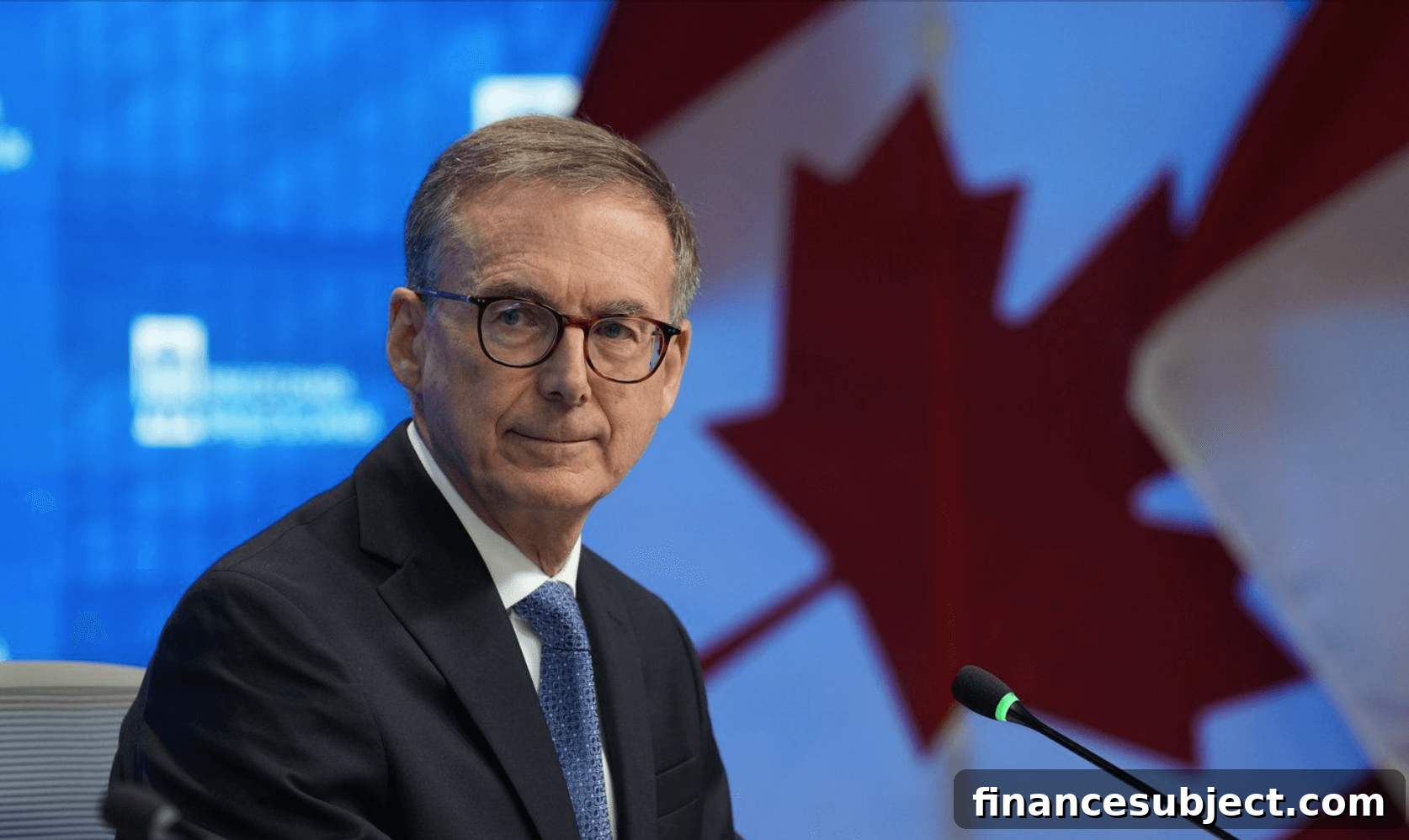
The Bank of Canada reduced its benchmark interest rate by 25 basis points on Wednesday, shifting its focus from inflation risks to a slowing economy. The policy rate now sits at 2.5%, ending a streak of three consecutive rate holds that began in March.
Governor Tiff Macklem explained that the balance of risks has changed since the bank’s July decision. He pointed to emerging weaknesses in the labour market and a sharp decline in exports as growing threats to growth, while earlier signs of persistent inflation pressures are easing. “With a weaker economy and less upside risk to inflation, governing council judged that a reduction in the policy rate was appropriate to better balance the risks,” he said following the announcement.
The Bank of Canada indicated it will assess developments over a shorter horizon than usual as it sets monetary policy in a rapidly changing environment. Macklem stressed the bank’s readiness to adjust the policy rate further if warranted: “We’ve demonstrated today, if the risks tilt, if the risks shift, we’re prepared to take action. And if the risks tilt further, we are prepared to take more action. But we’re going to take it one meeting at a time.”
Macklem forecasts modest growth amid rising unemployment and a shrinking economy
Macklem noted that some of the underlying inflationary pressures that concerned the Bank of Canada earlier in the year appear to be receding. He also said the federal government’s recent decision to lift most retaliatory tariffs on U.S. goods will ease price pressures going forward. The counter-tariff effects were most apparent in food prices in recent months, and their removal should bring relief in the affected categories.
At the same time, Canada’s unemployment rate has risen to 7.1% and the economy contracted in the second quarter as U.S. tariffs took fuller effect. Macklem reiterated that the central bank does not have a recession built into its baseline outlook, instead projecting modest growth of roughly 1% in the second half of the year. “It’s not going to feel good. It is growth, but it’s slow growth,” he said, underlining the uneven nature of the recovery.
Resource highlight
You’re 2 minutes away from getting the best mortgage rates.
Answer a few quick questions to receive a personalized quote, whether you’re buying, renewing or refinancing.
Powered by ratehub.ca
RBC economist questions the timing of the rate cut, citing firm consumer spending
Although many economists expected a rate reduction, not all forecasters supported the move. Nathan Janzen, assistant chief economist at RBC, called the decision a “close call” and said he was not convinced the economy needed additional monetary stimulus. He highlighted resilient consumer spending as a potential source of upward inflationary pressure.
Janzen also noted that the weakest parts of the economy remain concentrated in trade-exposed sectors—areas where targeted fiscal support may be more effective than interest-rate changes. “There’s probably a better policy response than changes in interest rates,” he said.
Macklem agreed that fiscal policy is better suited to address sector-specific impacts from tariffs, while monetary policy can help smooth economy-wide adjustments. “Monetary policy can’t undo the effects of tariffs. The most it can do is try to help the economy adjust at a macro level while keeping inflation well controlled,” he said.
Next rate decision will precede the federal fall budget
The Bank of Canada’s next interest-rate decision is scheduled before the federal government’s fall budget, which Finance Minister François-Philippe Champagne announced will be tabled on Nov. 4. Macklem downplayed concerns that the absence of fiscal details has constrained the central bank’s actions, saying government spending plans are one of many inputs into the bank’s forecasts and that monetary policymakers will update their models once the budget is released.
Janzen observed that the new 2.5% policy rate is only slightly below the midpoint of the Bank of Canada’s estimated neutral range, where policy neither stimulates nor restricts growth. “It’s not aggressively stimulating the economy. It’s still akin to easing your foot off the brakes rather than stepping on the gas from a monetary policy perspective,” he said.
Macklem added that if the tariff situation with the United States stabilizes, the bank expects near-term uncertainty to ease and plans to return to publishing a single central forecast at its next monetary policy report on Oct. 29.
Economists expect more cuts, but path depends on incoming data
CIBC senior economist Katherine Judge wrote that the economy is “losing resilience” and that inflation should remain contained, positioning the central bank for another rate cut at its October meeting. Financial markets were assigning just over a 40% probability of an additional quarter-point cut next month, according to LSEG Data & Analytics.
Janzen said it would be uncommon for a central bank to make only a single move in isolation and that RBC now expects further cuts to follow. However, he warned the Bank of Canada remains highly focused on current indicators, meaning incoming data on inflation, labour markets and international trade could prompt the bank to pause. Policy decisions will depend on how export activity evolves and whether trade-related cost pressures are passed on to consumers.
Newsletter
Get free MoneySense financial tips, news & advice in your inbox.
Read more news:
- Canadian home sales hit four-year August high as fall market heats up
- Stock news for investors: Groupe Dynamite Q2 profit jumps to $63.9M on strong sales growth
- $70B Anglo-Teck merger faces Ottawa review, shareholders react positively