
Good reads from around the web.
Whether you call it Smart Beta, factor investing, or return premia, trying to gain an edge with tailored passive funds has become increasingly popular. Some investors — including contributors to this site — tilt portfolios toward recognised factors such as value and size. Others remain sceptical, arguing that a plain global tracker remains the most rational choice.
The academic literature is encouraging in places: over long periods, certain groups of stocks labelled value, small caps, quality, low volatility, illiquidity and momentum have historically outperformed broad markets for reasons that academics continue to debate. Interpretations vary: some people call those returns compensation for greater risk, others treat them as anomalies, and still others think several factors are overlapping expressions of the same underlying effect. If you want a compact primer, there are accessible interviews and introductions that explain the concepts simply.
Whatever the explanation, new exchange-traded funds and alternative index funds have made factor-based strategies far easier to access. Relatively inexpensive Smart Beta ETFs have moved factor approaches out of hedge funds and into mainstream broker platforms. But fans and critics alike warn of important caveats.
Short-term: The Krypton factor
One obvious limitation is that the academic results can be misleading when translated into real-world investing. The premium observed in historical datasets is not guaranteed to appear in future returns for retail investors who buy and hold a packaged fund.
Another practical problem is timing: factors do not outperform consistently. They can go through prolonged stretches of underperformance that last years. Value stocks, for example, were widely out of favour for a long period after the financial crisis and only showed renewed strength more recently. That kind of extended weakness can test an investor’s patience and resolve.
Short-term divergences between different slices of the market can be dramatic. For example, recent data showed how distinct types of UK small-cap stocks have diverged in performance. The dataset behind that chart comes from academic analysis, but the message is simple: different groups of stocks — even within the same market segment — can behave very differently over short and medium horizons.
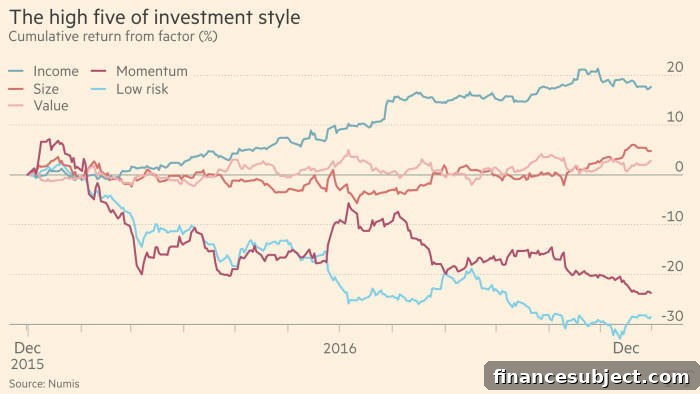
Stocks in the data belong to the Numis Smaller Companies Index.
Source: Financial Times
Practical availability is another constraint. In some markets it’s hard to find clean, investable versions of every factor—for instance, straightforward small-cap trackers can be difficult to access in certain jurisdictions.
Because factor returns are episodic, many investors choose to blend multiple factors within a portfolio to smooth outcomes. That approach makes sense: when one factor is underperforming, another might be doing well. But there’s a trade-off. Combine enough factors and you can end up approximating a broad, diversified global tracker — often at higher cost and greater complexity than a single, simple index fund.
Not everyone is convinced Smart Beta delivers on its promises. Prominent index fund pioneers and many long-term passive advocates remain sceptical about replacing plain global trackers with more complicated alternatives.
From the blogs
Highlights and thoughtful reads from personal finance and investing blogs.
Passive investing
- The Irrelevant Investor — The most powerful force in the universe
- Humble Dollar — What a lawyer learned about investing
- DIY Investor (UK) — A logical investment strategy revisited
- The Evidence-based Investor — Too many cooks in the kitchen
- T.E.B.I. (podcast) — Interview with Bill McNabb, Vanguard CEO
Active investing
- Smead Capital — Beware the Frightful Five
- The Irrelevant Investor — Sell Netflix, Buy Blockbuster
- UK Value Investor (PDF) — Is National Grid a low-risk dividend stock?
- Musings on Markets — Cracking the currency code
- The Waiter’s Pad — Reflections on Charley Ellis
- Investing Caffeine — Brain or machine?
- The Value Perspective — Accounts will only get you so far
Other articles
- Peter Lazaroff — Four reasons to buy bonds in 2017
- A Wealth of Common Sense — An investing pet peeve
- JP Asset Management — Principles for a successful retirement
- Retirement Investing Today — Mentally ready for financial independence
- Power Over Life — Investing is the ultimate collection
- Mr Money Mustache — Eulogy to another great dad
- Timothy Burke — The inspiration for Trump’s speech? (social media/video)
Product of the week: The Telegraph reviews Amazon’s new Platinum Mastercard and notes it isn’t the most generous rewards card; points can only be redeemed on Amazon. That said, there’s no annual fee and the sign-up bonus includes a small Amazon gift card.
Mainstream media money
Selected coverage from national and international outlets. Some pieces may sit behind paywalls; in many cases a search result or cached view can help you reach the article if you encounter a firewall.
Passive investing
- Financial Times — The end of active investing? (wide-ranging analysis)
- Telegraph — Vanguard cuts fees on LifeStrategy funds
- Financial Times — Do-it-yourself investors still shunning passive funds
- Guardian — Is the FTSE headed for a crash in 2017?
- Reuters — Struggling hedge funds still expense bonuses and bar tabs
- Bloomberg — How well does running Vanguard pay?
Active investing
- Telegraph — How the UK’s biggest fund lost £717m while markets rose
- Financial Times — Why some commentators are not that into Warren Buffett
- Bloomberg — ETFs have replaced individual stocks as the most actively traded assets
- Bloomberg — Another look at US asset valuations
- Telegraph — When it is worth paying for a human stock picker
A word from a broker
- TD Direct Investing — Do the markets need rebalancing?
- Hargreaves Lansdown — Lloyds shares: Buy, sell, or hold?
Other reading worth your time
- Guardian — Paying for care at home: costs and case studies
- Telegraph — Stamp duty blamed for housing ‘gridlock’ as owners stay put
- ThisIsMoney — Five ways to make extra money from your home
- Telegraph — Mortgage rates rising faster than savings rates
- Guardian — Owning a dog could cost you thousands over its lifetime
- New York Times — Early retirement: great for some, difficult for others
- Quartz — How Steve Jobs used a single piece of advice to help Apple and Nike
- Financial Times — The hidden value of a good night’s sleep
- ThisIsMoney — UK in denial over Brexit, say some Davos commentators
- BBC — Front pages reacting to Trump’s speech: “American carnage”
Book of the week: In light of recent political events, books that chart the rise of prominent figures have returned to bestseller lists. One well-known title that resurfaces periodically is Trump: The Art of the Deal, available in digital and paperback editions for modest prices.
Enjoyed these links? Subscribe to receive a curated weekly list of useful investing and personal finance reading.
- Some articles are only accessible via search-result previews if you encounter a paywall on desktop or mobile. If an article brings up a subscription wall on mobile, try switching your browser to request the desktop site for an alternative route to the content.[↩]