
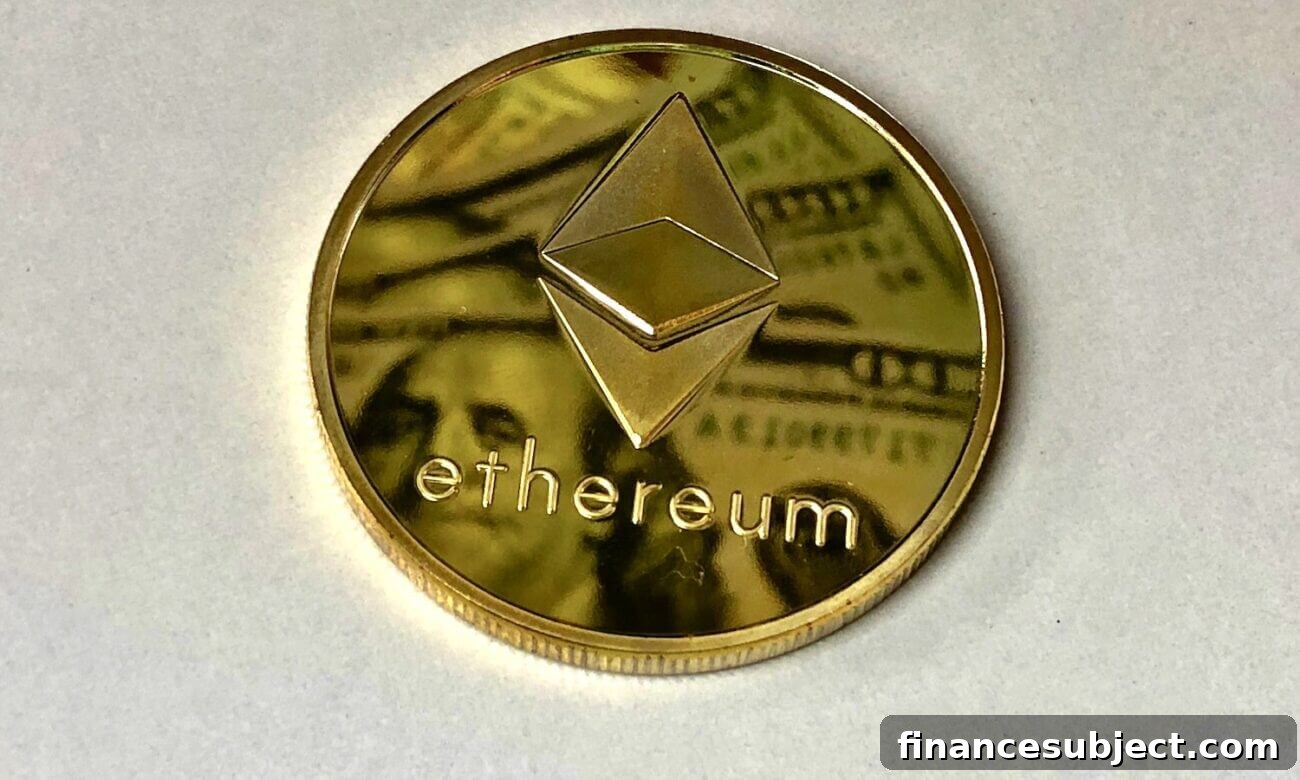
Even if you’re not actively investing in cryptocurrencies, you’ve likely heard of the two market leaders: Bitcoin and Ethereum. Together they dominate the crypto landscape, accounting for roughly 39% and 18% of the total market capitalization, respectively, with other coins trailing far behind.
Ethereum, created by Russian-born Canadian programmer Vitalik Buterin and launched in 2015, was built to expand on what Bitcoin introduced in 2009. Both Bitcoin and Ethereum run on blockchain technology—a decentralized, transparent ledger that records transactions securely. But while Bitcoin was designed primarily as a peer-to-peer form of digital money, Ethereum became a platform for broader innovations, enabling smart contracts, non-fungible tokens (NFTs) and decentralized applications (dApps) through a large developer ecosystem.
What is the Ethereum Merge?
The Ethereum network underwent a major technical upgrade known as “The Merge,” which fundamentally changed how the blockchain validates transactions. Although it sounds technical, the shift has significant practical consequences: it drastically cuts energy use, improves the platform’s long-term scalability, and changes how new ether (ETH) enters circulation. The environmental benefits have been widely praised, while some critics worry the change alters security assumptions. Below is a clear explanation of what The Merge involved and what it means for ether holders and the broader ecosystem.
What changed with Ethereum?
Before The Merge, Ethereum used a mining process similar to Bitcoin’s, called proof-of-work (PoW). Miners used powerful, specialized hardware to solve complex mathematical problems to add new blocks to the chain. This method has strong security properties but is extremely energy-intensive—in fact, Ethereum’s pre-Merge energy usage was comparable to the annual consumption of a country such as Uzbekistan, around 60 terawatt-hours per year.
To address sustainability and scalability, the Ethereum community moved from proof-of-work to a proof-of-stake (PoS) consensus mechanism. Under PoS, transaction validation is performed by validators who lock up (stake) their ETH as collateral rather than competing via energy-heavy mining. The Merge reduced Ethereum’s annual energy consumption by an estimated 99% or more, making the network vastly more energy-efficient.
How did The Merge happen?
The Merge, completed on Sept. 15, 2022, combined Ethereum’s original execution layer (the Mainnet) with a proof-of-stake consensus layer known as the Beacon Chain, which had been running in parallel since 2020. The Beacon Chain had been tested separately while the Mainnet continued processing transactions and smart contracts. When the two were merged, the Beacon Chain became Ethereum’s consensus backbone and took over transaction validation and state management. The transition went through extensive testing and, on the scheduled date, executed without major disruption.
Did The Merge create a new coin?
No. Despite rumors and confusion, The Merge did not create a new cryptocurrency. The token on the unified Ethereum chain remains ether (ETH). The label “Eth2” was sometimes used casually to describe the planned transition, but it never referred to a distinct coin. After The Merge, there is only ETH—no separate Eth1 or Eth2 token to migrate to.
What does The Merge mean for users and holders?
For most users and investors, The Merge required no action. Your transaction history, account balances and smart contracts were migrated seamlessly into the post-Merge Ethereum chain. If you hold ETH in a wallet or on an exchange, you didn’t need to upgrade anything to keep accessing your funds. The main practical change for many users is the reduced environmental footprint of the network and the introduction of staking as a native mechanism to participate in securing the chain.
Because of lingering misinformation, be cautious of scams claiming to trade or convert ETH for a nonexistent “Eth2” token. There is no Eth2 coin, and offers that ask you to transfer tokens for such a swap are fraudulent.
Risks and opportunities for ethereum investors
The move to proof-of-stake brings both benefits and new considerations for investors. On the opportunity side, PoS enables ETH holders to earn rewards by staking their coins—locking them up to support consensus—in exchange for a share of newly issued or protocol-paid rewards. Staking can provide passive income; current estimated annual percentage yields (APY) for staking ETH are often cited around 5%, though rates fluctuate and depend on the staking method.
On the risk side, any major architectural change carries uncertainty. Even with thorough testing and a successful Merge rollout, some investors remain cautious until the system proves durable over time. Market volatility around the Merge demonstrated this: ETH’s price experienced notable swings in the run-up and weeks following the upgrade. Additionally, staking introduces liquidity considerations—staked ETH is subject to lockup rules and unstaking timelines depending on the provider or method used.
If you’re considering staking, take time to understand how staking works, the potential rewards, and the risks involved, including smart-contract risk when using third-party staking services and the potential impact of network conditions on yields.
Aditya Nain is an internationally published author, educator and business owner. His firm specializes in investment research, writing and content. Connect with him on LinkedIn for daily posts on investing, business and life.
Read more about crypto:
- What you should know about cryptocurrency tax in Canada
- How to invest more sustainably in crypto
- How to stake Ethereum in Canada
- Crypto trading fees: Are you paying too much?