

It’s fair to say exchange-traded funds (ETFs) have reshaped the investing landscape by offering low fees, broad diversification and easy access to many markets. With more than 4,300 ETFs listed across Canadian and U.S. exchanges, selecting the right fund can feel overwhelming. Most online brokerages provide ETF screening tools that help narrow your options.
Not all ETFs are the same. They differ in management style (active versus passive), investment objective (income versus total return), benchmark index (broad-market versus niche), and regulatory or legal structure. Understanding these differences helps investors match a fund to their goals and risk tolerance.
In Canada, ETF providers must prepare a concise four-page “ETF Facts” sheet and a long-form prospectus for every fund they offer. These documents are filed with provincial regulators and posted on SEDAR (the electronic filing system for public securities documents in Canada) as well as on fund providers’ websites, so investors can find consistent, regulated information about each ETF.
For many investors, the ETF Facts sheet contains the most useful and accessible information. Presented in plain language, it typically includes:
- Investment objective
- Top holdings
- Past performance
- Risk rating
- Total fees
The fact sheet also lists quick facts such as the ETF’s inception date, assets under management (AUM), the management expense ratio (MER), the fund manager’s name, distribution schedule, ticker symbol, trading exchange and trading currency. ETF Facts sheets must be filed and posted at least annually and whenever there is a material change. Dealers are required to provide the ETF Facts sheet to purchasers within two business days after a transaction.
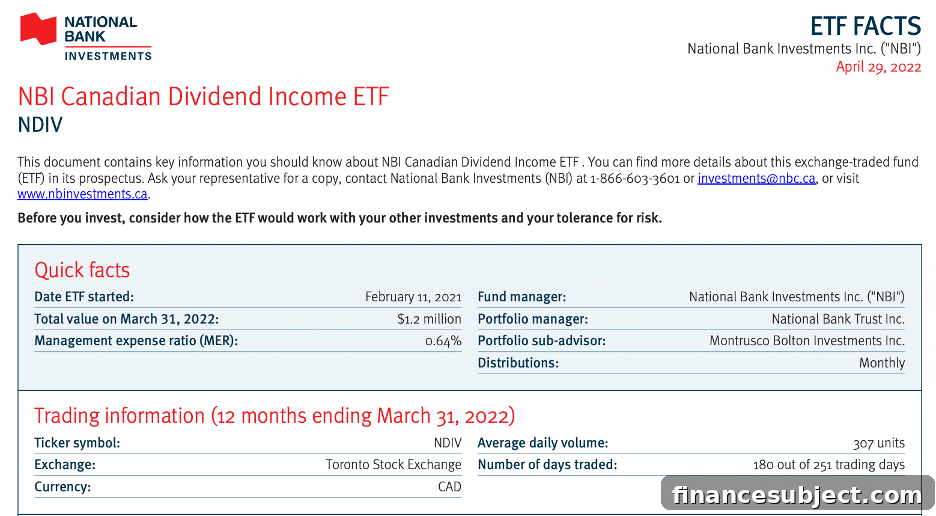
What is an ETF prospectus?
The four-page fact sheet is a summary; a long-form prospectus provides much greater detail. Every ETF must publish a prospectus that covers disclosures, fees and expenses, historical returns, legal structure, investment objectives and strategies, sector exposure, risk factors, distribution policy and income tax considerations, among other topics.
Most investors will not need to read the full prospectus for a simple index fund, but it becomes essential for more complex or actively managed ETFs. Prospectuses are the definitive source when you want to dig into the fund’s mechanics, detailed fee schedules and specific risks.
Regulators such as the Ontario Securities Commission allow a prospectus to be used to distribute securities for up to 12 months before it lapses; it may be renewed for an additional year if certain conditions are met.
What should investors look for in an ETF prospectus before they invest?
Bobby Argitis, business development manager at National Bank Direct Brokerage, suggests investors examine a prospectus when evaluating ETFs that use derivatives, leverage or other sophisticated strategies. These products can have risk profiles and cost structures that aren’t obvious from the fact sheet alone.
For example, the fact sheet for National Bank Investments’ Liquid Alternatives ETF (NALT) states the fund aims to provide a positive return with low correlation and lower volatility relative to global equity markets. It does so by taking long and short positions in financial derivatives and may introduce leverage of up to 300% of net asset value (NAV).
The prospectus for that series of ETFs provides more specifics: the fund relies on computer models and a rules-based approach to set long and short positions, uses futures contracts to obtain exposure to bonds, currencies, equities or commodities, and determines its leveraged position at the end of each trading day. If exposure exceeds 300% of NAV, the fund policy is to reduce exposure to 300% or less “as quickly as is commercially reasonable.”
Other ETF documents worth reviewing
Beyond the ETF Facts sheet and prospectus, other documents can add important context. Monthly profiles, quarterly disclosures, annual reports and annual financial statements provide transparency on performance drivers, trading activity and income sources such as securities lending.
Benjamin Felix, a portfolio manager at PWL Capital, recommends at minimum reviewing the annual management report of fund performance (MRFP) and the annual financial statements. The MRFP often contains details on portfolio turnover and trading expense ratios, while the financial statements show securities-lending income and foreign withholding taxes—elements that affect a fund’s total cost of ownership.
Passive index investors should also consider reviewing the index methodology from the index provider. Indexes with similar names can differ materially in construction and weighting, and some proprietary indexes may behave more like active management than a typical market-cap benchmark. Understanding the index rules clarifies what you are really buying.
Final thoughts on ETF documents
For many do-it-yourself investors, the ETF Facts sheet will answer the most pressing questions. However, when evaluating complex or leveraged ETFs, or when you want to fully understand fees and taxation, a careful read of the prospectus is worthwhile. Annual reports and financial statements reveal additional costs and income sources that influence long-term returns.
At minimum, read the ETF Facts sheet before buying. If you want to be confident about what you own, a deeper dive into the prospectus and related disclosures is never wasted time.
Your brokerage platform may offer tools and educational resources to help compare ETFs by strategy, fees and holdings. Some brokerages provide centre pages or dedicated ETF hubs where you can filter funds, read summaries and access prospectuses and reports.
This article is sponsored.
This paid post is intended to inform readers and may feature a client’s product or service. It was written, edited and produced by MoneySense in collaboration with freelancers.