
Ready for a bun fight? Commercial property remains one of the most debated asset classes among investors, especially those who prefer passive strategies.
We’re not comparing it to the fierce camps formed around gold or cryptocurrencies, but even an out-of-town office park with convenient motorway access seems to stir heated opinions.
- Proponents argue commercial property provides diversification from equities while offering higher returns than cash or government bonds. Many model portfolios include a dedicated allocation to property.
- Opponents counter that the diversification benefits are unclear, that most people already have property exposure via their home or through shares, and that large physical assets—difficult and costly to buy and sell—may not suit retail investors. Some model portfolios therefore omit property entirely.
Both sides make valid points. Below I outline the essential characteristics, historical performance, and practical considerations so you can decide whether commercial property belongs in your portfolio.
Characteristics of commercial property as an asset class
Academics typically position commercial property between equities and fixed income on a risk-and-return spectrum.
That description reflects the reality of bricks and mortar. Commercial property—offices, hotels, warehouses, or apartment blocks—is income-producing real estate leased to tenants. Rental income provides a steady cash flow that resembles the coupon payments of a bond, but with greater uncertainty.
Think of commercial property more like a corporate or high-yield bond than a government bond. Rent is not guaranteed and capital values can fluctuate. The quality of tenants and lease terms strongly influence risk: long-term leases to government bodies or blue-chip firms are relatively secure, while riskier tenants can offer higher yields but bring the possibility of default, void periods, and replacement costs.
Maintenance, refurbishment, and adapting buildings to technological and fashion shifts are ongoing costs. Older areas required investment to install central heating, insulation, lifts, and communications infrastructure. Landlords must decide what upgrades are necessary to keep properties competitive—decisions that affect net returns in ways a plain bond does not.
Compared with equities, property tends to change more slowly. It’s a real asset that can preserve value in inflationary environments in ways paper assets without inflation protection cannot. So property has a hybrid profile: partly bond-like because of income, partly equity-like because of active management and capital appreciation potential.
Some listed property companies and REITs (Real Estate Investment Trusts) engage heavily in development activity. Where development is a significant part of the business, these vehicles behave more like equities, with higher volatility and different return drivers than straightforward rental-focused property.
Always inspect the underlying strategy of any property fund or listed vehicle to understand whether you’re getting stable rental income, development exposure, leverage, or a mix.
An off-the-shelf property empire
Most private investors won’t buy whole office blocks or shopping centres directly. Instead, we pool capital through funds and listed vehicles to own fractional interests across many properties. That diversification reduces idiosyncratic risks compared to owning a single small commercial unit.
Property funds offer exposure through a single purchase and often distribute relatively high income, reflecting the cash-generating nature of most rental property. But funds also introduce their own frictions—fees, transaction costs, leverage, and sometimes liquidity constraints—which affect the returns ultimately received by retail investors.
Returns from commercial property
Looking at historical returns provides an objective view. Regulatory analysis and industry indices show that commercial property has delivered modest nominal returns over the long term, with substantial variability around those averages.
Data assembled for pension fund and adviser guidance points to average annual nominal total returns for commercial property in the low-to-mid single digits when fund-level costs, transaction expenses, and development impacts are included. Property returns tend to include a stable income component plus a more volatile capital growth element—during crises capital values can fall sharply.
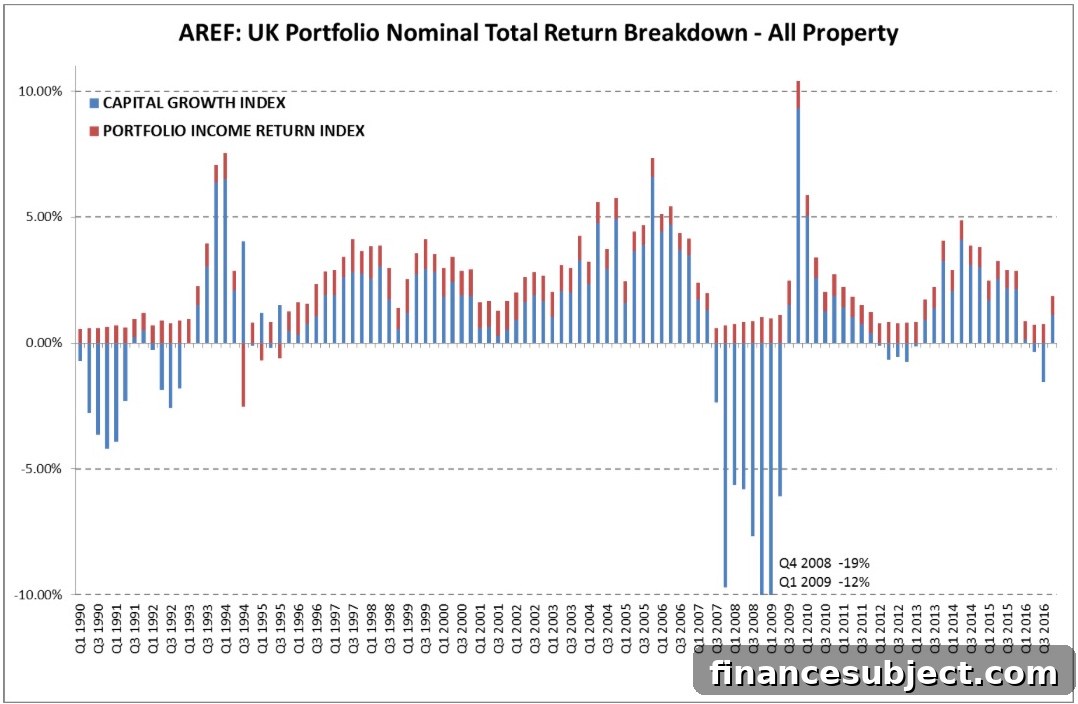
(Click to enlarge)
Source: FCA/AREF/Datastream
If you held property through 2007–2009, the fall in capital values could have felt worse than equity market declines in the short term. That episode highlights how property can be volatile when liquidity and pricing freeze up.
An aside about income
Income is a large and comparatively steady part of property returns. Because of this, holding property exposure within tax-advantaged wrappers such as an ISA or pension will often be more tax-efficient. For listed vehicles, much of the payout may be classified as a property income distribution rather than a conventional dividend, which has tax implications outside shelters.
The REIT stuff
Many retail investors gain exposure to commercial property via REITs and listed real-estate funds. These vehicles offer liquidity and diversification, but they also introduce stock-market volatility—listed property can behave like a hybrid of shares and property returns.

Source: FCA / Bloomberg
Since the global financial crisis, REIT performance has been mixed: sharp losses during the crisis followed by periods of strong recovery. The short history of the modern REIT structure in some markets limits the length of reliable historical data available to investors.
Views vary. Some investors argue that global REITs provide useful diversification and reasonable returns relative to bonds, while skeptics point to the limited long-run data and structural differences between direct property investment and listed vehicles.
Future returns from commercial property
Looking forward, commercial property is likely to offer returns between those of bonds and equities: higher than very liquid government bonds but lower than the long-run expected returns from equities. The asset class also compensates investors for illiquidity, upkeep costs, and other practical risks.
Forward-looking estimates from regulators and industry tend to assume a modest spread of property returns over government bonds. But these expectations shift as bond yields and macroeconomic outlooks change—government yields are an important anchor for return assumptions across asset classes.
Structural trends add uncertainty. The shift to online retail, changing office usage patterns, and evolving consumer behaviour can reduce demand for some property types or force substantial refurbishment and repositioning costs.
For most investors, a modest allocation—often in the region of 5–10%—to property or global REITs is a sensible compromise between diversification and risk, given valuation, interest-rate environments, and the secular challenges facing parts of the sector.
In a follow-up article I will explain practical ways to gain property exposure without stepping onto a building site or negotiating with tenants. Subscribe to receive the next piece.
- A professional bond investor will look into the viability of the company or government behind the bond. But the actual security itself is just an IOU with a known income attached.[↩]
- That is, not inflation-linked bonds[↩]
- i.e. Development.[↩]
- That is, without adjusting for inflation.[↩]
- This is based on the performance of members of the UK Association of Real Estate Funds (AREF) and published by IDP.[↩]
- In short, the letting income is paid out as a PID, whereas money made from other activities can be paid out as a dividend.[↩]
- Real Estate Investment Trust.[↩]
- Global index funds as favoured by some investors will include a small percentage of property companies.[↩]
- Some funds restricted redemptions during market stress, such as after the Brexit vote correction.[↩]
- A REIT can be sold at any time, but potentially at a discount to underlying value. A non-listed fund may be gated, locking up capital to prevent panic selling but limiting access if you need the money.[↩]