
After the success of his acclaimed book Just Keep Buying, bestselling author Nick Maggiulli returns with The Wealth Ladder. Below, Nick explains why the Wealth Ladder is a practical framework for tracking progress and improving your financial life.
When I was five, my father taught me how to play chess. For fun, he invited his friends over and let them challenge me. They were always surprised when I won.
Picture it: you’re 27 and a kindergartner just knocked your ego with a single word—checkmate.
Jokes aside, I wasn’t a chess prodigy. My father’s friends simply didn’t play well. I stopped playing for several years after my parents separated, then rediscovered chess in high school. My friend and I started a chess club. I memorized openings and practiced responses until my first five to ten moves were automatic. I improved—but a lesson from a competition changed how I thought about improvement.
At my first real tournament I watched Victor, a top player, and realized he didn’t approach chess the way the rest of us did. Sometimes he opened conventionally, sometimes not. He would accept a gambit one game and ignore it the next. His decisions seemed to come from a different logic I couldn’t replicate by just memorizing openings.
The revelation was simple but powerful: effort alone wasn’t the limiting factor—my strategy and framework were. I could practice for hundreds more hours and never reach Victor if I didn’t change how I thought about the game. Where and how you apply effort matters more than effort by itself.
Years later I recognized the same dynamic applies to building wealth.
Thinking differently
Without the right framework, people often work harder and longer without improving their financial outcomes. They try to apply the latest tips, blame poor luck or a bad boss, or assume they simply need more discipline. In reality, many are using the wrong strategy for their circumstances—memorizing openings while the Victors of finance are playing a different game.
As Andy Grove observed, “There are so many people working so hard and achieving so little.” The problem, in many cases, isn’t effort: it’s strategy.
What if instead of one-size-fits-all rules, we used a flexible framework that taught you how to think about money across changing circumstances? Interest rates shift, careers evolve, family needs change. A static checklist won’t work for a lifetime. What you need is a guiding structure you can rely on as your situation changes.
That structure is the Wealth Ladder.
Introducing the Wealth Ladder
Would $100 change your life? What about $100,000 or $100 million? The answer depends on where you are today. For most people, $100 million would transform life; for a billionaire it might barely register. This relativity matters when you measure wealth.
By “wealth” I mean net worth: everything you own (property, savings, investments) minus what you owe (mortgages, loans, credit card debt).
We tend to think of wealth as a smooth progression—more is always better and each additional dollar increases happiness or lifestyle. But in practice, meaningful changes in lifestyle and financial choices happen in steps, not dollar-by-dollar. Someone with $500,000 often lives much like someone with $400,000; a move from $50,000 to $150,000, by contrast, can be transformative.
So, think of wealth as a ladder instead of a line. Each rung corresponds to a range of net worth that affects how you spend, earn, save, and invest. Moving from one rung to the next often requires fundamentally different strategies.
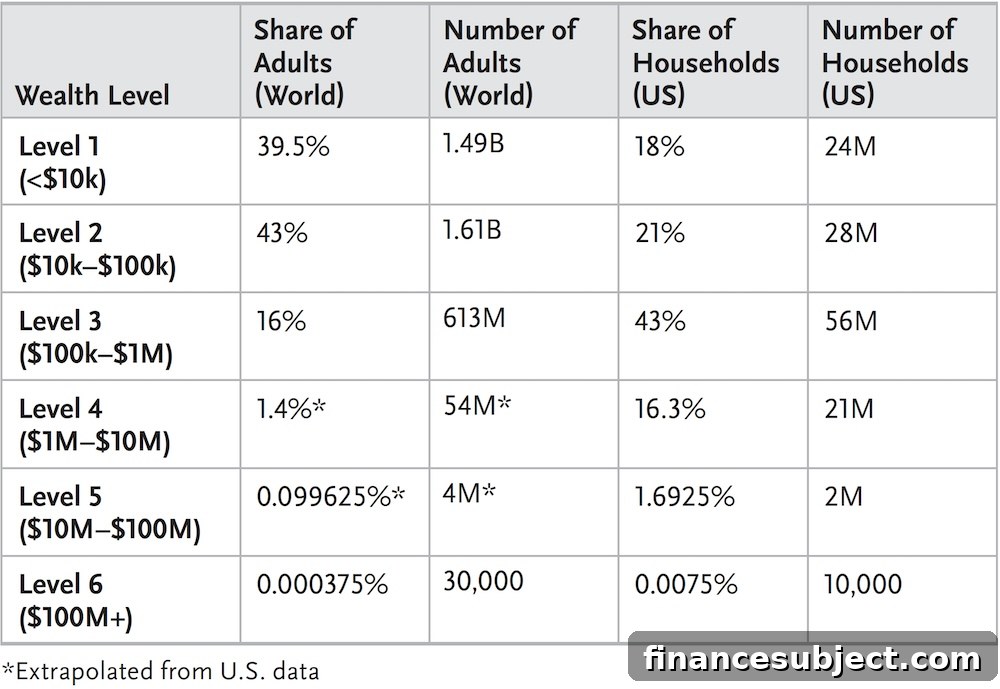
The Wealth Ladder divides net worth into these levels:
- Level 1 (<$10,000)
- Level 2 ($10,000–$100,000)
- Level 3 ($100,000–$1 million)
- Level 4 ($1 million–$10 million)
- Level 5 ($10 million–$100 million)
- Level 6 ($100 million+)
Each level is roughly ten times the previous because that scale typically produces a meaningful lifestyle shift.
Wealth around the world
Most people globally fall in the lower levels of the ladder. As wealth rises, the number of people at each successive level drops dramatically. For example, billions of adults are below $10,000, while only a tiny fraction reach the highest tiers.
Because wealth is concentrated differently across countries, national distributions vary. In wealthier economies, you’ll see more households in middle rungs; in other regions, most households will cluster in the lower rungs. Mapping wealth into these levels helps explain why perceptions of “rich” differ: someone in Level 4 may look up at Levels 5 and 6 and consider themselves not rich, even if they are a millionaire.
When you translate economic classes into the Wealth Ladder, you get a clearer picture:
- Level 1. Lower class (<$10k)
- Level 2. Working class ($10k–$100k)
- Level 3. Middle class ($100k–$1M)
- Level 4. Upper middle class ($1M–$10M)
- Level 5. Upper class ($10M–$100M)
- Level 6. The superrich ($100M+)
Understanding your current rung reveals which strategies are appropriate and which are wasted effort.
How to climb the ladder
Conflicting financial guidance often comes from advisors addressing different rungs. Budgeting advice matters deeply for someone in Level 1 or 2, but it won’t meaningfully move someone already in Level 6. Conversely, business scaling or complex tax strategies can be critical for wealthy households but irrelevant for those just starting out.
The Wealth Ladder helps you match tactics to your position. Think of it like a fitness coach: a beginner and an elite athlete need different diets and workouts. The same is true for financial decisions. When you use this framework, budgeting, saving, investing, entrepreneurship, and risk-taking become tools chosen for the right rung, not one-size-fits-all commandments.
Once you learn to see wealth this way, your choices change: the careers you pursue, the risks you take, and the habits you keep will be more aligned with the outcomes you want. The difference between those who build lasting wealth and those who struggle often comes down to choosing the right strategy for their level and focusing effort in the right places.
The Wealth Ladder in practice
My own background shapes this framework. I grew up in a working-class family in Southern California. My parents faced financial instability, and I had no ready-made financial models to follow. I was the first in my family to graduate college, attended Stanford, and later worked in litigation consulting before moving into financial research and writing.
Today I work at a wealth management firm and have analyzed extensive datasets that track household finances across decades. Those experiences, combined with my personal journey, informed the Wealth Ladder concept. It’s meant to distill research and practical lessons into a simple, applicable framework for people at every stage.
Time to step up
The Wealth Ladder is designed to help you build meaningful wealth in ways that improve your life, not just your net worth. My aim is to provide guidance you can adapt as circumstances change—so you can climb intentionally, avoid common pitfalls, and recognize when “enough” is enough.
Are you ready to climb?
Note: This piece summarizes the Wealth Ladder framework and the ideas behind Nick Maggiulli’s new book. Consider where you stand on the ladder, which strategies fit your current level, and how a level-based approach could simplify your financial decisions.