

Welcome to the Canadian Crypto Observer. Financial journalist and author Aditya Nain provides concise analysis of market-moving headlines to help Canadian investors understand the cryptocurrency landscape.
How will a Trump presidency affect crypto?
Before Donald Trump won the U.S. presidential election on Nov. 5, many crypto investors expected his administration to take a friendlier stance toward digital assets than a Kamala Harris administration might have. High-profile endorsements from figures such as Elon Musk, who has publicly supported various cryptocurrencies including meme coins, helped shape that view.
The market reacted quickly. On election night, as Trump’s victory became clearer, bitcoin’s U.S. dollar price jumped roughly 8%, climbing from about $69,400 to above $75,000 and surpassing its March 2024 high. In the days that followed, bitcoin continued to trend higher, trading above $85,000 at the time of writing.
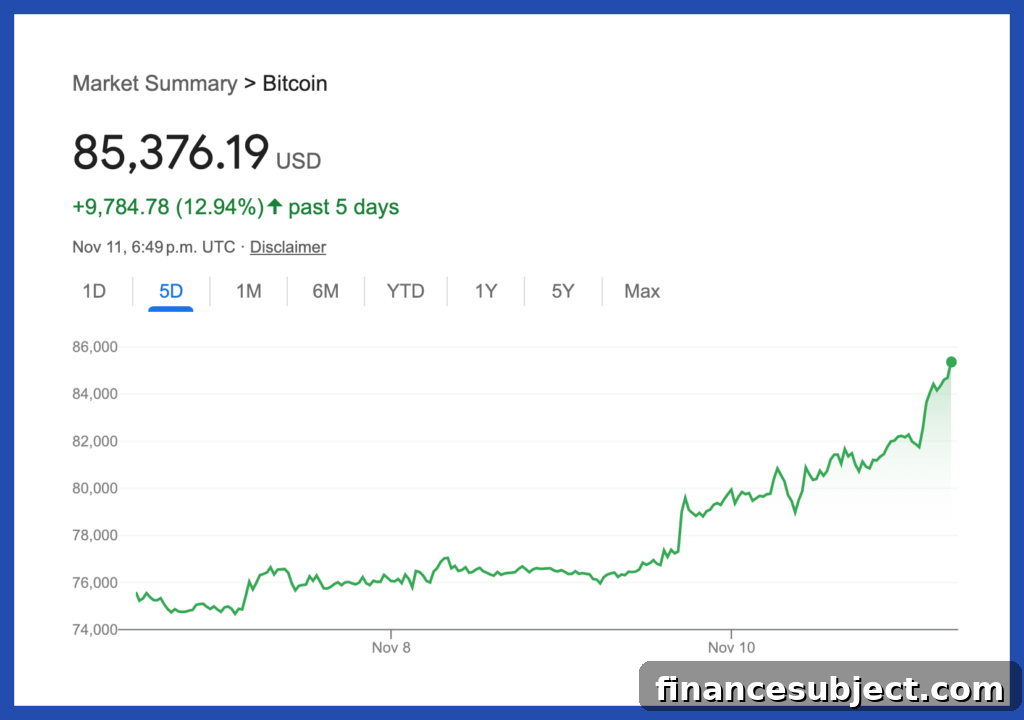
Source: Google
Yet the president’s preferences do not determine crypto policy alone. The chair of the U.S. Securities and Exchange Commission (SEC) plays a central role. Gary Gensler, an MIT professor who has taught courses on blockchain, has been viewed as a more cautious regulator since taking the helm of the SEC in June 2021. A key question for markets: will Gensler finish his term through June 2026, or will a new SEC chair appointed under a Trump administration shift the agency’s approach to digital assets?
Beyond regulation, investors are pricing in broader macro effects tied to a Trump presidency—especially higher inflation expectations. Trade tensions and potential tariff increases with major partners such as China would raise import costs, which can feed into consumer inflation. Higher inflation expectations often drive interest in assets perceived as hedges or alternatives, and that dynamic can support crypto prices.
Also read
The best crypto platforms and apps
We’ve ranked the top crypto exchanges available to Canadians.
Bitcoin hits $100,000
On Oct. 29, 2024, bitcoin reached CAD$100,000. While the global crypto market tracks prices in U.S. dollars, hitting six figures in Canadian dollars is a milestone that resonates with Canadian investors.
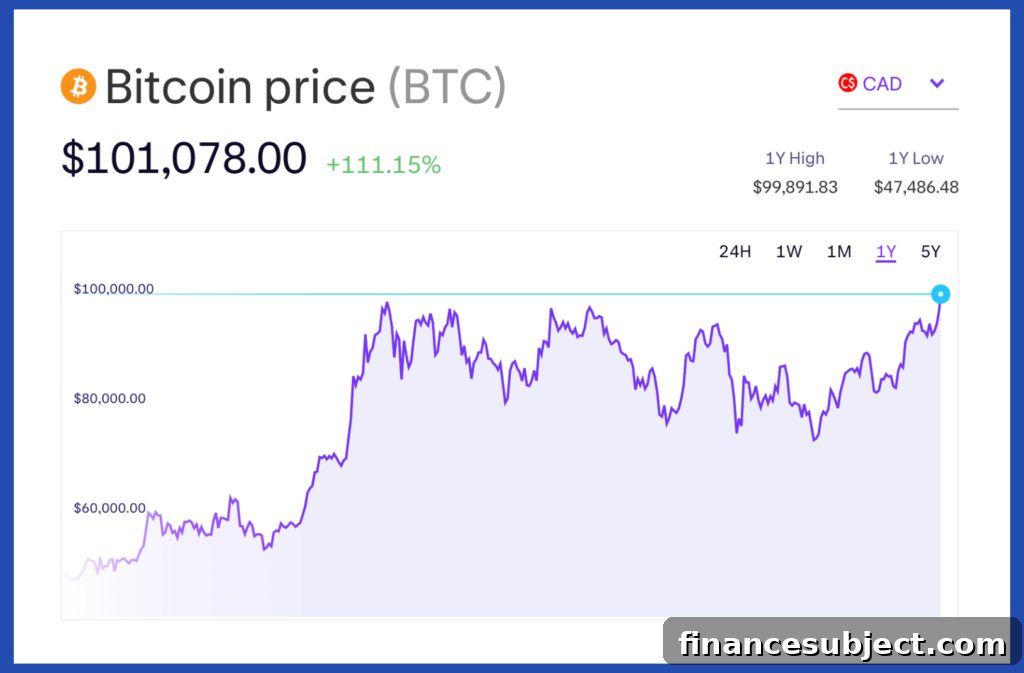
The Canadian-dollar milestone matters mainly for sentiment and technical analysis performed by local traders. Price points quoted in CAD can become psychological levels that influence buying and selling behavior among domestic investors.
Canadian bitcoin pricing depends on two factors: the U.S. dollar bitcoin price and the CAD–USD exchange rate. A change in either can move the bitcoin price in Canadian dollars:
- CAD depreciation: If the Canadian dollar weakens versus the U.S. dollar (for example, USD$1 rises from CAD$1.30 to CAD$1.35), bitcoin’s price in Canada increases even if the U.S. bitcoin price remains unchanged.
- CAD appreciation: If the Canadian dollar strengthens (for example, USD$1 falls from CAD$1.30 to CAD$1.25), bitcoin’s price in Canadian dollars falls, all else equal.
Coinbase scores a touchdown with the CFL
U.S.-based crypto exchange Coinbase became the official crypto partner of the Canadian Football League (CFL) and the 111th Grey Cup, sponsoring the opening coin toss for the championship game in Vancouver on Nov. 17, 2024. This marks Coinbase’s first formal partnership with the CFL.
Why invest in Canadian sports sponsorships? Coinbase’s research identifies Canada as one of its strongest non-U.S. markets, with an estimated five million crypto holders—roughly 12%–13% of the population. Canada was also the first country to approve and launch a spot bitcoin exchange-traded fund (ETF), making it an attractive market for crypto firms targeting growth and mainstream adoption.
The CFL partnership aligns with marketing strategies that target demographic overlaps between sports fans and crypto investors. Research has shown a higher proportion of male fans in both groups, making sports sponsorships an effective way for crypto firms to raise brand awareness. The strategy mirrors other high-profile sports deals in the industry, where exchanges and crypto services have invested heavily in visibility through leagues and venues.
Tools
MoneySense’s ETF Screener Tool
Is the creator of bitcoin Canadian?

An HBO documentary released in October, titled Money Electric: The Bitcoin Mystery, considers whether Canadian software developer Peter Todd could be Satoshi Nakamoto, the pseudonymous creator of bitcoin. Satoshi published the bitcoin whitepaper in 2008 and launched the network in 2009, then stopped communicating with the community in 2011. The original Satoshi address holdings—roughly one million bitcoin—remain untouched, adding to the mystery.
Todd has publicly dismissed the claim, calling the documentary’s suggestion a publicity stunt and warning that such speculation could attract unwanted attention. Given the long list of individuals who have been suggested as Satoshi over the years, Todd is one of many whose names have circulated in public debate.
Other figures who have been proposed as Satoshi include early contributors, cryptographers and developers closely connected to bitcoin’s origins. Below is a concise table summarizing some of the better-known candidates and their connections to bitcoin.
| Name | Background | Connection to bitcoin | Claim status | Denied being Satoshi |
|---|---|---|---|---|
| Hal Finney | Computer scientist and cryptographer | Early bitcoin adopter; received the first BTC transaction | Claimed by others | Yes |
| Nick Szabo | Computer scientist and cryptographer | Creator of “bit gold,” an early conceptual predecessor to bitcoin | Claimed by others | Yes |
| Adam Back | CEO of Blockstream; creator of “Hashcash” | Hashcash influenced bitcoin’s proof-of-work design | Claimed by others | Yes |
| Wei Dai | Computer scientist | Creator of “B Money,” referenced in early bitcoin discussions | Claimed by others | Yes |
| Gavin Andresen | Software developer | Worked closely with Satoshi and became lead developer afterwards | Claimed by others | Yes |
| Dorian Nakamoto | Physicist and engineer | Linked by surname and some circumstantial details; no direct evidence | Claimed by others | Yes |
| Craig Wright | Computer scientist and entrepreneur | Has publicly claimed to be Satoshi | Self-claimed | No |
What’s next for crypto?
The U.S. presidential election was a major near-term catalyst for crypto markets, but investors should avoid making decisions based solely on political outcomes. Regulation remains a key factor shaping crypto’s future, and the regulatory environment is still developing on both sides of the border. The president can influence appointments and policy direction, but market participants should remember that many other institutions—regulators, courts, and international bodies—also shape the landscape.
Cryptocurrencies are inherently volatile and speculative. With bitcoin trading at or near record highs in U.S. dollars, feelings of FOMO (fear of missing out) can tempt investors to act impulsively. A prudent approach is to assess risk tolerance, diversify appropriately, and invest only what you can afford to lose. For investors focused on long-term goals, separating political sentiment from financial planning generally leads to better outcomes.
Newsletter
Get free MoneySense financial tips, news & advice in your inbox.
More about crypto:
- Gemini is exiting the Canadian market, plus more crypto news
- Should you consider ETFs that include crypto?
- 10 common crypto scams and how to avoid them
- How Coinbase is reshaping Canada’s crypto landscape