

Author, public speaker and former financial services professional Mike Drak emphasizes that retiring is only the beginning—and that what follows can be the most challenging and rewarding phase. In this excerpt from his book Longevity Lifestyle by Design, Drak argues that a successful transition requires a retirement vision that goes beyond spreadsheets and savings targets, so you can design an engaging, active “second life.”
The new retirement
For decades, popular advertising has pushed a narrow image of retirement: the ideal couple relaxing on a beach or playing endless rounds of golf. That portrayal is misleading. Not every retiree wants that lifestyle, and many cannot afford it. These idealized scenes create unrealistic expectations and often cause anxiety because most people know their own retirement won’t match that scripted fantasy—and many have no clear idea what it will look like.
We need to stop accepting these clichés. They limit imagination and obscure the wide variety of meaningful, fulfilling paths available after leaving a primary career. Instead of clinging to an outdated stereotype, think instead about shaping a thoughtful plan for continuing engagement, purpose and activity.
The retirement distribution curve
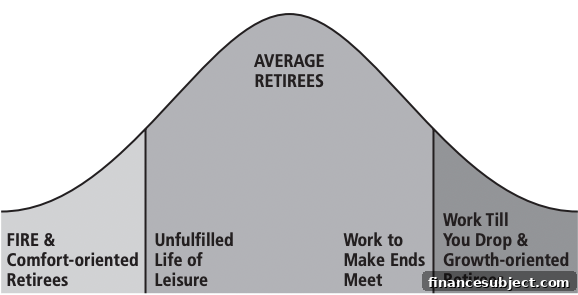
As the distribution curve illustrates, many people are moving away from the twentieth-century model of a sharp transition into full-time leisure. That traditional “full-stop” retirement—where you suddenly slow down and stay idle—has become less common. The single word “retirement” no longer captures the variety and potential of what people are now doing. A better framing is to think of retirement as a “second life.”
Your first life centers on learning, earning and achieving: education, career-building and saving to provide for family and future security. Your second life begins when you step away from your primary career—whether by your choice or through circumstances beyond your control. That transition can be disorienting, but it can also open possibilities if you plan thoughtfully.
Rather than an endpoint, your second life can be a new starting line: an opportunity to blend meaningful work, creative pursuits, travel, relationships and adventure in a way that suits your interests and energy. How you frame this stage will influence how energized and fulfilled you feel.
Research supports the changing view of retirement. A May 2022 study by Age Wave and Edward Jones, “Longevity and the New Journey of Retirement,” found that only 27% of respondents see retirement primarily as rest and relaxation, while 55% call it “a new chapter of life.” In that survey, 59% said they plan to work in some way during retirement, mainly to stay mentally engaged and maintain financial comfort. These findings underscore that many people envision retirement as a blend of work and leisure rather than a permanent halt to activity.
Approached with intention, your second life can be a personal renaissance—more creative, more meaningful and more adventurous than the years that came before. Consider it the payoff for decades of effort: an opportunity to pursue significance, not just to step back.
Although the word “retirement” will still appear throughout this book because it is widely understood, try to reframe it in your mind as your second life. That mental shift opens possibilities and helps you create a positive plan to work toward.
Questions for self-reflection
- What kind of retiree do you want to be?
- Where do you fall on the bell curve for how people approach their second life?
- If you find yourself in the large middle of uncertainty, what steps will you take to clarify your vision?
- When you leave your primary career, will you see it as crossing a finish line—or as the start of an exciting second life?
Takeaways
- People want very different things from retirement; a great second life looks different for everyone.
- Approaches to retirement vary based on experience, needs, interests and financial circumstances; there is no single right answer.
- Many people are rejecting the idea of a full-stop retirement; they prefer to stay active, engaged and learning.
- Longer life expectancy makes the traditional model of decades of pure leisure impractical for many people—both financially and psychologically.
- For many, the second life is less about accumulating wealth and more about finding meaning, growth and renewed purpose.
- With the right mindset and preparation, your second life can recreate the excitement and possibility you felt early in your career.
- Don’t let a narrow definition of retirement limit what you can become.
Mike Drak spent 38 years in the financial services industry. He now leads workshops and speaks publicly to help people plan for retirement opportunities and purposeful second lives. He is a senior contributor on the topic of retirement and longevity.
This excerpt comes from the book Longevity Lifestyle by Design (September 2022). The book explores how to redefine retirement and offers practical guidance for designing a fulfilling second life.
Read more about retirement planning:
- Why you need a financial plan
- Financial planning in your 70s
- How inflation can affect your retirement plans