

At the time of writing, the S&P 500, Nasdaq Composite and Dow Jones Industrial Average were hovering near all-time highs, but as we moved into the latter half of November, market performance showed increased volatility and uncertainty. Rising markets can feel encouraging, yet many investors respond to lofty valuations with concern—understandably, since every advance has historically been followed by periods of retracement. The key is distinguishing short-term noise from long-term progress.
Some of the market anxiety is amplified by high-profile commentary. New York Times financial journalist Andrew Ross Sorkin has drawn comparisons between today’s booming markets and the 1920s prior to the crash, while investor Michael Burry—known for predicting the 2008 housing market collapse—has taken positions betting against some AI-related stocks such as Nvidia and Palantir Technologies. That pessimism contributed to one of the Nasdaq’s worst weeks this year. Still, companies like Nvidia, valued at more than US$4.5 trillion, and Palantir, valued at more than US$4 billion, continue to report robust fundamentals.
Keep perspective. Yes, major U.S. indices are at or near record levels, and yes, markets will decline from time to time. But the long-term trend has historically been upward. For context, the Dow Jones Industrial Average crossed the 1,000-point mark in 1972; today it sits many multiples higher. Corrections are a normal part of the market cycle: modest pullbacks of 5%–7% can occur a few times within a 12-month period, while larger declines of 20% or more—typical bear-market magnitude—tend to happen one or two times over several years. These events are painful for short-term returns but common in the broader context of long-term growth.
We just experienced a meaningful drawdown. In April, when the announcement of reciprocal tariffs triggered a politically driven selloff, markets fell nearly 20%. That drop reflected market reaction to policy risk rather than fundamental deterioration of many companies, and since then the major U.S. indices have generally recovered and resumed upward movement.
Tune out the noise
Investors have enjoyed strong gains recently. Over roughly the last three years, the S&P 500 climbed more than 70%, with many portfolios showing annualized returns well above long-term historical averages. While such gains feel exceptional, the long-run norm for returns is likely closer to 8%–10% annually. Even if the market experiences a 5%–10% pullback during the remainder of the year, many portfolios will still be substantially ahead year-to-date. That’s not a cause for panic; it’s a reminder to separate emotion from strategy.
Corrections and recoveries follow a familiar pattern: markets reach new highs, give back some gains, form a base, and then resume the climb beyond previous peaks. A decline does not mean your investment plan has failed—it often represents a temporary retrenchment of gains you previously earned. Those gains can return over time for investors who remain invested and adhere to a disciplined approach.
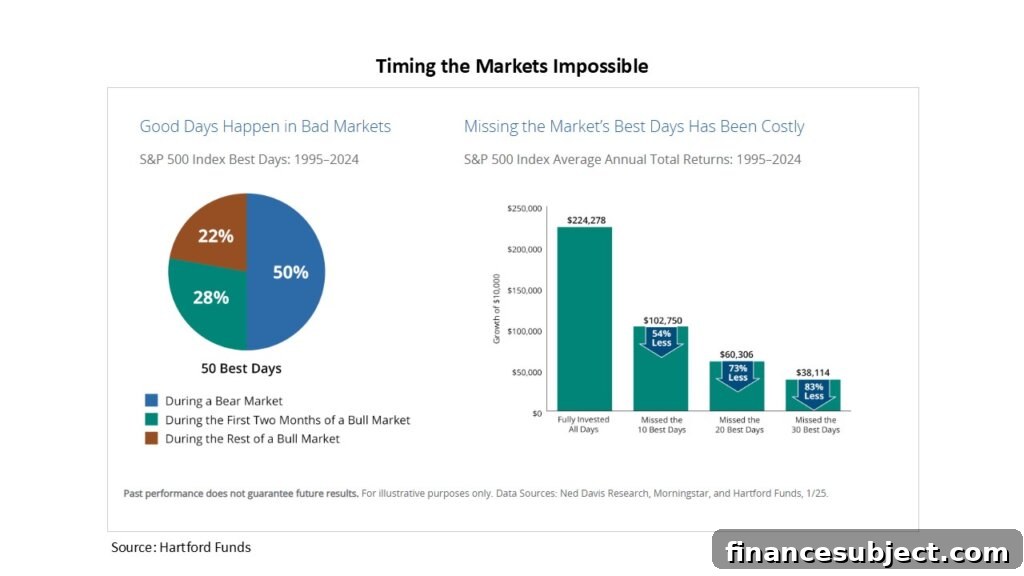
No one can reliably and consistently time market tops and bottoms. Trying to capture every upward move or to avoid every dip usually leads to missed opportunities and poorer long-term results. Instead, focus on time in the market: staying invested through volatility rewards patient investors over years and decades.
Also read
The best online brokers, ranked and compared
Why you need to stay invested
Historical research underscores the cost of stepping away. Analysis from Hartford Funds finds that, over a 30-year span, half of the S&P 500’s 50 best single trading days occurred during periods that included bear markets. Missing just the 10 best days in that timeframe would have reduced returns by roughly 54% compared with remaining fully invested. Those statistics highlight how quickly large rebounds can occur and how damaging missed opportunities can be for long-term wealth accumulation.
Start with clear financial goals and an investment horizon. Knowing whether you need capital in five years versus twenty-five years determines the blend of assets that will help you meet those objectives. For long-term growth, equities remain a compelling option for many investors, particularly when interest rates are relatively low and cash yields do not keep pace with inflation.
Focus on high-quality companies that generate profits and show sustainable growth potential. Avoid chasing short-term trends or speculative “hot” stocks. Maintain diversification across sectors and asset classes to reduce concentration risk. Regular portfolio reviews with an emphasis on risk management will help you stay aligned with goals—consider trimming positions that have appreciated substantially and redeploying gains into undervalued or higher-quality opportunities.
These principles—clarity of goals, diversification, quality selection, and disciplined rebalancing—form a reliable approach that can succeed across market environments, whether markets are hot or cool.
Newsletter
Get free MoneySense financial tips, news & advice in your inbox.
Read more about investing in the stock market:
- Is the stock market going to crash in 2025?
- Is the AI boom a ‘bubble’? Tech leaders don’t think so
- What’s behind the Nvidia rally?
- Top 100 dividend stocks in Canada 2025