

Welcome to the Canadian Crypto Observer. Financial journalist and author Aditya Nain offers perspective on market-moving headlines to help Canadian investors navigate the cryptocurrency market.
Stablecoins are in the limelight. What are they?
A stablecoin is a cryptocurrency built on blockchain technology whose value is intended to remain steady relative to an underlying asset, most commonly the U.S. dollar. For example, one Tether (USDT) is designed to equal one U.S. dollar. You can think of stablecoins as the cash of the crypto ecosystem: they let you stay inside the crypto world without exposing funds to the frequent and sharp price swings of bitcoin (BTC), ethereum (ETH) or Solana (SOL).
Stablecoins play a central role in crypto markets. Key facts to know:
- In April 2025, stablecoins accounted for more than 50% of on-chain transaction volume.
- Two of the 10 largest cryptocurrencies by market capitalization are U.S.-dollar stablecoins: Tether (USDT) and Circle’s USDC.
- As of May 25, 2025, USDT and USDC together had a market capitalization exceeding $218 billion (figures in U.S. dollars unless noted). For context, that is slightly below Netflix and slightly above McDonald’s by market cap.
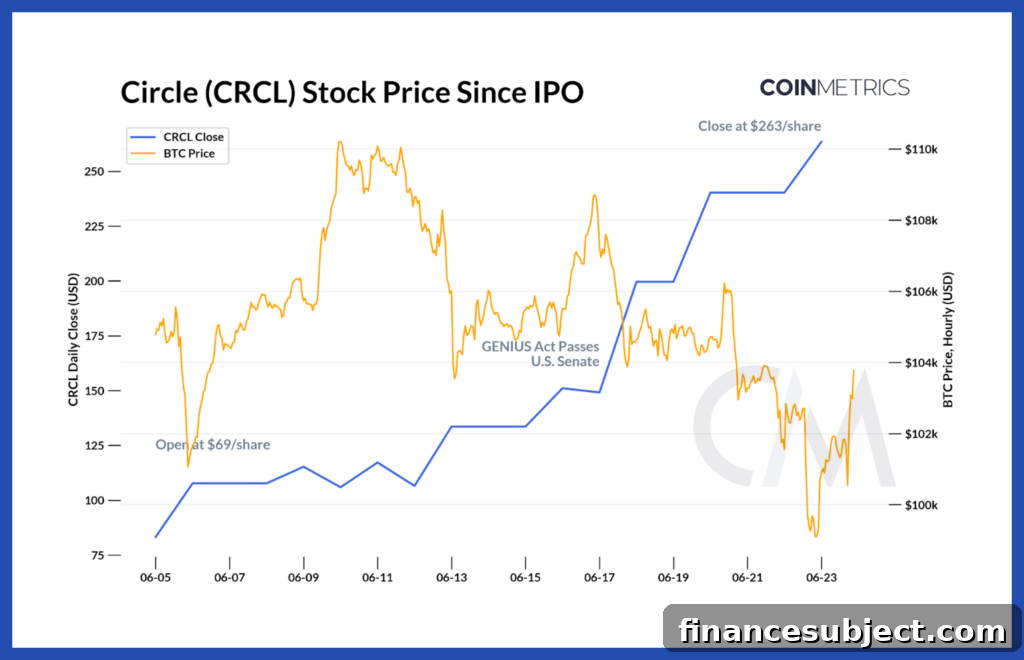
While stablecoins are useful, they can also pose systemic risks if not properly regulated. To address those concerns, on June 17, 2025 the U.S. Senate approved the GENIUS Act (Guiding and Establishing National Innovation for U.S. Stablecoins), which would create a federal framework for issuing U.S.-dollar stablecoins. The bill is not yet law; it must still pass the U.S. House of Representatives before becoming legislation, and the timeline remains uncertain.
Stablecoin issuer Circle goes public, gains over 800%
Stablecoins are receiving additional attention after Circle Internet Group Inc. (CRCL), the company behind the USDC stablecoin, listed on the New York Stock Exchange via an initial public offering on June 5, 2025. The stock saw a dramatic run in its early trading days:
- The IPO was priced at $31 per share, while the stock opened on the NYSE at $69.
- On its first trading day, CRCL shares traded as high as $103.
- Within weeks, CRCL reached an intraday high near $300.
- At the close of trading on June 24, CRCL was priced at $220.
- At its peak of almost $300, CRCL had risen more than 800% from its IPO price and over 330% from its listing price.
This strong listing underscores Wall Street’s appetite for publicly traded crypto-related companies. Unlike many recent tech IPOs, Circle reported profitability: in 2024 it recorded $1.67 billion in revenue and a net profit of $157 million, which helped boost investor interest.
Also read
The best crypto platforms and apps
A ranking of the best crypto exchanges for Canadian investors.
Could Amazon and Walmart launch their own stablecoins?
Retailers dislike paying credit card interchange fees. Every card payment carries a fee that networks such as Visa or Mastercard collect; for large retailers those fees can amount to billions annually. Stablecoins could offer an alternative payment method with lower transaction costs.
If a retailer like Walmart or Amazon issued its own dollar-pegged stablecoin—imagined here as “WUSD”—customers might buy the token through the retailer’s app and use it like digital store credit. For a $100 purchase, using a store stablecoin could potentially eliminate the roughly $2.50 interchange fee that a retailer would otherwise pay, allowing the merchant to save on fees and possibly pass savings to customers through discounts or lower prices. Settlement would also be faster, meaning merchants could access funds almost immediately and potentially earn interest sooner.
Access to a retailer-issued stablecoin would likely be as simple as buying it within an app and holding it in a digital wallet that looks like regular balance or store credit to users. Behind the scenes, the balance would be a blockchain-based token. The business case is straightforward: reduced payment friction and lower fees for both merchants and potentially consumers.
Whether major retailers pursue this route depends heavily on regulation. Passage of the GENIUS Act would create a clear federal path for issuing U.S.-dollar stablecoins, making it easier for corporations to design compliant products. Without federal clarity, regulatory uncertainty and potential legal constraints could delay or deter such plans.
Canadians can now buy XRP via an ETF
Canadian investors have new options to gain exposure to cryptocurrencies through exchange-traded funds. Spot ETFs for XRP—the fourth-largest cryptocurrency by market capitalization—are now available on Canadian exchanges.
Unlike bitcoin, which is often described as digital gold, or ethereum, which serves as a smart-contract platform, XRP is a utility token designed for fast, low-cost cross-border payments. Created by Ripple Labs, XRP is used by some financial institutions to improve remittance and other cross-border payment processes.
Key details for the XRP ETFs trading on the Toronto Stock Exchange:
| 3iQ XRP ETF | Purpose XRP ETF | Evolve XRP ETF | |
|---|---|---|---|
| Ticker | XRPQ | XRPP | XRP |
| Management fee | 0% for the first six months; then 0.59% | 0% until February 2026; then 0.69% | 0.75% |
| Assets under management (AUM) in CAD | $42.35 million | $21 million | $7.65 million |
| Eligible for registered accounts | Yes | Yes | Yes |
Crypto price swings are common
Cryptocurrencies are speculative, high-volatility assets prone to large price swings. Even stablecoins can be risky if they are not adequately backed by real-world assets or if their issuers lack transparent reserves and sound governance.
Investing in bitcoin, XRP, or other crypto assets carries market, technological and regulatory risks. Crypto investments should match your objectives, time horizon and risk tolerance. Stay informed about regulatory developments, understand fee structures and be alert to scams and security risks that affect wallets and exchanges.
Read more about crypto:
- Will bitcoin crash in 2025?
- Bitcoin tops USD$100,000 for the first time
- Price of bitcoin hits new high after Trump victory, and more crypto news
- How to protect your crypto from hacks
Newsletter