
The following is an excerpt from Shannon Lee Simmons’s new book Making Bank: Money Skills for Real Life.
Oliver, who learned to ask for what he needs
| Age: | 16 |
| Sibling status: | Only child |
| Income source: | Has a regular allowance |
| Regular income: |
$150 a month from allowance |
| Current savings: | $500 in an online chequing account; an RESP for university (if he gets in); a stock simulator account with $5,000 in it—Oliver makes stock trades to practise, then his dad executes the trades for real in an online investment account that Oliver will have access to when he’s 18 |
Back to Oliver. I asked if there was anything else he wanted to discuss about money.
He glanced at his dad, then at me.
“Is crypto a good investment?” he asked.
“That’s a big question,” I said, smiling.
John cleared his throat. “You should know I invest money on Oliver’s behalf. He experiments in a stock simulator, then I place the actual trades so he learns about investing, dividends, capital gains, and so on.”
“And cryptocurrency,” I added with a grin.
John looked at Oliver, then back to me. “Yes. I also bought some cryptocurrency. It didn’t work out as well as we’d hoped.”
“As well as you’d hoped,” Oliver corrected.
“Son, you were curious too—I only traded with your permission,” John protested.
“Dad, I’m just teasing,” Oliver said, grinning.
John straightened, a little embarrassed.
“Oliver,” I asked, “do you genuinely want my take on crypto, or are you trying to put your dad on the spot?”
Oliver put a hand over his chest in mock offense. “Of course I want to know if my future is ruined by a bad crypto pick.”
John raised a warning, and Oliver held up his hands like a peace offering.
“John, how much of the $5,000 you manage for Oliver was invested in crypto?” I asked.
“We bought $500 near the end of 2021,” he replied, watching my reaction.
What makes an investment “good” or “safe”?
“A lot of people tried crypto for the first time in 2021,” I said. “Some made money, some lost money.”
“We lost,” Oliver said.
“What’s it worth now?” I asked.
“About $350,” John answered.
“So not a great return,” Oliver observed.
“Hold on,” I said. “Yes, that’s roughly a 30% loss, but judging an investment after only a year isn’t ideal. The same can apply to a blue-chip dividend stock that dips in price. Time horizon matters.”
“Aren’t blue-chip stocks safe?” Oliver asked.
“What do you mean by ‘safe’?” I asked.
He shrugged. “Like, it won’t go down?”
“Once money leaves high-interest savings accounts or guaranteed investment certificates (GICs), it becomes subject to market fluctuations. All investments carry volatility. If you want zero chance of loss, stick to savings accounts or GICs—but those offer little growth beyond inflation.”
“That’s why people invest—to grow money faster than inflation,” John added.
I nodded. “Exactly. Growth potential comes with risk. But risk in investing isn’t the same as gambling.”
Is investing like gambling?
“Some people equate the two, but they’re different,” I said. “Investing involves assessing value, diversification, time horizon and probability. Gambling is about betting on chance with little to no expectation of measurable return.”
“I get that,” Oliver muttered.
I explained the risk-return trade-off: higher potential returns usually come with higher risk. He compared it to slot machines: low-stakes machines risk less and offer smaller rewards; high-stakes machines can yield bigger wins or bigger losses.
“That’s a useful metaphor,” I said. “But investing, when done responsibly, relies on research, diversification and strategy rather than pure chance.”
“Investing can be irresponsible too,” John said.
“Yes,” I agreed. “If someone chases trends or memes without understanding the investment, it can resemble gambling. Buying into a hot tip or a viral stock without thinking through the implications can lead to big losses.”
“Many people thought crypto was trendy,” I added.
How much risk should you take with your investments?
Oliver bristled. “Putting $500 into crypto isn’t the same as wagering your life savings on a meme stock.”
“It’s not,” I said. “That’s the precise difference. Risk is contextual. Investing becomes irresponsible for two reasons: first, using money you’ll need within one to two years; second, putting highly volatile investments into funds you cannot afford to lose.”
“So putting $500 into crypto as an experiment isn’t irresponsible for you,” I continued. “You don’t need that money soon, you have a long time horizon, and even if it went to zero, you’d still be okay financially. But if you put the entire $5,000 into a single high-risk bet, that would be reckless.”
Oliver mentioned people who post risky trades online and try to double their money. “Sometimes it works,” he said, almost nonchalant.
“Often it doesn’t,” I replied. “YOLOing—putting everything into one risky play—is close to gambling. It can lead to buy-high, sell-low behavior, which ruins many investors.”
Should you follow investment advice from social media?
I turned to John. “Online trading threads that celebrate massive risk or losses can encourage desperate choices. People who feel stuck might take outsized risks hoping for a shortcut.”
Oliver smiled at first, but I was stern. “It’s not amusing when someone’s life savings vanish. I’ve seen it break families.”
“It’s their fault—they made the trade,” Oliver offered defensively.
“Often it’s more complicated. Desperation, social pressure, and fear of missing out drive reckless decisions. Posting your entire savings on a long shot can start a cycle of ever-larger bets to chase losses.”
Oliver admitted he hadn’t considered that and had found it funny online. The silence that followed felt instructive.
Don’t YOLO with your money
Oliver joked about combining funds and investing everything in a penny stock. We laughed, and the tension eased.
“I need to know you don’t think YOLOing the market is smart,” John said to his son.
“No,” Oliver replied. “Unless it’s money you can afford to lose.”
“Exactly,” I said. “Only use disposable funds—money you’ve already allocated for risk-taking after you’ve covered bills, short- and long-term savings, and basic needs.”
“Who has ‘play money’ these days?” John asked.
“Not many,” I agreed. “That’s why reckless bets are worrying.”
“So should we keep investing as we are?” John asked.
“Start by assessing Oliver’s risk tolerance,” I suggested. “He’s comfortable with volatility and has a long time horizon for that $5,000. With blue-chip stocks, diversified holdings and low fees, the portfolio suits his goals and temperament.”
Oliver confirmed he plans to leave the funds alone for several years, and John agreed. I praised their diversified, balanced approach and encouraged responsible experimentation with only a small portion of discretionary funds.
“And if I want to take high-risk bets at 18, I can use money I’m willing to lose?” Oliver asked.
“Yes,” I said. “But don’t treat it like gambling. Learn, limit exposure, and never risk essentials.”
Is it ever OK to lose money in the markets?
John was surprised. “You think it’s OK for him to lose money?”
“If it’s a controlled loss with money he can afford to lose, yes,” I replied. “Experiencing a small loss can teach real risk tolerance. Saying you can handle volatility is different from facing it emotionally. Safe, measured experiments help you learn how you react and develop better financial judgment.”
“It’s a problem only if I start using money I can’t afford to lose,” Oliver said.
“Exactly. Prioritize essentials, emergency savings and long-term plans first. If you have leftover funds, thoughtful experimentation is a way to learn.”
They nodded. The conversation had covered budgeting, risk, diversification and responsible investing—practical lessons for a young investor.
John checked the time and stood. “We’ve taken a lot of your time. Thank you.” We shook hands.
“It was lovely to meet you,” I said. John stepped outside while Oliver packed his backpack.
I sighed and smiled. “I can’t wait to see how you build your first million.”
“It won’t be from YOLOing or sports betting,” he said with a grin.
“Good. Do you feel confident about the allowance and the plan?”
He nodded. “The allowance will be a game changer.”
“I think so too,” I said. We laughed, and he promised to stay in touch.
I felt hopeful. He’s smart and resourceful; those skills will serve him well. He has time on his side to learn and grow—so do you.
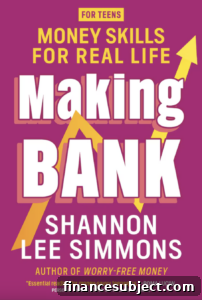
Excerpted from Making Bank: Money Skills for Real Life by Shannon Lee Simmons. (HarperCollins, 2025). Simmons is a Certified Financial Planner and life coach, a Chartered Investment Manager, bestselling author and founder of the New School of Finance Inc. She is also the author of Worry-Free Money, Living Debt-Free and No-Regret Decisions.